
The Cold Truth
A Farmer, a Snake, and the Consequences of Kindness

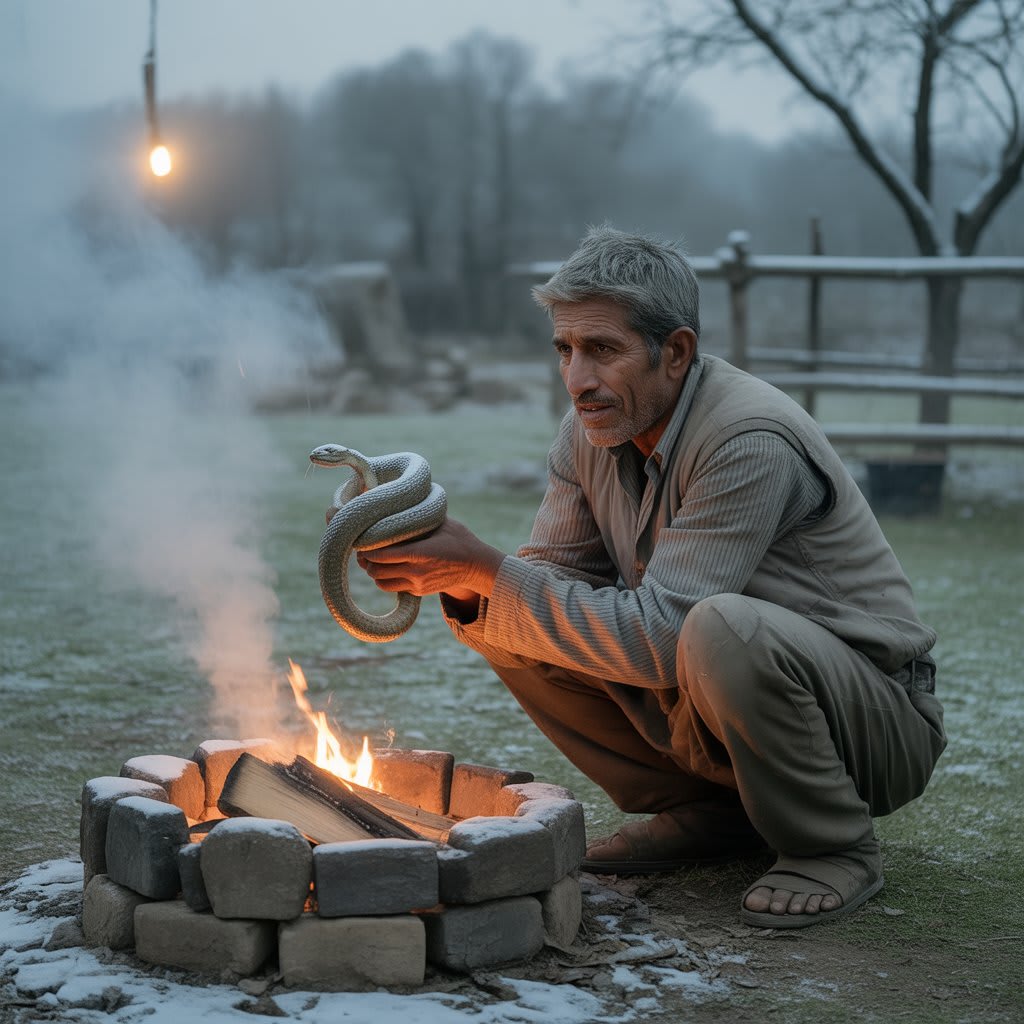
It was a freezing morning in the village of Barikot, where winter wrapped everything in silence. The fields lay stiff with frost, and a thick fog clung to the narrow paths that twisted between mud-brick houses. Gul Nawaz, a middle-aged farmer known for his quiet nature and steady hands, was walking toward the main road to find someone in town who could repair his broken water pump. As he passed the canal on the edge of his farmland, something unusual caught his eye. There, lying half-frozen in the brittle grass, was a snake — motionless, its dull skin blending with the earth. Most villagers would have taken a stick to it or walked away without a second glance. But Gul didn’t move. He crouched down, looked closely, and saw that the snake was still breathing, barely.
Instead of fear, Gul felt an unexpected stir of sympathy. Maybe it was the way the snake looked — not fierce, not coiled to strike, just defeated by the cold. He had seen animals suffer through harsh winters before, but never a snake. Still, life was life. He carefully removed his wool scarf, wrapped the snake gently, and tucked it into his cloth bag. The decision wasn’t heroic or planned. It was instinct — the same instinct that told him to water his crops by hand during droughts or nurse a wounded bird when others wouldn’t bother. He continued his walk home, the bag pressed gently to his side.
When he arrived, his wife, Shabana, frowned as she watched him step into the courtyard. “You’re back early,” she said, then noticed the bundle in his arms. “What’s that?” Gul placed the scarf on a small wooden bench. “It’s a snake,” he said calmly. “I found it near the canal. It’s frozen — barely alive.” She stepped back instantly. “You brought a snake into the house?” He shook his head. “No. I’ll keep it in the shed. Just want to give it a little warmth.” She didn’t argue, but her expression said enough. Gul walked to the small shed behind their house, cleared a space in a corner, and placed the snake in an old wooden crate filled with straw. He lit a lantern beside it and added a few drops of mustard oil to its dry skin, something he’d always used for the cows in winter. Over the next two days, he checked on it like he would a sick animal. The snake didn’t move much — just the slow rise and fall of its breathing — but that was enough.
On the third morning, the crate was no longer still. The snake twitched, then moved. Its eyes opened slowly, tongue flickering in and out. Gul watched from a distance, arms crossed, feeling a small spark of relief. He hadn’t told anyone in the village what he had done. He wasn’t looking for praise. He didn’t think of the snake as a pet. It was just a living thing that needed help. He remembered how his father once rescued a drowning crow and kept it in their home for a week until it flew again. Gul believed in small kindnesses — the kind no one talks about but that stay with you. That morning, he allowed himself a quiet smile.
But nature is not always grateful. The next day, when Gul opened the crate to check on the snake again, something had changed. The snake was no longer weak. It was alert, coiled tightly in the corner. Before Gul could react, it struck — fast and without hesitation. Its fangs pierced the skin of his wrist, sharp as a thorn. He stumbled backward, crying out. The pain burned through his arm. Shabana ran to him and, seeing the swelling, tied a rope above the bite to slow the venom. Their teenage son sprinted to fetch the village doctor. The snake had already disappeared, slithering out through a small gap in the wooden wall. The doctor arrived and treated the bite. Thankfully, it wasn’t from a deadly species — the pain was sharp, but Gul’s life wasn’t in danger.
That evening, Gul lay on a charpai by the fire, his wrist bandaged. Outside, the cold wind whistled through the bare branches. Shabana sat beside him, quiet for a long time before speaking. “You helped it, and it bit you,” she said. Gul looked into the fire. “It was suffering. I helped it because I could. I didn’t expect anything in return.” She sighed. “But it nearly cost you your life.” Gul nodded slowly. “That’s the cold truth. A snake stays a snake. No matter how much warmth you offer, it won’t forget its nature.” His words settled between them like the frost outside — quiet, still, undeniable. Not every kindness is returned. And not every creature, no matter how desperate, chooses to change.
About the Creator
Musawir Shah
Each story by Musawir Shah blends emotion and meaning—long-lost reunions, hidden truths, or personal rediscovery. His work invites readers into worlds of love, healing, and hope—where even the smallest moments can change everything.
Keep reading
More stories from Musawir Shah and writers in Fiction and other communities.
The House That Wrote Letters Back
When Lydia first stepped into the weathered seaside house, it smelled faintly of salt and old wood. The realtor had called it charming with potential, but to Lydia, it felt like something else entirely—like the house had been waiting. She had come here after her divorce, tired of the city, tired of voices that promised comfort but carried nothing but noise. The ocean was meant to be her quiet, her restart. But the very first morning, she discovered something that turned her solitude into a mystery: a folded letter on the kitchen table in her own looping handwriting.
By Musawir Shah5 months ago in Fiction
Miss Persephone's Manual to a Seemingly Ordinary Life
Miss Persephone was found at the dining table, her blue eyes swollen, her tears arriving and retreating like the tides of the ocean. Earlier that day, her family had visited her in the retirement home where she had lived for eight years. It was her eightieth birthday.
By Imola Tóth6 days ago in Fiction




Comments (1)
Salam Bhi zama stories na published kege taso ta sa idea shta dy Cha da sa issue da mata dasara Bia owayai Thanks