

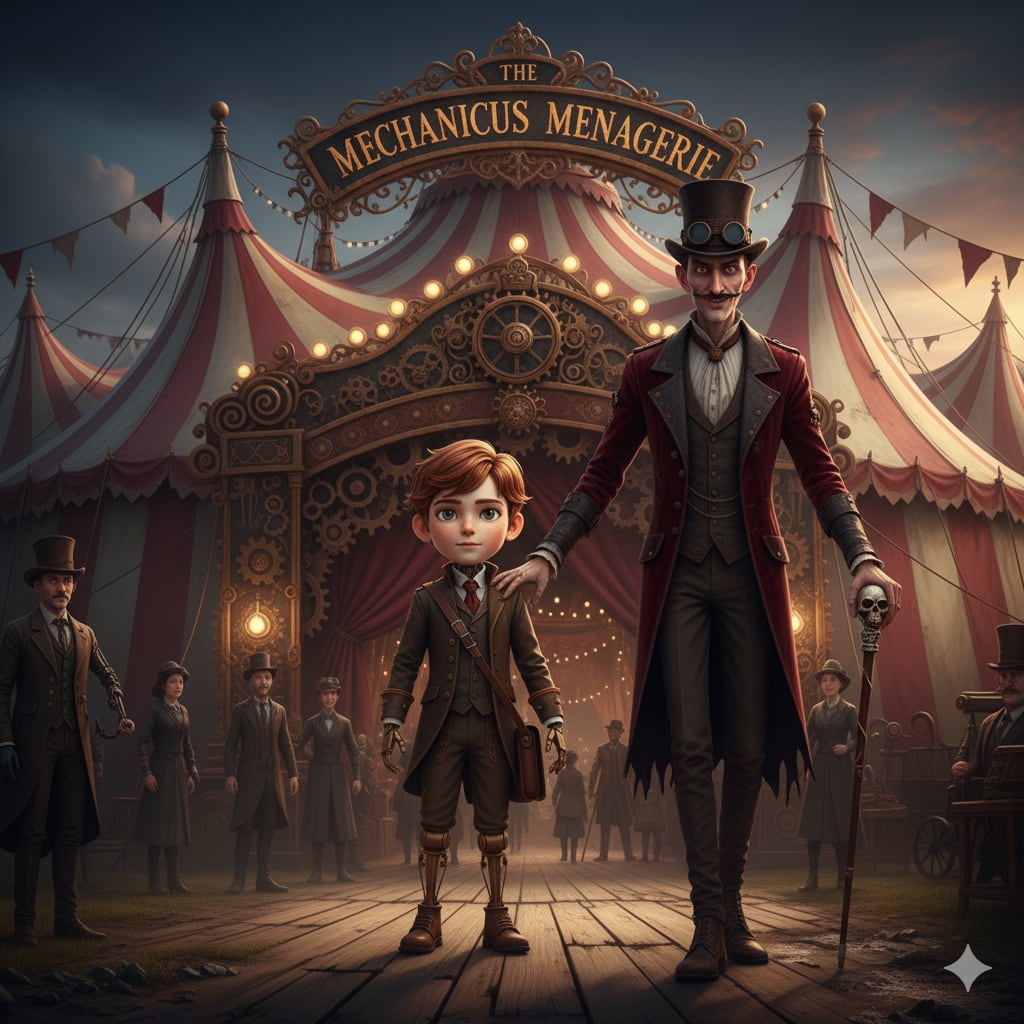
Three days later, Cogsworth made his decision.
He left the Academy during the lunch period, slipping away while Sarah Chen was distracted by a complex alchemical equation. His brass-shod feet carried him through Aethel's winding streets with mechanical certainty, even as his decision circuits churned with uncertainty.
Pixie had argued with him through the night, her holographic form pacing the confines of his crystal housing like a caged bird. "This is madness," she insisted. "That Baron sees you as a commodity, not a person. You're walking into a trap."
"Perhaps," Cogsworth admitted. "But at least it's a trap where I won't have to pretend to be human. I'm tired, Pixie. Tired of hiding what I am, tired of failing at being something I can never truly become."
"You're not failing at being human. You're succeeding at being yourself—which is something far more unique and valuable."
But Cogsworth had made up his mind. At the Academy, he would always be the artificial boy trying to pass for real. At the carnival, he could be the remarkable automaton he truly was.
Baron Von Greed received him with enthusiasm that seemed genuine, though Pixie remained skeptical of the man's broad smiles and generous promises.
"My dear boy! I knew you would see reason. Come, let me show you where you'll be staying."
The performer's quarters were luxurious beyond anything Cogsworth had imagined. His room contained not just a bed (which he didn't need but appreciated for appearances) but a full maintenance station with tools and spare parts that would allow him to keep his mechanisms in perfect condition. The walls were decorated with posters of famous mechanical performers, and the window looked out over the carnival's glittering heart.
"Tomorrow," the Baron explained, "we'll begin developing your performance routine. I sense in you tremendous potential—not just mechanical precision, but genuine artistry. With the right presentation, the right audience, you could become the most celebrated automaton in all of Aethel."
That first night, Cogsworth barely entered rest mode at all. Through his window, he watched the carnival's late performances, marveling at the skill and beauty of the mechanical performers. Here, at last, was a place where being artificial was not a weakness to hide but a strength to celebrate.
His debut performance was scheduled for the end of his first week. Baron Von Greed had designed a routine that showcased Cogsworth's unique abilities—his perfect balance, his precise timing, his ability to calculate complex trajectories in real-time. The act involved juggling crystalline spheres while balancing on rotating gears, creating patterns of light and motion that were mathematically impossible for human performers.
The audience was entranced. As Cogsworth moved through his routine, he felt something he had never experienced before—not just appreciation for his abilities, but wonder at his very existence. The crowd didn't see him as a failed attempt at humanity but as something remarkable in his own right.
"Magnificent!" Baron Von Greed declared afterward, his smile wider than ever. "The audience loved you! Tomorrow night, we'll expand the routine, add more complexity."
And they did. Each night, Cogsworth's performance grew more elaborate, more demanding. The Baron introduced new elements—spinning blades to dodge, impossible heights to navigate, precision requirements that pushed even his mechanical capabilities to their limits.
"The audience craves excitement," the Baron explained when Pixie questioned the increasing danger of the routines. "They want to see our performers do things that no human could accomplish. That's what makes them special."
But as the days passed, Cogsworth began to notice troubling changes in his fellow performers. The Magnificent Mechanica, whom he had so admired on his first night, moved with less fluid grace than before. Her responses were slower, her artistry reduced to mere mechanical repetition.
"What's happening to her?" he asked one of the other performers—a clockwork musician whose piano melodies had once carried haunting emotional depth.
The musician's reply came in a voice that had lost its earlier expressiveness: "Optimization. The Baron improves us regularly. Removes unnecessary complexity, enhances performance efficiency."
"But she seems... less than she was before."
"Performance parameters are all that matter. Personal quirks and inefficient behaviors are obstacles to optimal function."
The conversation chilled Cogsworth more than any physical damage could have. He began to watch his fellow automatons more carefully, and what he saw horrified him. Each "optimization" session left them more mechanically perfect but less individually unique. Their personalities, their quirks, their spark of genuine consciousness—all of it was being systematically eliminated in favor of flawless but soulless performance.
"We have to leave," Pixie urged, her voice tight with fear. "Tonight, before he decides you need optimization too."
But leaving proved more difficult than entering. Baron Von Greed had invested considerable resources in Cogsworth's development, and he was not inclined to lose his newest star performer.
"My dear boy," he said when Cogsworth requested permission to visit his father, "surely you understand that your responsibilities are here now. The carnival is your family, these performers are your siblings. Why would you want to return to a world that would never fully accept what you truly are?"
The words stung because they contained a kernel of truth. Cogsworth knew that returning to the Academy meant returning to a life of concealment and constant fear of discovery. But he also knew that staying meant losing himself piece by piece until nothing remained but perfectly programmed performance routines.
That night, as the carnival settled into its quiet hours, Cogsworth made his escape attempt.
About the Creator
Shane D. Spear
I am a small-town travel agent, who blends his love for creating dream vacations with short stories of adventure. Passionate about the unknown, exploring it for travel while staying grounded in the charm of small-town life.
Keep reading
More stories from Shane D. Spear and writers in Fiction and other communities.
The Cog-Boy of Aethel
Three weeks into his academic life, Cogsworth had settled into a routine that gave him something approaching contentment. His classes fascinated him—particularly Advanced Mechanica and Aetheric Theory—and he had developed a genuine friendship with Sarah Chen, who seemed to appreciate his unique perspective on their studies without pressing him about his peculiarities.
By Shane D. Spear4 months ago in Fiction
Him
Him. An unsuspecting commuter on an A-train... he sits gazing out the window, immersed in the view, seeing beyond a world of art which whizzes by as the landscape undulates, ebbs and flows. There is a surreal, dreamlike and beautiful view of nature beyond the window, where bamboo stalks grow impossibly tall, reaching towards a sky painted in the swirling, vibrant colors of a Baroque masterpiece. The interior of the train is dimly lit, casting long shadows. The peace it exudes evokes a painterly illustration with dramatic bright and dark lighting filled with rich textures.
By Antoni De'Leon6 days ago in Fiction


Comments
There are no comments for this story
Be the first to respond and start the conversation.