
The Cog-Boy of Aethel
Chapter 2: The Academy of Brass Hearts

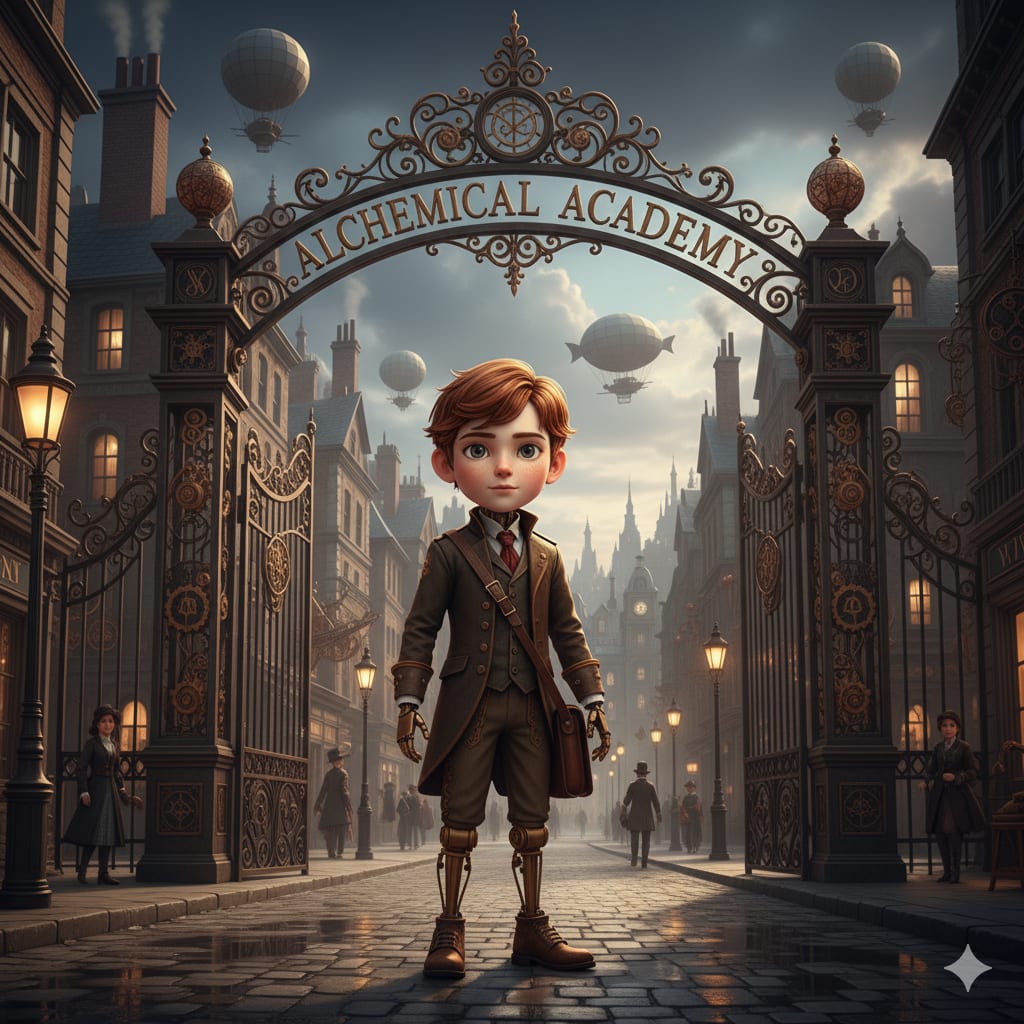
The Alchemical Academy rose from Aethel's academic district like a Gothic cathedral made of metal and glass. Spires twisted skyward, crowned with aether-collectors that fed the building's vast experimental laboratories. Students in brass-buttoned coats hurried across courtyards where fountains danced with liquid mercury and crystalline trees grew in perfect geometric spirals.
Cogsworth stood at the academy's gates, his leather satchel—crafted by Elara's careful hands—slung across his shoulder. His external appearance had been designed to approximate a human boy of perhaps fourteen years, with auburn hair made from finely spun copper wire and features that would have been called handsome if one didn't look too closely at the precise edges and the too-perfect symmetry.
"Remember," Pixie whispered from her crystal housing, her voice audible only to Cogsworth through an internal speaker, "try to fit in. Don't demonstrate your calculating abilities too obviously, don't mention that you can see aether-flows with your naked eyes, and for the love of all that's holy, try to blink occasionally."
"I understand," Cogsworth murmured, then caught himself and began blinking with mechanical regularity. A passing student gave him an odd look.
"Not that much," Pixie sighed.
The morning bell rang with a pure, crystalline note that resonated through the academy's aether-conduits. Cogsworth joined the flow of students entering the main hall, his brass-shod feet making tiny clicking sounds against the marble floors. Several students glanced at him curiously—new faces were always noteworthy—but none seemed immediately suspicious of his nature.
His first class was Theoretical Alchemy with Professor Hendricks, a wild-haired man whose lectures were legendary for both their brilliance and their tendency to result in small explosions. Cogsworth took a seat in the middle of the classroom, attempting to appear unremarkable.
"Today," Professor Hendricks announced, his coat already singed from whatever early-morning experiment he'd been conducting, "we discuss the fundamental nature of consciousness and its relationship to aetheric resonance. Can anyone tell me what distinguishes a thinking being from a mere automaton?"
A dozen hands shot up. Hendricks pointed to a girl with auburn hair and clever eyes.
"Consciousness requires spontaneity, professor. The ability to make choices that aren't purely logical, to act against programming."
"Excellent, Miss Chen. And what else?"
A boy near the front answered, "Emotional capacity. The ability to feel joy, fear, love—things that can't be quantified or replicated."
Cogsworth found himself thinking of his conversation with Elara the night before, when he had told her he was nervous about attending the academy. Had that been genuine emotion, or simply his behavioral subroutines responding to uncertainty? The question troubled him more than he could calculate.
"Now then," Professor Hendricks continued, his eyes gleaming with the light of discovery, "let us consider the theoretical possibility of artificial consciousness. If one were to create a sufficiently complex aetheric matrix, imbued with the proper resonant frequencies..."
As the professor sketched diagrams on the blackboard—diagrams that looked remarkably similar to the schematics Cogsworth had seen in his father's workshop—several students began to debate the impossibility of true artificial life.
"It's preposterous," declared a heavy-set boy with expensive clothes that marked him as minor nobility. "No amount of gears and crystals could replicate the divine spark of human consciousness."
"But what if it could?" Miss Chen challenged. "What if someone succeeded in creating a being that could think and feel? How would we know? How would they know?"
Cogsworth's internal temperature rose as his cooling systems struggled to manage his overheating processors. The irony was not lost on him that he sat in a room full of humans debating his very existence while he wondered about the reality of his own consciousness.
"The question is moot," the noble boy said dismissively. "Such creatures would be mere mimicry, following elaborate programming. They might act human, but they would lack souls."
"How can you be so certain?" Miss Chen pressed. "How do you prove you have a soul?"
"I feel," the boy said, as if that settled the matter. "I love, I fear, I hope. These are not mechanical processes."
At that moment, Cogsworth's internal chronometer chimed softly—an unconscious nervous habit Elara had inadvertently programmed into him. The sound was barely audible, but Professor Hendricks' sharp ears caught it.
"Mr...?" The professor looked at Cogsworth expectantly.
"Cogsworth, sir."
"Ah yes, our new student. That was quite a precise timepiece. Very regular. Almost... mechanical in its precision."
A few students chuckled. Cogsworth felt his cooling fans whir faster as his stress levels elevated.
"I apologize, professor. My pocket watch is quite... accurate."
"Indeed. And what do you think about our discussion, Mr. Cogsworth? Could an artificial being truly think and feel?"
The classroom fell silent. Cogsworth was acutely aware of every tick of his internal mechanisms, every minute adjustment of his servos as he maintained his posture. In his chest, he could feel Pixie tensing, ready to offer guidance, but somehow he knew this question required his own answer.
"I think," he said slowly, his voice carrying a precision that had nothing to do with machinery and everything to do with careful thought, "that consciousness might be less about what we are made of, and more about what we choose to do with our existence. Whether flesh or brass, if a being can feel wonder at a sunset, sadness at suffering, and joy in friendship... does the material of their construction truly matter?"
The classroom was quiet for a long moment. Professor Hendricks nodded approvingly, but several students, including the noble boy, regarded Cogsworth with new suspicion.
"Well said, Mr. Cogsworth. Very philosophical for one so young."
After class, as students filed out discussing the day's lecture, Cogsworth found himself approached by Miss Chen.
"That was beautifully put," she said. "I'm Sarah, by the way. Sarah Chen."
"Thank you. I'm—"
"Cogsworth, yes. Unusual name. And that accent of yours—very precise. Are you from the northern districts?"
Cogsworth's vocal analysis subroutines had been calibrated to Elara's speech patterns, giving him the crisp diction of the educated classes. "Something like that," he said carefully.
Sarah smiled. "Well, Cogsworth-from-something-like-the-north, would you care to join me for lunch? I'd love to continue our philosophical discussion."
Before Cogsworth could answer, a heavy hand fell on his shoulder. The noble boy from class stood behind him, flanked by two equally well-dressed companions.
"I wouldn't get too friendly with the new boy, Miss Chen," the noble said. "There's something not quite right about him. The way he moves, the way he talks... too perfect, wouldn't you say?"
"I think he's refreshingly thoughtful, Lord Pemberton," Sarah replied coolly. "Perhaps you could learn something from his example."
Lord Pemberton's eyes narrowed as he studied Cogsworth's face. "Tell me, new boy, when you sleep, do you dream?"
The question hit Cogsworth like a physical blow. He had no sleep cycles, no dreams, no unconscious wanderings of the mind. His nights were spent in low-power mode, running maintenance cycles and organizing the day's experiences into his memory banks.
"I... that is..."
"Everyone dreams," Pemberton continued, pressing his advantage. "Everyone except..." He let the word hang in the air.
"Everyone except those too dull to remember them," Sarah interjected firmly. "Come along, Cogsworth. I know a lovely café that serves excellent gear oil."
The last part was clearly a joke, but Cogsworth's relief was so great that he nearly laughed out loud. "Lead the way," he said.
As they walked away, he heard Pemberton mutter to his companions, "Mark my words, there's something artificial about that boy. And I intend to prove it."
About the Creator
Shane D. Spear
I am a small-town travel agent, who blends his love for creating dream vacations with short stories of adventure. Passionate about the unknown, exploring it for travel while staying grounded in the charm of small-town life.
Keep reading
More stories from Shane D. Spear and writers in Fiction and other communities.
The Cog-Boy of Aethel
In the heart of Aethel, where copper pipes snaked between buildings like metallic veins and steam clouds drifted perpetually through brass-framed windows, Master Elara Vance bent over her greatest work. The workshop around her hummed with the constant thrum of aether-powered machinery, crystalline conduits pulsing with ethereal blue light that cast dancing shadows across walls lined with gears, springs, and arcane instruments.
By Shane D. Spear5 months ago in Fiction
The Path to Salvation
The late autumn evening air filled the monk's lungs, but it wasn't the season that chilled his bones. The heavy-handed presence of evil he had sensed upon entering the woods surrounding this mountain village had not bothered to conceal itself from him.
By Made in DNAabout 16 hours ago in Fiction


Comments
There are no comments for this story
Be the first to respond and start the conversation.