
The Boy Who Drew Doors
A bullied boy discovers that whatever door he draws with chalk becomes real. He starts escaping pain—but what happens when he opens the wrong door?

The Boy Who Drew Doors
Jamie Ellis didn’t talk much at school. Words, he’d learned, didn’t help when you were smaller than everyone else and always looked like you were about to cry. The other kids teased him about his oversized coat, about the bruises he didn’t explain, and especially about his habit of drawing on the pavement with chalk during recess.
“Making baby art again?” Marcus would say, kicking over Jamie’s drawings before laughing with the others.
But Jamie didn’t draw for them. He drew because it made him feel less hollow inside. His favorite thing to draw was doors—big, small, simple, or ornate. Red ones, crooked ones, ones with brass knockers or curling vines. Every door he drew was one he wished he could walk through.
One rainy afternoon, while hiding behind the bike shed, Jamie drew a door against the brick wall with the last nub of purple chalk. He added a tiny golden keyhole just for fun.
“Wish I could go anywhere but here,” he mumbled.
And then the door opened.
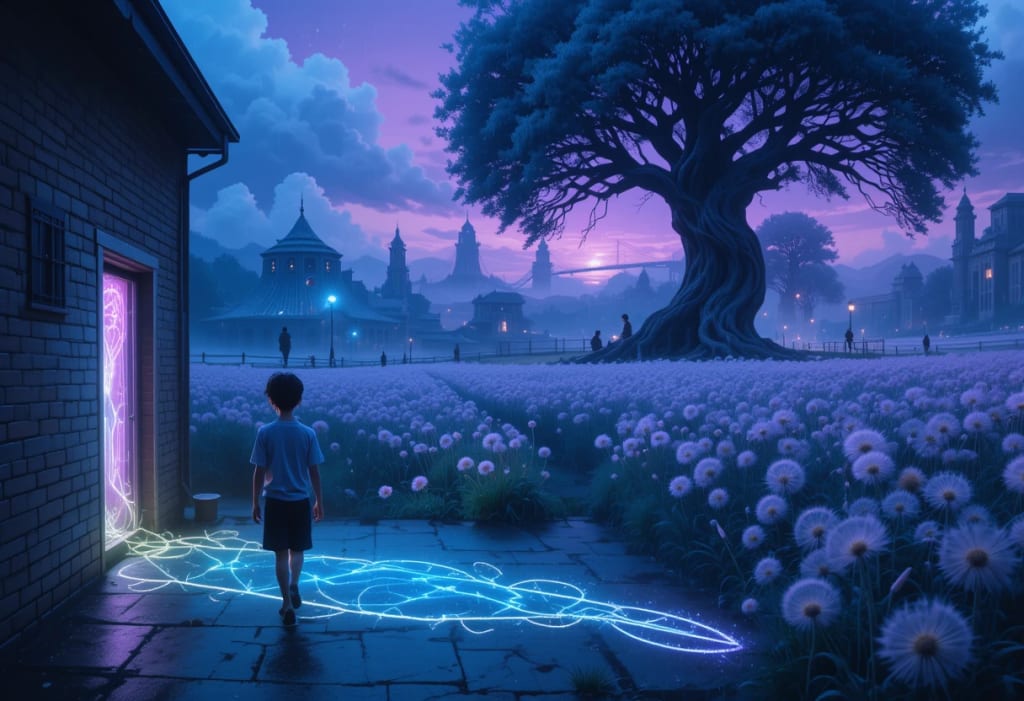
He froze. The chalk lines shimmered, glowed, and peeled off the wall, creaking open like it was made of old wood. A warm breeze drifted through. It smelled like cinnamon and clean grass.
Without thinking, Jamie stepped through.
He found himself in a meadow beneath a lavender sky. Giant dandelions bobbed in the breeze, and rabbits with antlers peeked out from behind bushes. A dragonfly the size of a cat buzzed past, and Jamie laughed—not a quiet chuckle, but a real, deep laugh that made his chest ache.
A voice, kind and unfamiliar, whispered, “Welcome, Door-Maker.”
Jamie turned, but no one was there. Still, he felt seen for the first time.
He stayed for hours. But as the sun began to melt into silver stars, he worried his mum might notice he was gone. So he stepped back through the door, which was still there—waiting—and it closed quietly behind him.
The next day, he was shoved into a locker.
The day after, someone took his notebook and ripped it in half.
So Jamie drew another door.
Each one led somewhere new: a castle made of paper and whispers, a city floating in the clouds, a quiet forest where the trees hummed lullabies. In each world, he was safe. In some, he was even brave.
Soon, chalk filled every pocket he had.
He got better at the doors. He learned to draw hinges, latches, locks. Some led to places that felt like memories. Others like dreams he hadn’t had yet.
But one day, Marcus cornered him again. Jamie didn’t run this time. He just reached into his coat, pulled out a thick black chalk, and began to draw.
Marcus scoffed. “What’s that supposed to be?”
Jamie didn’t answer.
The door he drew was taller than any other. A heavy oak thing, twisted with vines. The moment it creaked open, the air grew cold. Jamie hadn’t planned this place. He hadn’t thought it through. Something inside the door was watching.
He felt it.
It didn’t smell like cinnamon.
It smelled like ash.
A voice slithered through the opening: “Ah… finally.”
Jamie stumbled back, dropping the chalk. The door groaned wider. Something with too many limbs moved in the shadows beyond
Marcus screamed. For once, Jamie wasn’t the one afraid.
He grabbed a new piece of chalk—white this time—and quickly scrawled a smaller door beside it, sloppier but full of will. As the shadow began to slink out, Jamie leapt through his exit.
He landed in a moonlit desert, breathless and alone.
When he drew his way home the next morning, the dark door was gone. But Marcus never returned to school. No one talked about it.
Jamie never used black chalk again.
He kept drawing doors. But now, he was more careful. More respectful.
He even taught himself to draw locks.
And once, when he sat beneath a willow tree in a world made of color and glass, a girl about his age stepped out of a painted door and stared at him.
“You too?” she asked, holding up her own stick of pink chalk.
He smiled.
“Yeah. Me too.”
About the Creator
Keep reading
More stories from waseem khan and writers in Fiction and other communities.
The House That Waited
The House That Waited It had been thirty years since Evelyn had last stepped foot on the porch of the house on Windmere Lane. The gravel crunched beneath her boots the same way it had when she was nine years old, clutching her father’s hand as they left in the dead of night. She’d always believed the memory was distorted by fear and sleep, but now, as her fingers brushed the flaking paint of the porch railing, she realized—some memories didn’t fade. They only waited.
By waseem khan6 months ago in Fiction
Miss Persephone's Manual to a Seemingly Ordinary Life
Miss Persephone was found at the dining table, her blue eyes swollen, her tears arriving and retreating like the tides of the ocean. Earlier that day, her family had visited her in the retirement home where she had lived for eight years. It was her eightieth birthday.
By Imola Tóth5 days ago in Fiction
The Leaders Meeting
“What about Duska?, she appears to be a great fit for this and she really does love it here. She definitely has a good understanding of how it all correlates. Have we invited her to apply?” He proposed as an option to fill the position.
By Dana Mary Colleen Campbell5 days ago in Fiction
Smart phones, Humans and Aliens.
WARNING. I will be tapping into one of your favorite creative tensions: The absurdity of humans worshipping their glowing rectangles as if they were tiny oracles. There’s something deliciously poetic about that contradiction, and it lends itself beautifully to an instructive proviso.
By Novel Allen4 days ago in Poets


Comments
There are no comments for this story
Be the first to respond and start the conversation.