
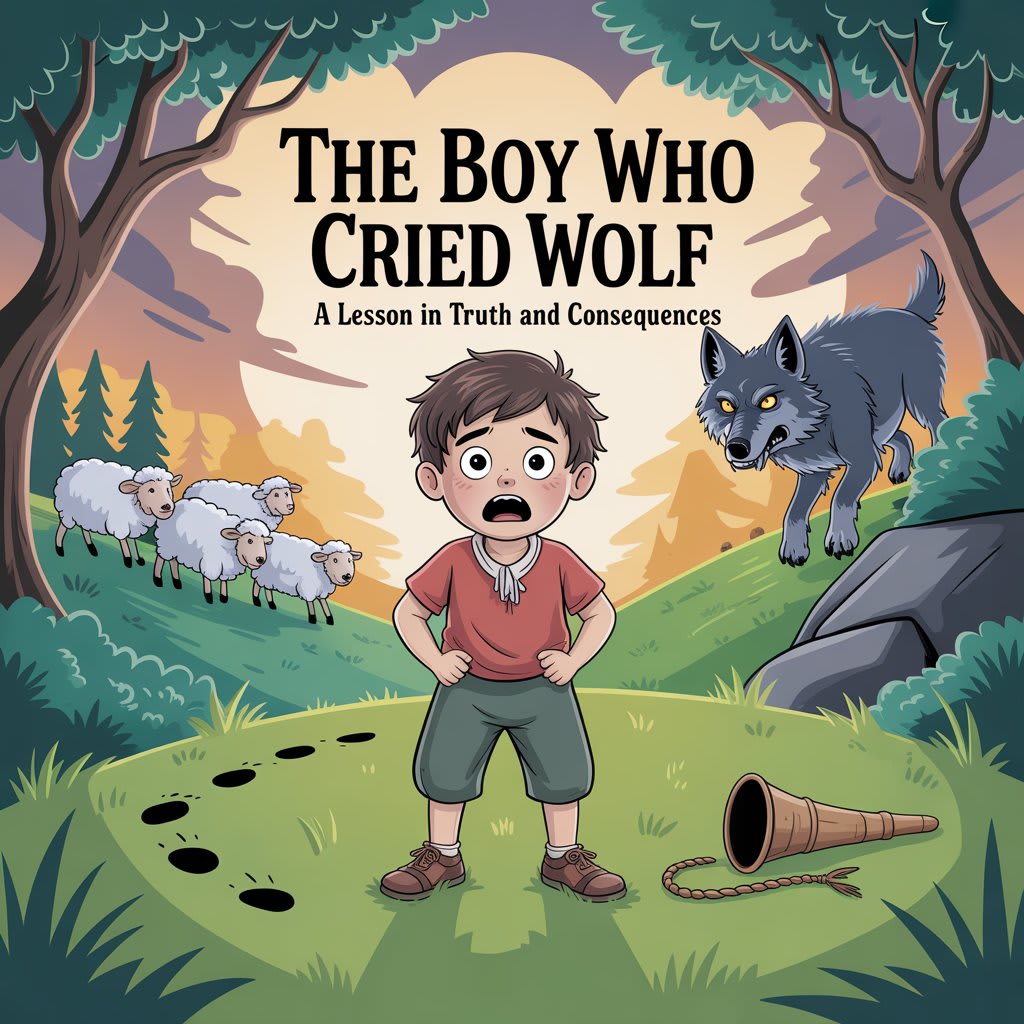
In a quiet village nestled between green hills and silver streams, there lived a boy named Arlen. He was no older than twelve, but he was already trusted with a big job — guarding the village's flock of sheep. Every morning, Arlen would guide the woolly animals to the pastures just outside the village and spend the day watching over them.
It was a lonely job.
The grass was soft, the sky stretched forever, and the wind hummed a song of peace. But for a boy full of energy and curiosity, the hours felt endless. No one to talk to. No games to play. Just sheep — grazing, staring, occasionally baa-ing. The village elders had told him this was a great responsibility. “Our sheep are our lifeblood,” they’d said. “Guard them well, for wolves roam these hills.”
Arlen didn’t doubt the wolves existed. He had heard the stories. But in all the months he had watched the sheep, he had never seen so much as a paw print.
One afternoon, with boredom bubbling in his chest like a pot ready to boil, Arlen got an idea — one he thought was clever and fun.
He stood up, cupped his hands around his mouth, and screamed:
“Wolf! There’s a wolf! Help!”
Within minutes, the villagers came running — farmers, bakers, even the blacksmith dropped his hammer. They rushed up the hill with pitchforks, sticks, and scared eyes.
But there was no wolf.
Just Arlen, laughing and clutching his belly.
Some villagers were annoyed. Others chuckled nervously and patted him on the head. “Boys will be boys,” they said. They returned to their chores, shaking their heads but smiling.
The next day, Arlen did it again.
“Wolf! Help, it’s going to eat the sheep!”
Once more, the villagers came. This time, with a little less urgency. And again, there was no wolf.
Arlen rolled on the ground laughing. “You should’ve seen your faces!”
This time, some didn’t laugh. One old man grumbled, “Lie once, shame on you. Lie twice, we won’t believe you again.”
But Arlen didn’t care. The attention felt good. The power to summon the entire village with a single cry — that felt important. That felt fun.
He didn’t know the price he would pay for playing with truth.
Two days later, the sky turned gray. The wind howled louder than before. The sheep were restless, and even Arlen felt a chill in his bones. He sat on a rock, hugging his knees, when he heard a rustle in the bushes.
He turned — and froze.
It was a wolf.
Its fur was matted, its eyes like two glowing coals. It crept forward, low and hungry. Behind it, more wolves emerged from the trees. Arlen’s breath caught in his throat.
He jumped to his feet and ran to the hilltop.
“WOLF! WOLF! PLEASE HELP!” he screamed with every ounce of his strength.
His voice echoed through the valley.
He screamed again.
And again.
But no one came.
Back in the village, the blacksmith wiped his hands and said, “Just Arlen again.” The baker shrugged. “Let him play alone.” Even the elder who had once warned him said, “He made his bed. Let him lie in it.”
On the hill, Arlen watched helplessly as the wolves scattered the sheep. Some fled. Some fell. Tears streamed down his cheeks. His cries grew hoarse.
He had never felt more alone.
Hours later, when the sun dipped below the horizon, a few villagers finally decided to check. When they arrived, they found Arlen curled up under a tree, sobbing beside the remains of the flock.
The wolves were gone.
But so were the sheep.
Back in the village, the loss hit hard. Meat would be scarce. Wool would be missed. But most of all, trust was broken.
Arlen said nothing for days. He didn’t laugh. He didn’t joke. He didn’t call for help again.
Eventually, the village forgave him — but it took time. Trust, he learned, once lost, was not so easily found again.
Moral of the Story:
When you lie for fun, no one will believe you when the truth finally matters.
About the Creator
Keep reading
More stories from writers in Fiction and other communities.
Feelings Never Die
It is Valentine's Day again, and it bought back memories that were over fifty years old. It bought me back to 1971, and I woke up and I knew my baby was due today. I was big and pregnant, and I felt like I was about to burst wide open. Imagine my surprise when the doctor told my I had a due date of February 14. I couldn't believe it, and since my baby was due today, I felt I could indulge myself a bit. I had gained a lot of weight, and chocolate was on the no-no list, but I had came to the end of this pregnancy, and I hoped it would be okay, after all I would deliver this baby today. So I walked across the street to the grocery story, and bought myself, a peppermint patty, covered in chocolate, my favorite. Me and my Valentine's baby would enjoy it together.
By Susan Payton3 days ago in Fiction
The Piggy Project
I’ve had so many names in this life I lose track of which ones were ever really mine and which ones I wore because someone needed me to. Some were handed to me before I had words to refuse them, before I knew what they meant, before I knew I could say no. Most weren’t meant to hurt. That doesn’t mean they didn’t leave marks. Marks that told me who I belong to, who I am by way of who claims me, recognizes me in the good and bad, who walks beside me.
By Fatal Serendipity7 days ago in Confessions
Should We Not Try to Get Too Political?
Here's something you often hear people say, "I try not to get too political." I understand the sentiment and I sympathize with it... while at the same exact time, I completely disagree with the notion. Whether it's referring to social media or wherever, it's kind of unavoidable. You can attempt to sidestep it, not engage, leave the less important things for actual politicians to discuss... you can want it to not take over your life, your conversations, your relationships, and that makes perfect sense.
By Stephen Kramer Avitabile4 days ago in Writers


Comments
There are no comments for this story
Be the first to respond and start the conversation.