
The Blank Expanse Between Worlds
A lost man discovers what he truly is under the ice of a frozen pond.

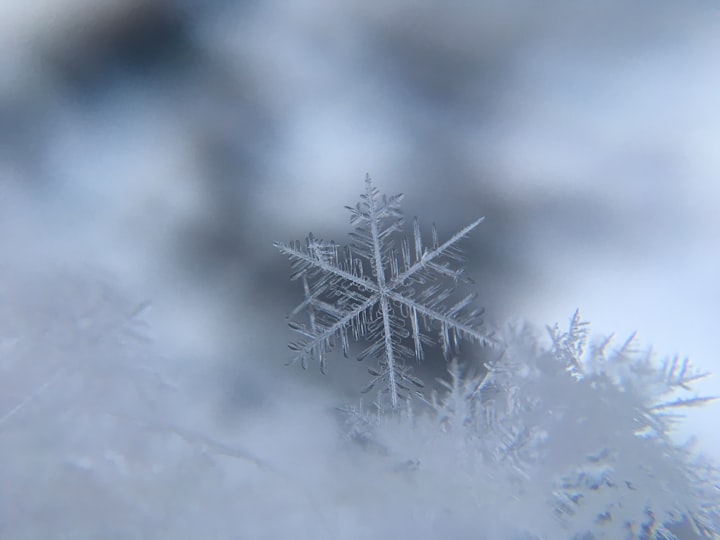
Two paths diverged in a snowy wood. Perfect, tiny flakes gently drifted down from a slate-gray sky. Jack turned and saw his footprints gradually disappearing beneath the falling powder. Tall trees and impassable undergrowth surrounded him. The gleaming blankness of the ground ahead filled him with the same anticipation that a fresh sheet of paper once had. He remembered how full of potential each page had once seemed.
The snow hissed softly as it fell and branches cracked here and there under the accumulating weight. To Jack it sounded like a great typewriter, the forest itself hunting and pecking away as it wrote its own story all around him. Jack had pawned his typewriter after the stories had stopped coming. Too much drink and their inescapable faces had driven the stories from his head.
He’d seen the war as an opportunity, a chance to experience something other than the farm that was supposed to be his legacy. He’d thought it would give him something to write about other than cursed scarecrows who came to life and silver spacecraft alighting in the corn to whisk bewildered farmboys off on galactic adventures. Time and time again his father had told him that people weren’t interested in fantasies anymore, that they only cared about progress. The old man had insisted that the future was about corn, not spacemen and robots. He said Jack was afraid of progress.
The war was supposed to change that, to drive the youthful fancies from his head and teach him to be a man in a world his father always said wouldn’t coddle him the way his mother had. Jack hadn’t felt coddled in a very long time, he couldn’t remember his mother’s face. He remembered Teddy’s face.
Teddy had been on the troop transport that had carried Jack and thousands of other fresh faced young men across the sea to fight the great evil threatening the world. Those eager boys were interested in fantasies, no matter what Jack’s father thought. Teddy was from The Big Apple and had a fiendish sweet tooth. He was always looking to trade the cigarettes he won playing cards for chocolate and packets of sugar. Teddy claimed to be in a gang and carried a straight razor, saying he was going to be the one to find the guy responsible for this whole mess and he was going to shave off that damn mustache before he killed him.
Teddy had a silver pillbox ready and he said when he got home he was going to sell that mustache for a million dollars. The last time Jack had seen Teddy he’d been laying in the sand at the edge of the surf screaming as he tried to shove his intestines back inside himself. Jack had wondered about the cost of progress as he’d charged up the beach that day.
Snow crunched underfoot as Jack made his way down the road less traveled. Neither way was marked, but the wider path had not called to him the way the narrow one did. It was a trail through the woods made by deer that men had walked on long enough that it probably had a name, though Jack was ignorant of it. Come to think of it, he didn’t know where he was or how he had gotten here.
His clothes seemed unfamiliar except for the olive drab jacket protecting him from the chill. Jack had always recovered his jacket after every bar fight and blackout and night in jail. He felt his pockets for the flask he knew wasn’t there, but razor was.
He didn’t remember taking it, but he remembered many nights in flophouses and under bushes when he’d held the deadly sharp blade to his throat or wrist, but his father had been right, he was afraid of progress. The newsreels had been in black and white but the war was in bright, screaming color. Jack’s memories were blood-red and shit-brown canvases under blue skies full of drifting black smoke.
A large branch snapped explosively and crashed to the ground. Jack nearly leapt into the underbrush to take cover before he remembered where he was. Since getting home he’d preferred to drink in solitude. The slamming doors and barking laughter at taverns put him on edge. Jack was always on edge.
Part of that had to do with their faces. For all the righteous glory he had been told to expect; despite the rare look of pride he had seen in his father’s eyes when his enlistment papers arrived; despite the actual ticker-tape parade he had marched in, when Jack closed his eyes all he could see were their faces.
He thought about Chip, who had been graphically recounting an encounter he’d had with a colored girl back home when a sniper’s bullet had exploded his head. One of Chip’s teeth had embedded itself in Jack’s cheek and the two weeks he’d spent in a hospital tent burning up with fever from the resulting infection had been one of the high points of Jack’s war.
He thought about Marie, a beautiful girl who had been so grateful that Jack and his platoon had liberated her village that she’d taken him to her featherbed. Jack tried to remember that night. Between kisses she’d said things to him in a language he couldn’t understand but it didn’t matter. He tried to remember the way her long hair felt between his fingers; he tried to remember the gentle pressure of her soft mouth on his and the way her breath mingled with his own, but all he could see was her naked body dangling from a tree with “Collaborator” painted across her breasts.
He thought about the blonde, blue-eyed boy. He could have been no more than fourteen but Jack didn’t know that when he’d surprised him in the old glassworks and shot him in the back. Jack hadn’t hesitated when he’d seen the insignia on his sleeve. The boy had fallen, still clutching the sausage he had been slicing and pleaded with Jack in his guttural tongue. Jack had shot him again and again and the boy had died with his dinner in his hand.
Jack found himself at the edge of a frozen pond again facing two choices. He didn’t know where he was or where he was going, but turning back seemed to not be an option. He could circuit the pond, but the forest ran close to the shoreline and progress would be slow. Jack didn’t want to twist an ankle out here. A break in the trees across the frozen water indicated the continuation of the path. Jack stepped into the ice.
He shuffled his way carefully across the slippery surface wishing he had something to drink. Pausing halfway across he looked up. The sky was a diffuse gray so bright it hurt his eyes. Snowflakes collected on Jack’s eyelashes. He stuck out his tongue. Suddenly the ice cracked like a gunshot. Chip’s face flashed across Jack’s vision and he forgot where he was. He hit the deck and crashed through the ice.
The first sensation was electricity as the shock of the situation and the freezing water overloaded Jack’s nervous system. Then the cold. Then the tightness in his chest. Then the fear. Jack kicked up, reaching for the hole, but found only an expanse of ice. He saw bubbles rush past his face, defying gravity to dance on it. The white field before him reminded him of a movie screen. Jack pressed his face to it and saw a man on the other side.
The man dangled via cables from some contraption. He was encased in a tight-fitting, ribbed, black suit. A reflective black helmet covered his whole head, except his mouth, which formed a tight-lipped grimace. The man’s legs kicked in time with Jack’s own as he kicked. Jack pulled the razor from his pocket and pounded it against the ice. The tapping it produced was nearly inaudible, but Jack saw the man pound his fist similarly against the air.
Jack tried to remember. It came in spurts. He hadn’t grown up on a farm, though he remembered beyond a bored youth in the fields. He remembered being stalked through the corn by a cursed scarecrow, safe in the circle of firelight offered by his torch. He remembered gray aliens inviting him aboard their craft and then flying it from planet to planet hunting strange beasts on each new world. He remembered the war.
He remembered living in an apartment with his single mother who needed to work, but had bad lungs and couldn’t leave the house on days when the airborne nanobot index was too high. He remembered the dust that collected on everything on those days, even in their pod, which was supposed to be hermetically sealed. He remembered being educated in virtual classrooms by friendly, glitchy, virtual teachers. He didn’t remember anything he learned.
He remembered the prohibitions against unapproved physical contact during the lonely plague years. The first time was bearable because his mother was there, but she’d coughed herself away forever by the second and third. He remembered friendly, glitchy, virtual lovers. He remembered his job doing some mindless task that no one wanted to pay a machine to do. He remembered all of the ways he’d escaped this life.
Under the ice Jack wondered if it was intentional. He’d been trying to drown himself in a bottle since he’d gotten home, maybe this was just faster. Jack went limp as he sank to the bottom. He saw himself on the screen above dangling from the cables of his virtual reality setup. This game was intense. It was even better than the wargame he’d played recently. That one had given him nightmares. He’d missed two shifts after getting lost in the drug simulators. He was on thin ice at work.
The water was freezing, the new generation of thermal integration was unreal. Jack had heard that a few people had died after catching on fire in one virtual world or another but the latest firmware update was supposed to address that. Jack thought about the spray of freckles across Marie’s chest and the way she had laughed and blown smoke rings as they laid there afterwards. It was hard to know what was real.
Before he hanged himself while on vacation with his wife and daughter, Austrian physicist Ludwig Boltzmann expressed the undeniable truth that in a universe seeking thermal equilibrium it is astronomically more likely that a single brain, replete with memories, should pop into existence in the void than for the entirety of creation to do the same
Was any possibility more absurd than any other? Jack’s limbs grew heavy as his body ran out of oxygen in the freezing black water. Jack was hungry and he didn’t understand the point of this game anyway. It seemed to be some sort of philosophical puzzle. He wanted to compile some food and watch that new feed where people fought cloned versions of extinct animals.
Jack’s vision was going black. Time was running out and he was going to lose if he didn’t figure out what this game was. Maybe it was about finding out what you really are. Was he a disappointment to his father; or the light of his mother’s short life; or a disappointment to himself; or a spaceship pilot; or a soldier; or a writer; or just a brain experiencing all of this for a mere moment before entropy returned it all to the void?
Jack dangled weightlessly and looked up, his vision dwindling to a pinpoint in a sea of blackness and saw himself dangling weightlessly and saw himself dangling weightlessly and correctly surmised that he was but a metaphor in a story on a page that was no longer blank.
About the Creator
J. Otis Haas
Space Case
Keep reading
More stories from J. Otis Haas and writers in Fiction and other communities.
All of Everything and Beyond
I am a Toiler, made in the image of The Creator, who is Perfect. My Task is to serve my Queen by serving The Creator, who filled the world with Danger and clumsy Giants to keep Her creation humble. If I succeed in my Task I will be rewarded with wings and fly off to join Her in The Sands Above.
By J. Otis Haas5 years ago in Fiction
Pearl
1980 something. we all hung out at Pearl and you and i were nothing special, or so i thought. i mean we all danced, drenched in our own sweat, our own saline solution of fear, too many beers, shots, laughter, tears, fucks in the bathroom and i don't know when we began to be afraid. do you?
By ROCK aka Andrea Polla (Simmons)3 days ago in Fiction


Comments
There are no comments for this story
Be the first to respond and start the conversation.