
The Battle of Corinth (146 BC)
Scene of the Battle of Corinth (146 BC): last day before the Roman legions looted and burned the Greek city of Corinth.

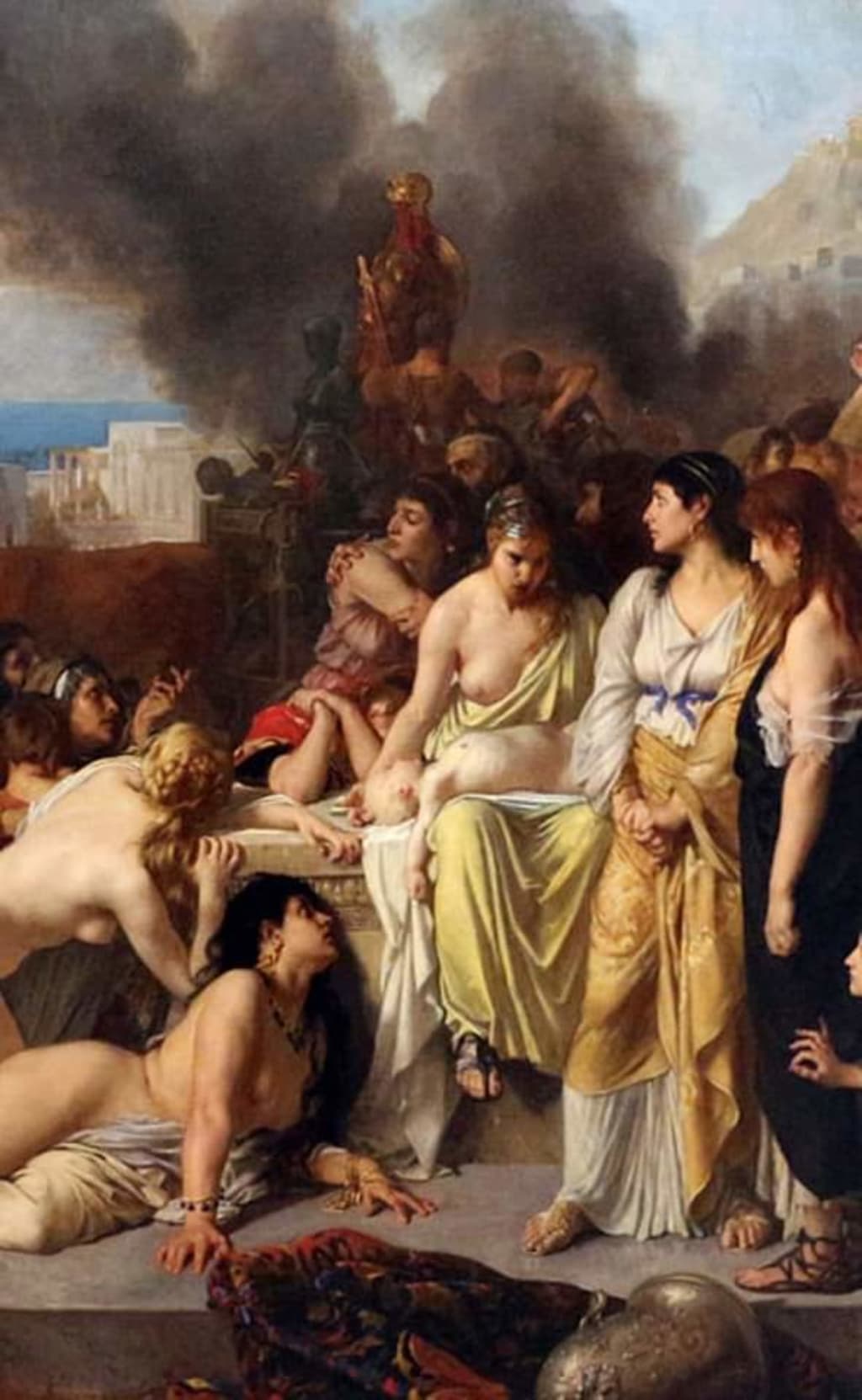
The Battle of Corinth in 146 BC was a significant military conflict that marked the end of the Achaean League and the final destruction of Greek city-state independence. The battle took place near the city of Corinth in southern Greece and was fought between the Roman Republic and the combined forces of the Achaean League and other Greek city-states.
The Achaean League was a loose federation of Greek city-states that had been formed to resist Macedonian domination in the region. However, by the mid-2nd century BC, the League had come under the influence of Rome, which was expanding its power and influence in the Mediterranean world.
In 146 BC, the Achaean League declared war on Rome, hoping to regain its independence. The Romans responded by sending a large army under the command of the consul Lucius Mummius to Greece. The Roman force was well-equipped and well-trained, and it quickly advanced into the heart of the Achaean League's territory.
The two sides met in battle near Corinth, and despite the valiant efforts of the Greek defenders, the Romans emerged victorious. The city of Corinth was sacked and burned, and many of its inhabitants were killed or enslaved.
The Battle of Corinth marked the end of Greek city-state independence and the beginning of Roman domination in the region. The Achaean League was dissolved, and many of the remaining Greek city-states were incorporated into the Roman province of Achaea. The Roman victory also had wider implications, as it demonstrated Rome's military power and helped to establish its dominance in the Mediterranean world.
The Battle of Corinth is often seen as a turning point in Greek history, as it marked the end of the Hellenistic period and the beginning of the Roman era in the region.
Rome's troubles came to a head after the Social War (91-89 B.C.E.), when Rome's allies revolted to obtain citizenship, and there were invasions of eastern provinces by Mithridates VI of Pontus. Lucius Cornelius Sulla, consul in 88 B.C.E., was appointed by the senate to lead an army against Mithridates. However, Gaius Sulpicius, one of the tribunes, had the plebeian assembly give the command to Gaius Marius, who had held several consulships to deal with earlier Roman problems, instead. Sulla marched on Rome, drove out Marius, and murdered Sulpicius. However, when Sulla left for the east, Marius returned and seized power. But when Sulla returned, he was able to defeated his opponents (Marius had died by now) and make himself dictator in 81 B.C.E.
Julius Caesar However, in the 70s B.C.E., more revolts led the generals Pompey and Crassus to power. Pompey defeated Mediterranean pirates, defeated Mithridates in the east, and reorganized the eastern provinces. When he returned to Italy, his opponents stifled his efforts to give land which he had promised to his veterans. As a result, he, Crassus, and Julius Caesar, a young and brilliant military leader, formed an alliance known as the First Triumvirate. Caesar became consul in 59 B.C.E., and later led a successful military campaign in Gaul. By the end of the 50s B.C.E., however, relations between Pompey and Caesar were strained (Crassus had died in battle in 53 B.C.E.) In 49 B.C.E., Caesar led his army across the river Rubicon (invading his own country) and defeated Pompey, and had himself declared dictator for life. Though the cherished institutions of the Roman Republic had been weakened by many decades of infighting, Caesar's crossing of the Rubicon was the final nail in the coffin. As much reviled as he was feared and admired, Caesar was murdered by a group of senators, putatively representing the institutions of the Republic, led by Brutus and Cassius on March 15, 44 B.C.E.
However, the Republic was not restored. In his will, Caesar officially adopted his great-nephew, Octavian, as his son and hier. Octavian, a budding young general all of 18 years old, was told this at the same time he learned of his great-uncle's death. It was an early mark of his prodigous political talent that he was soon able to reach a power-sharing agreement with Mark Antony, Caesar's chief lieutenant who assumed he was the heir apparent, and Lepidus, another of Caesar's inner circle. These three generals divided the empire among themselves and formed the Second Triumvirate. They eventually turned on each other, Lepidus lost his influence, and Octavian finally defeated Antony at the battle of Actium in 31 B.C.E., after which Antony and Cleopatra, ruler of Egypt and lover of Antony, committed suicide.




Comments
There are no comments for this story
Be the first to respond and start the conversation.