

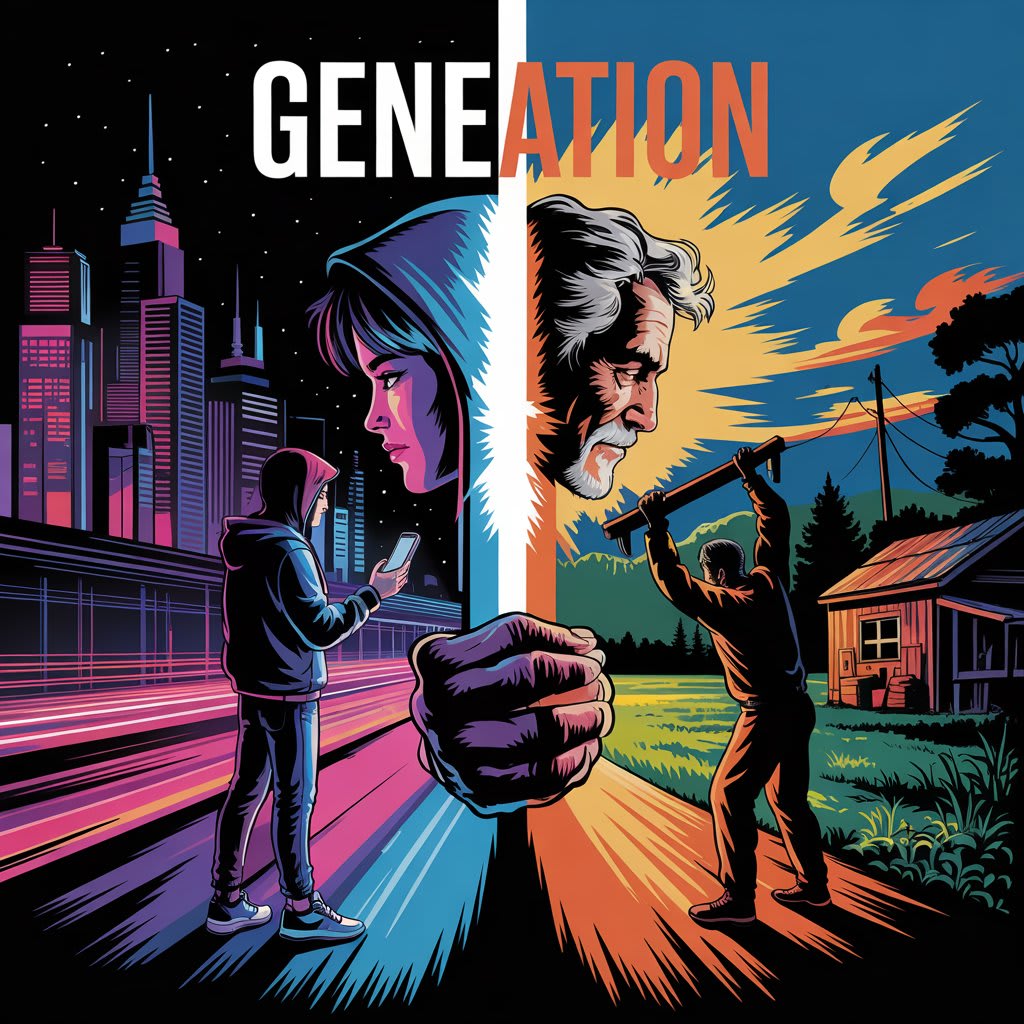
In a world increasingly defined by technology, power had become something many measured by metrics and data—followers, likes, trends, influence. But there were those who still believed that power had a deeper, more visceral root, something beyond the digital or social landscape that could be quantified. It was in the hands of those who had lived through struggle, hardship, and sweat. It was in the calluses on their hands, the grit in their eyes, and the fire in their hearts.
A Conflict of Worlds
The old man, Jackson, had spent most of his life working the land. His hands were thick and weathered from decades of planting, plowing, and harvesting crops. His mind had been shaped by years of hard labor, his values etched deeply into the soil of his farm. For him, power came in the form of endurance, patience, and strength—the ability to survive without the luxuries that the modern world provided.
His daughter, Sarah, on the other hand, had never known the hardships of a farm life. Raised in the glow of screens and the pulse of the city, she had learned to see the world through the lens of technology. Her world was one of constant connectivity, social media, and digital networking. Where her father had once fought the land to survive, Sarah fought algorithms. She was a tech entrepreneur, a creator of digital spaces that brought people together—but also separated them. She built apps that changed lives, platforms that connected millions in an instant, all from the comfort of a sleek office in a city that never slept.
As Sarah returned home for the first time in years, she was faced with a simple question: what had truly changed? The world outside had evolved in ways she could not have imagined when she was younger, but the small farm she grew up on seemed unchanged. The same fields, the same barn, the same worn path leading to the house. Jackson was still out there, working the land with a quiet determination that had never faded, even as the world around him transformed.
But Jackson, too, saw the difference. Where he once watched his daughter grow up with dreams of helping on the farm, he now saw her as a stranger—someone who had traded the honest, real work of life for a virtual world where everything was digital and fleeting. He wondered what had become of the strength that had once defined their family. Did it still exist in this new world of machines and codes?
The Challenge
Their conversation that evening was a quiet one at first. They talked about the usual things—her work, his health, the weather. But as the night wore on, something shifted. Jackson stood up and walked to the old wooden shelf in the living room. He took down an old, leather-bound book that had been passed down through generations of their family.
“I want you to understand what it means to be strong,” Jackson said, his voice heavy with years of experience. “Strength isn’t just about what you can measure on a screen. It’s not about followers or likes. It’s about perseverance, about working with your hands, about seeing things through even when the world tells you to quit.”
Sarah looked at the book, the pages worn and yellowed. She remembered it from when she was young. It had always been a symbol of her father’s values—a kind of legacy she had long since abandoned in favor of the fast-paced digital world she now inhabited.
“I understand, Dad,” Sarah replied softly. “But the world has changed. It’s not just about physical labor anymore. You can do so much more with technology. I can reach millions with a single click. Isn’t that power, too?”
Jackson shook his head. “Maybe it’s power. But it’s not true strength. There’s a difference.”
The argument, though respectful, lingered in the air between them. Jackson’s hands, gnarled and worn, were a testament to the kind of strength that had kept their family alive through countless generations of toil. Sarah’s hands, soft and unscarred, were a testament to a different kind of strength—one built on knowledge, innovation, and connection.
The next morning, Jackson issued a challenge: “If you think your strength is greater than mine, then show me. You spend your days in a world of digital ease. I spend my days in a world of sweat and muscle. Let’s see who can last the longest doing what we do best.”
At first, Sarah hesitated. The idea of competing in her father’s world—of digging into the earth, working with tools, and enduring physical exhaustion—felt like an ancient practice that didn’t belong in her modern world. But she was no stranger to competition. And something about her father’s challenge stirred something in her—a reminder of the resilience she had inherited, even if it had been buried under layers of convenience and comfort.
The Test of True Power
The challenge began early the next day. Sarah found herself in a field of tall, unyielding grass. The task was simple: she was to help her father harvest the crops by hand, using nothing but a sickle. It was a skill she had watched her father perform as a child, but had never been taught to do herself. Her fingers trembled slightly as she gripped the sickle, unsure of how to approach the work.
Jackson watched her, his face unreadable, but there was a quiet pride in his eyes. He had long since mastered this task, moving with the rhythm of the land, understanding each swing and motion. Sarah’s first attempts were clumsy, the sickle cutting through the stalks at an awkward angle. Her arms began to ache quickly, and she felt her breath growing heavy. Sweat beaded on her forehead, a feeling she was not accustomed to in her climate-controlled office.
“You’re doing it all wrong,” Jackson said, offering a patient but firm critique. “Let the tool do the work. You don’t fight the land. You work with it.”
Hours passed. Sarah’s hands were sore, and her back ached in ways she had never felt before. The digital ease of her life seemed like a distant memory as she realized how little she knew about the real world her father had fought to build. She looked over at him, still working with a calm, steady rhythm. His strength was not just in his muscles—it was in his unyielding spirit, his refusal to be broken by time or hardship.
As the sun began to set, Sarah felt a sense of exhaustion that was both foreign and humbling. The field was vast, and there was still so much left to do. She paused, looking over at her father. His face was tired, his clothes soaked with sweat, but his eyes shone with an inner strength that didn’t come from muscles alone.
“You’re right,” she said quietly, wiping the sweat from her brow. “This... this is true strength. It’s not just about being smart or fast. It’s about endurance. It’s about being connected to something greater than yourself.”
Jackson nodded, his expression softening. “And you’ve got that strength in you, too, Sarah. It just needs to be tapped into.”
The Measure of True Power
As the challenge came to an end, both Sarah and Jackson were physically drained. But it was clear that something had shifted between them. Sarah realized that her father’s idea of power was not one to be dismissed or trivialized. It was a power rooted in the land, in experience, in the ability to endure and thrive no matter what the world threw at you.
For Jackson, the challenge had reminded him that his daughter’s strength was just as vital, though different. She had built something of her own in a world that had little space for the old ways. But now, he understood that true power could be measured in different ways—sometimes through the sweat on your brow, sometimes through the ingenuity of your mind.
When Sarah returned to the city, she did so with a new sense of respect for her father’s way of life. She had learned that power was not just about the tools you used or the networks you built. It was about resilience, the ability to rise above challenges, and the wisdom to know that strength existed not just in the body, but in the heart and mind as well.
And perhaps, in the end, that was the measure of true power.
About the Creator
Keep reading
More stories from Jawad Ahmad and writers in Fiction and other communities.
Whisper in the dark
The night was thick with a silence that felt almost suffocating. It wasn’t the kind of peace that brought comfort, but the kind that made every crack in the floorboard and every gust of wind feel like an omen. Lily sat on the edge of her bed, the only light in the room coming from the soft glow of a candle flickering beside her. The house had always been old, creaking and groaning as though it held memories of forgotten lives. But tonight, it felt different. There was something... off about it.
By Jawad Ahmad 10 months ago in Horror
The Passenger
The one unspoken rule: don't let the driver be held responsible for the crash. Shoved into a car with them as you are only allowed to have relationships if you stay in their car and never leave. The insult looming of having to become resilient when jumping out of the car to get through being independent and those copying you choose alone and brag about being able to choose it. It is a sick mockery that is allowed to go on. These people taking from you while not asking for it and you adapting way better than most while surviving. Now there is insult to injury of those pretending they don't have people or making alone time a "silly little fun thing" to be up to after they destroyed someone's life.
By Seashell Harpspring about 4 hours ago in Fiction


Comments
There are no comments for this story
Be the first to respond and start the conversation.