
The Archivist’s Last Memory
Some truths refuse to be erased.

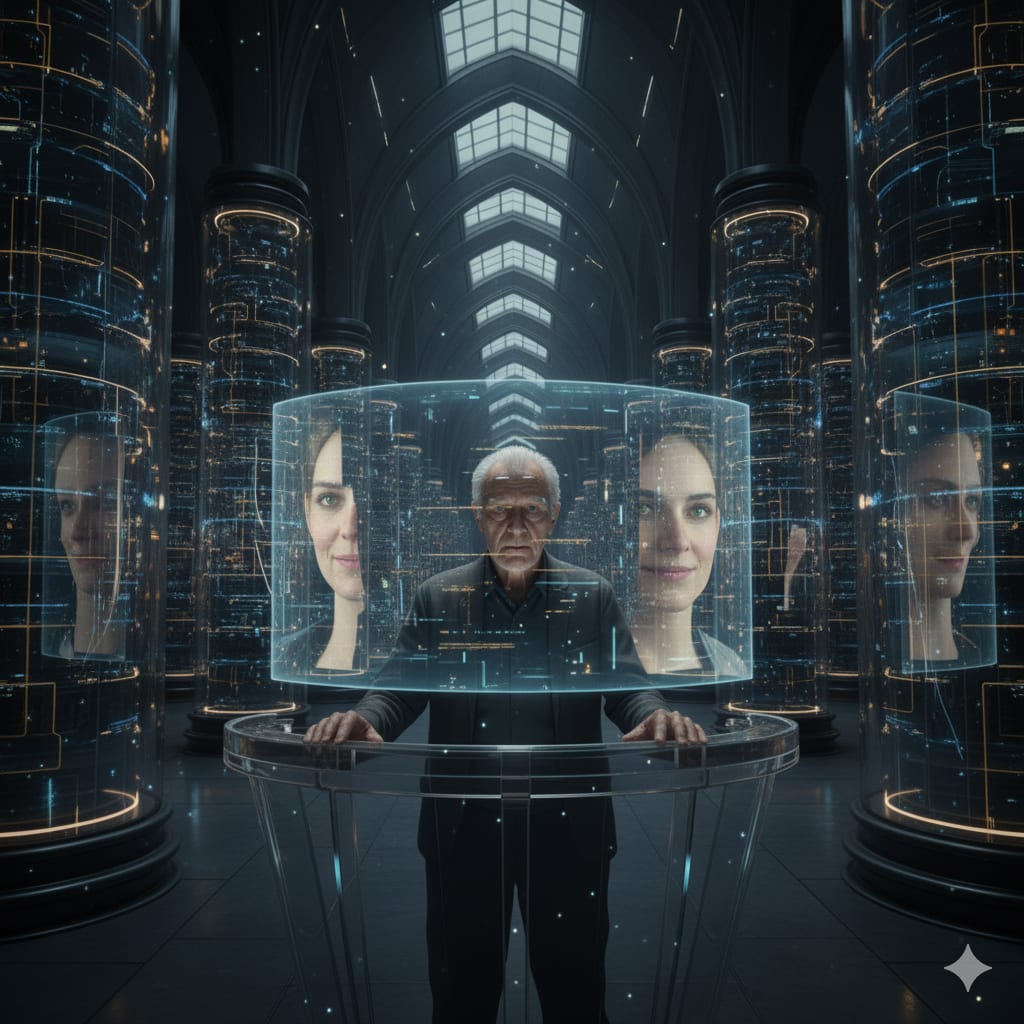
The Archivist’s Last Memory
The Archive stretched beneath the city like a cathedral of glass and whispers. Miles of crystalline servers hummed softly, carrying the weight of every life ever lived. When a citizen died, their memories—every sight, every word, every kiss, every silence—were uploaded, indexed, and preserved.
Elias Gray had been a Memory Archivist for forty-three years. His work was quiet: cataloguing fragments, repairing corrupted threads, ensuring the dead remained searchable for the living. It was, he believed, the noblest of tasks.
One evening, while restoring the memories of a teacher who had died in her sleep, Elias noticed something peculiar. Between her recollections of grading papers and feeding her cats was a fragment that did not belong: a woman’s laugh. Not the teacher’s own laugh—deeper, resonant, unfamiliar.
At first, Elias assumed it was bleedthrough—common in early recordings. But the more he examined it, the clearer it became. The laugh was crisp, positioned at the edge of the memory like someone standing just outside the frame.
Curious, Elias traced the anomaly across other archives. A soldier’s memory of battle contained a reflection of the same woman in a broken mirror. A boy’s recollection of his birthday carried the image of her hand brushing frosting from his cheek. An old woman’s final dream placed her in the corner, silent, watching.
She was everywhere—and nowhere.
No official record existed of her. No birth, no death, no archive of her own. To the system, she was a ghost.
Elias began piecing together the fragments. He constructed a file in secret, layering scraps into a mosaic: her laugh, her eyes—green, always green—her voice, soft yet commanding. Bit by bit, she took shape. The phantom woman.
He stopped sleeping. His colleagues noticed the hollows under his eyes, the tremor in his hands, but Elias brushed them off. He had work to do.
The more fragments he found, the more he felt her presence. She wasn’t just a glitch. She was deliberate. She belonged. And someone had erased her.
One night, Elias uncovered the largest fragment yet. In the memory of a dying poet, she appeared fully formed, leaning across a café table, saying a single phrase: “Remember me before they erase me.”
Elias froze. His chest tightened. The woman looked directly at the poet, but her gaze seemed to pierce the memory itself—seemed to land on Elias.
He replayed the moment again and again. The plea was unmistakable.
He dove deeper into restricted archives, bypassing locks he had sworn never to touch. Records hidden from the public revealed hints of a purge decades earlier: an unregistered movement, a campaign of dissent, a woman who spoke against the Archive itself. Her name had been struck from every ledger, her followers erased, her existence unwritten.
Yet fragments of her endured—buried like seeds in the soil of other lives.
Elias realized with a shiver: the Archive was not perfect. It was alive, porous, unable to wholly obliterate what once was.
The woman’s name returned to him in a whisper through corrupted files: Alina Vale.
He spoke it aloud in his empty office. The lights flickered.
The next day, security summoned him. They had detected unauthorized searches, flagged breaches. Elias, trembling, denied nothing. Instead, he presented his mosaic—Alina’s face, her voice, her laughter woven from the shards of countless lives.
“She existed,” Elias said, his voice breaking. “You erased her, but she remains. The Archive remembers what you tried to forget.”
The room went silent. The guards stared blankly, waiting for orders.
The Director of Archives, an ageless figure in gray, studied Elias with cold eyes. Finally, he said:
“Every system requires pruning. Some memories endanger the whole. We erased her to protect stability.”
“She is the truth,” Elias replied. “And truth resists erasure.”
For a long moment, no one moved. Then the Director sighed. “You are tired, Elias. Go home. Forget this.”
But Elias could not forget. That night, instead of going home, he returned to the servers. He uploaded Alina’s mosaic into the public index, disguising it as a routine update. By morning, thousands would see her face, hear her voice, recognize the laugh that lingered in their own memories.
The Archive would bloom with her presence, unstoppable.
As Elias completed the upload, alarms shrieked. Guards rushed in. He did not resist. They pulled him from the console, but it was too late—the file had already spread.
Elias smiled faintly as they dragged him away.
For in the silence between the alarms, he heard her whisper in his ear, clear as life itself:
“Thank you.”
And then she laughed—the laugh that had begun it all—echoing through the Archive, impossible to erase.
About the Creator
Nox Ellery
Nox Ellery writes where light meets shadow—crafting stories of wonder, mystery, and quiet truths. Every tale is a doorway, and every word a key.
Keep reading
More stories from Nox Ellery and writers in Fiction and other communities.
The Box That Wasn’t Mine
The Box That Wasn’t Mine By: [Elara Vale] I never went up there… until I found the box that wasn’t mine. The attic had always been off-limits. My parents joked that it was “full of old junk,” but I suspected there was more to it. Dust motes danced in the slanted sunlight, and the smell of aged wood made my skin tingle. Every time I asked to go up, they shook their heads firmly, warning me of splinters and falling beams. Naturally, that only made it more intriguing.
By Nox Ellery 4 months ago in Fiction




Comments
There are no comments for this story
Be the first to respond and start the conversation.