
The Archive of Forgotten Things
A philosophical tale of loss, love, and the fragile threads of memory that define who we are.
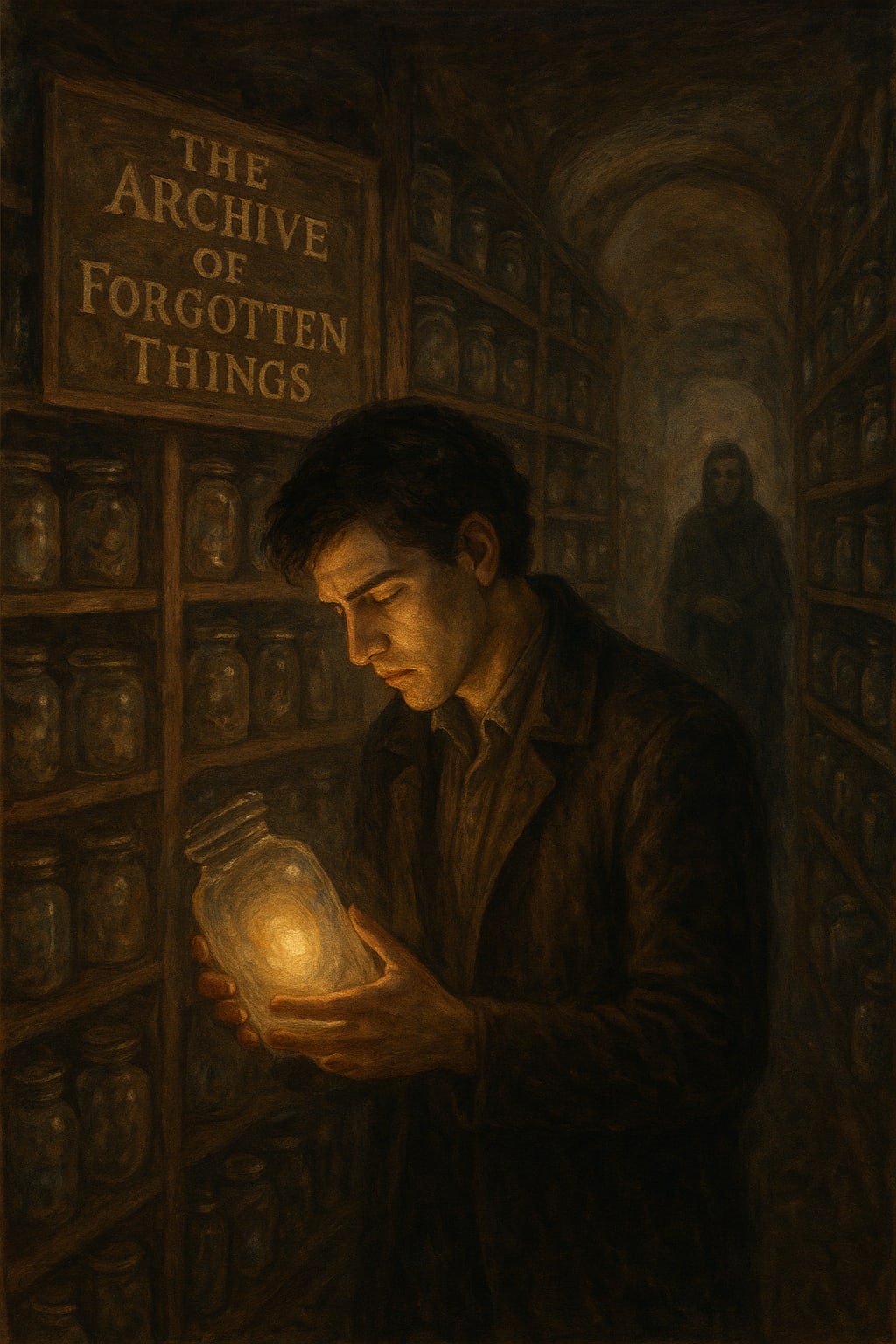
Arman had always lived with a peculiar fascination for memory. Not memory as in facts—he could never remember formulas or phone numbers well enough to impress anyone—but memory as in texture, the lingering weight of moments.
He would catch himself dwelling on small things others discarded: the way sunlight once fell across his school desk at the exact hour between lunch and boredom, the muffled sound of his grandmother’s radio playing news in a language he never fully understood, the smell of wet clay during childhood monsoon rains. These fragments seemed useless in the practical sense, yet they made him feel alive in ways that even great achievements could not.
But memory was not always kind. Sometimes it came like a storm. A face he longed never to see again would suddenly flash before him in the middle of an ordinary meal. A long-forgotten sorrow would rise at night and steal his sleep, as though determined to remind him of wounds that never fully healed.
So when Arman stumbled one late evening upon a strange building tucked into the narrowest alley of the old city, he felt both wonder and dread.
The sign hanging above its crooked door was carved in fading letters:
“The Archive of Forgotten Things.”
At first he thought it a curio shop, one of those places selling trinkets, coins, and faded postcards to wandering tourists. But something about the sign pulled at him, like it had been waiting for him. Without hesitation, he pushed the heavy door open.
Inside the Archive
The air inside was cool and smelled of dust, parchment, and something even older—like the stillness of time itself.
Rows upon rows of shelves stretched endlessly, though the building from outside had looked no larger than a bakery. Each shelf was lined not with books but with **glass jars**. Every jar glowed faintly, each holding something indistinct, something hovering between light and shadow.
Arman stepped closer. One jar pulsed with the faint sound of a lullaby, sung in a trembling voice. Another jar swirled with the taste of mango, so vivid he nearly tasted its summer sweetness on his tongue. A third held the blurred shape of a dog running through a foggy alley, its bark echoing softly.
It dawned on him slowly. These were not objects. They were memories.
“People come here when they forget.”
The voice startled him. He turned. Behind a tall oak desk stood a man—or something that resembled a man. Thin as a shadow, his presence was neither threatening nor warm, simply inevitable, like the ticking of a clock. His robes looked woven out of dust. His eyes, dark and bottomless, seemed to hold centuries.
The librarian.
“What is this place?” Arman asked, though he already knew.
“The Archive,” the man said, gesturing to the shelves. “When memories leave people—when they slip away from fragile minds—they come here to rest. They do not vanish. Nothing ever vanishes. It simply moves.”
Arman’s breath caught. His curiosity burned.
“Can I find my own?”
The librarian tilted his head. “Yes. But beware. Not all memories wish to be found. Some depart for a reason. Some are forgotten not by accident, but by mercy.”
The Search
Despite the warning, Arman began to wander the aisles.
The shelves seemed infinite. He opened jar after jar. With each one, a sensation filled him, a fragment of some stranger’s life—or perhaps his own.
A jar released the sound of coins clinking in a father’s hand, a memory of being given pocket money for the very first time. Another revealed the scent of jasmine drifting through an open window during the first night of marriage. Another yet carried the heavy silence of a hospital waiting room, where someone whispered prayers under their breath.
Not all memories were joyful. Some were soaked in sorrow. A child’s cry muffled under blankets. The hollow echo of a slammed door. A trembling hand signing a divorce paper.
And then, unexpectedly, Arman began to find fragments of himself.
He opened one jar and tears stung his eyes—the lullaby his mother used to hum while cooking rice. Another held the warmth of his grandmother’s wrinkled hands pressing an orange into his palm. Another yet revealed the thrill of running barefoot in the village fields, wind cutting across his face like freedom.
For the first time in years, he felt whole. He felt like a man rediscovering a childhood he thought was gone forever.
But then he saw it.
A jar glowing differently from the others. Not with light, but with something heavier, darker, pulsing with dread.
Against the silent warning in the librarian’s eyes, he lifted it.
The Jar of Pain
The moment he opened it, the Archive seemed to collapse around him. He fell to his knees as the memory swallowed him whole.
Screeching tires.
The shattering of glass.
The sudden, awful silence.
And blood.
It was the day of the accident.
His brother’s face appeared before him—eyes wide with fear, then dimming into stillness. Arman remembered the weight of his brother’s body in his arms, the desperate shaking, the screams that ripped through his own throat, begging him not to leave.
He had forgotten this day, or rather, buried it. For years he had carried a hole in his heart but not the full memory of why. Now, it returned, raw and merciless.
He collapsed, sobbing, the jar rolling from his hands.
The librarian’s voice broke the silence.
“That is the nature of memory,” he said gently. “It gives shape to who you are, but it also chains you to what you cannot change.”
Arman’s voice trembled. “Then why remember at all? If it hurts this much, why not let it stay forgotten?”
The librarian knelt beside him, his eyes softening.
“Because forgetting completely is death. Memory, even the painful kind, proves you lived. Proves you loved. To erase sorrow is to erase joy as well. You cannot keep only one.”
The Visitors
In the days that followed—though time in the Archive was strange and slippery—Arman met others wandering the aisles.
An old woman clutching a jar of laughter, saying it was the last time her husband had laughed before illness stole him away.
A young man trembling with a jar that held his father’s voice calling him “son” for the very first time.
A mother weeping over a jar that contained the sound of her stillborn child’s heartbeat.
Each carried both relief and agony at their rediscoveries. Some clutched their jars tightly, refusing to let go. Others placed them back on the shelves, whispering goodbyes.
Arman realized then: **the Archive was not a gift or a curse. It was a mirror.**
It gave nothing people had not once possessed. It only reminded them of what they had tried—sometimes desperately—to forget.
The Lesson
Eventually, Arman returned to the librarian.
“I can’t carry it all,” he confessed. “The good and the bad. It’s too much.”
The librarian nodded. “You are not meant to carry it all. Memory is not a box you drag through life. It is a river. You drink from it, but you cannot hold it. You let it flow.”
Arman thought of his brother. He thought of the accident. He thought of the laughter, the lullabies, the summer fields.
“So what am I to do?”
“Live,” the librarian said simply. “Not to cling. Not to erase. But to live in such a way that even if the memory fades, it was once worth remembering.”
Leaving the Archive
When Arman stepped outside again, dawn was breaking over the old quarter. The city was stirring awake—vendors setting up stalls, a stray cat slinking across rooftops, the bells of a nearby mosque calling for prayer.
He carried no jar with him. Yet he felt fuller than he had in years.
For he now understood: memory was not meant to be permanent, nor perfect. Forgetting was not always loss—it was mercy, it was survival. And remembering was not always blessing—it was weight, it was reminder.
What mattered was not whether he could hold every moment forever, but whether he could live each moment fully enough that, if it ever found its way to the Archive, it would shine on a shelf, waiting to be rediscovered by someone who once lived deeply.
And so he walked into the new day—not clinging to memory, not running from it, but embracing life as the fleeting miracle it was.
About the Creator
Keep reading
More stories from noor ul amin and writers in Fiction and other communities.
The Summer I Bought My First Laptop
The summer break had just begun at our med school. The campus was buzzing with students rushing to catch their buses and trains home. In the middle of all the goodbyes, I left without hugging my best friend, Umar. I don’t know why—it wasn’t intentional, but as soon as I reached home, my phone buzzed.
By noor ul amin5 months ago in Fiction
Miss Persephone's Manual to a Seemingly Ordinary Life
Miss Persephone was found at the dining table, her blue eyes swollen, her tears arriving and retreating like the tides of the ocean. Earlier that day, her family had visited her in the retirement home where she had lived for eight years. It was her eightieth birthday.
By Imola Tótha day ago in Fiction




Comments
There are no comments for this story
Be the first to respond and start the conversation.