

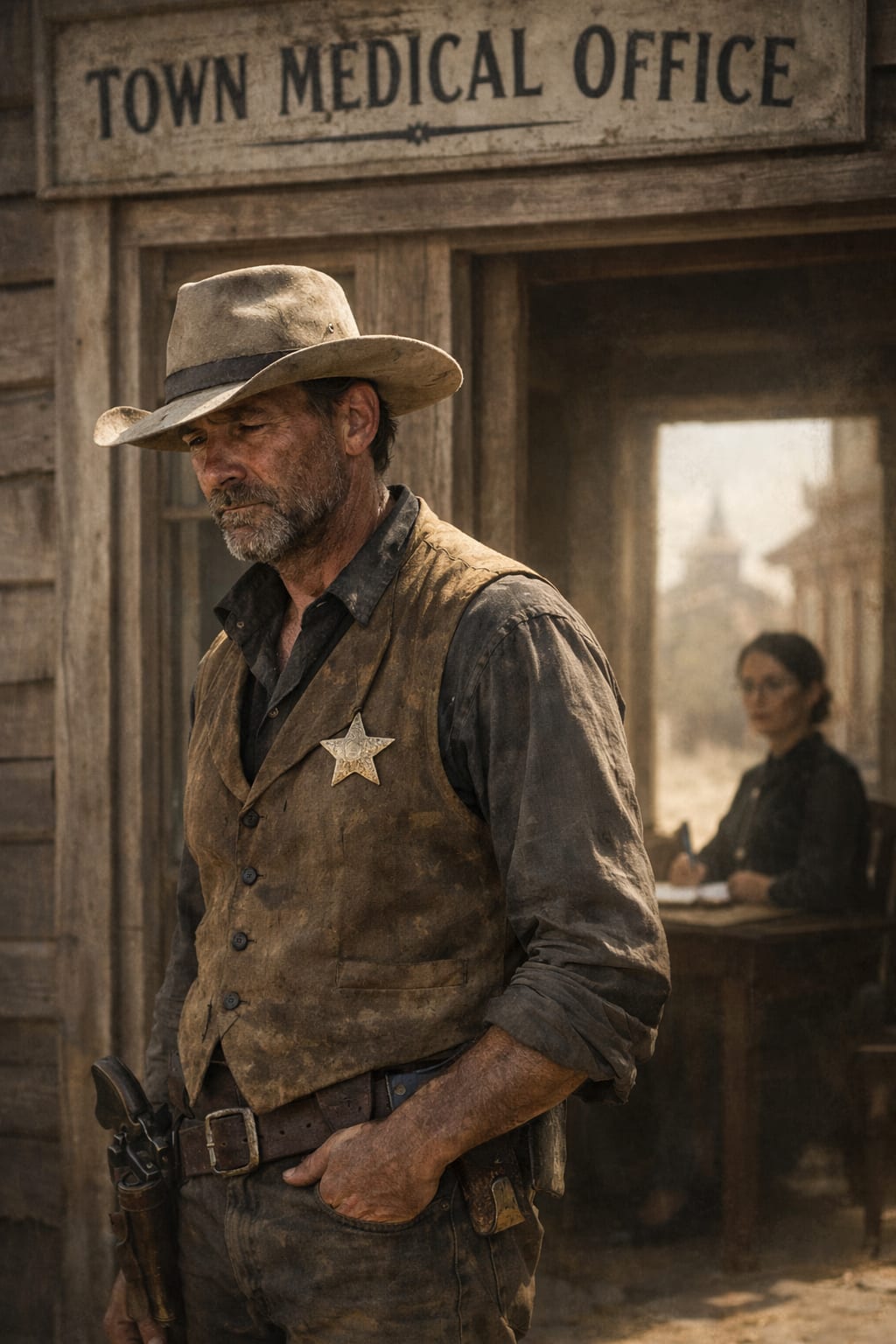
The letter did not accuse him of anything.
That bothered Balin McLeod more than if it had.
DEPUTY BALIN McLEOD,
YOU ARE REQUIRED TO ATTEND SCHEDULED SESSIONS WITH THE TOWN MEDICAL OFFICE.
Required meant unavoidable. It meant someone else had already decided something about him.
Balin folded the paper precisely and slid it into his vest. He stood outside the office longer than necessary, watching heat shimmer in the air above the street. Noon light pressed down hard, flattening the town into stillness. Nothing moved.
He went in.
The office was spare. Two chairs. A desk. A window that let in too much light and not enough air. Dust motes hung in the heat. A glass of water sat untouched.
The town doctor sat behind the desk, reading.
She was in her late thirties or early forties. Her posture was straight without strain, as if the chair existed for formality rather than comfort. Her dress was plain, dark, and practical. Clean lines. No ornament. Nothing chosen to be remembered.
Thin wire spectacles rested low on her nose. When she looked up, she removed them and set them beside her notebook, folding the arms before placing them down.
“Deputy McLeod,” she said. “I’m Dr. Holt.”
Her face was narrow and composed. Not cold. Just economical. Her eyes did not hurry to soften what they saw. They stayed open, steady, unadorned.
Balin took the chair closest to the door. It creaked once and settled. He noted it without thinking.
“These sessions are part of a newer medical approach,” she said. “Cognitive therapy. We will examine how your thoughts and habits influence your actions.”
Balin frowned slightly. “Sounds like thinking about thinking.”
She considered him for a moment.
“Sometimes,” she said. “More often, it is noticing when your thinking is driving the wagon and you are riding in the back.”
She opened her notebook.
“You may speak when ready.”
Balin did not.
The light through the window crept slowly across the floor.
⸻
The second session followed a pattern.
She asked about his work. His patrol routes. How long he had carried a gun. Whether he slept. Whether he drank.
Balin answered cleanly. He did not volunteer. He did not embellish. Facts stayed put if you didn’t press them.
When he spoke about procedure, her pen moved steadily. When he mentioned the weight of the gun at his hip, the way his hand hesitated when it brushed the grip, the pen stopped.
“When did that begin?” she asked.
“After the saloon.”
“What happens in your body when you consider drawing?” she asked.
His fingers tightened once, then flattened again against his thigh.
“Something pulls back,” he said.
She waited.
“I don’t trust it,” he added.
She wrote that down.
The light had climbed higher on the wall.
⸻
They spoke of the saloon in the third session.
Poker table. Raised voices. Whiskey. Balin standing too fast, the room tilting before he realized it had.
“When did the gun discharge?” she asked.
“When I reached to stop it,” he said. “Or tried to.”
“When did you understand someone had been killed?”
“When everything went quiet.”
She looked up at that. Not at him. At the space where the words settled.
“And when did you understand it was a child?”
Balin’s breath caught. His hand moved before he could stop it, pressing flat against his leg.
“When I saw his face,” he said. “Too young.”
The room stayed still. Heat pressed in. Dust hung unmoving in the light.
After a while, his hand steadied.
She wrote again.
⸻
She did not ask about his childhood until the fourth session.
The heat was worse that day. The window stood open an inch, useless.
“Tell me about your parents,” she said.
Balin’s shoulders tightened.
“Why.”
“Patterns,” she said. “Not blame.”
He considered leaving. He stayed.
“My mother was emotional,” he said. “Everything was urgent. Loud. Personal.”
“What did that feel like to you?” she asked.
He thought before answering.
“Unstable.”
“And your father?”
“Quiet,” Balin said. “Agreeable. He waited things out.”
“What did you learn from that?” she asked.
“That reacting makes it worse,” he said. “That silence lasts longer.”
She wrote slowly.
“And who carried responsibility in that house?”
Balin exhaled through his nose.
“I tried. Somebody had to.”
“That’s enough for today,” she said.
⸻
The tremor worsened before it eased.
Balin avoided his gun. His hand hovered near it, then pulled back. At night, he dreamed of the saloon floor and the boy’s open eyes.
In session, Dr. Holt explained plainly.
“Your nervous system now associates the weapon with loss,” she said. “Avoidance is expected.”
“I can’t be a deputy without it,” Balin said.
“Then we must examine whether the role is still serving you.”
That stayed with him.
⸻
In the sixth session, she asked a question he had not prepared for.
“If you were not defined by your badge or your gun,” she said, “what would you be doing?”
Balin stared at the wall. The crack near the window had grown longer.
“I don’t know.”
She did not rush him.
“I always liked pigs,” he said finally. “They’re smart. Honest. Better company than people.”
She noted it without comment.
⸻
The disagreement near the general store was small.
Voices rose. A bottle broke. Someone laughed too sharply.
Balin stepped forward out of habit, then stopped. His hand stayed where it was.
He spoke instead. Slow. Even.
It took longer. Someone shoved him. He adjusted his footing and stayed upright.
No one died.
That night, his hands shook while he washed them. He noticed the shaking and finished anyway.
⸻
The final session came without a letter.
Balin went because he wanted to.
The office was unchanged. Heat pressed in through the window. The glass of water remained untouched.
Dr. Holt listened as he spoke.
“I’m retiring,” he said. “From the badge. From the gun.”
She did not interrupt.
“I don’t think I was ever meant to hold the line like that,” he said. “It feels like I haven’t been driving.”
She nodded once.
“And now?” she asked.
“I’m going to raise pigs,” he said. “They don’t pretend.”
She wrote a final note.
“Your past influenced you,” she said. “It does not define you.”
Balin stood.
Outside, the town looked the same.
Heat sat heavy on the street. Dust waited.
Balin stood there without reaching for anything.
Then he turned and walked the other way.
About the Creator
Jesse Lee
Poems and essays about faith, failure, love, and whatever’s still twitching after the dust settles. Dark humor, emotional shrapnel, occasional clarity, always painfully honest.
Violence Begets
"Any last words, cowboy?" "None you'd understand, sodbuster." "Funny. That's Marshall Sodbuster to you. But I meant some last nugget that would help us in the adjudication of the myriad offenses counted against you and your gang. I wasn't asking for penitence."
By Adam Diehl5 days ago in Fiction
Fair Exchange, No Robberies
Dark Memoirs - Index There are at least two kinds of people in the world: those who write this half-arsed kind of intro to a story that looks to separate the rare and the norm, and those who realise it's an overused framing device and don't.
By Paul Stewart7 days ago in Chapters


Comments
There are no comments for this story
Be the first to respond and start the conversation.