
The American Robin: A Song of Hope, Survival, and Spring
How a Familiar Backyard Bird Became a Symbol of Renewal Across North America

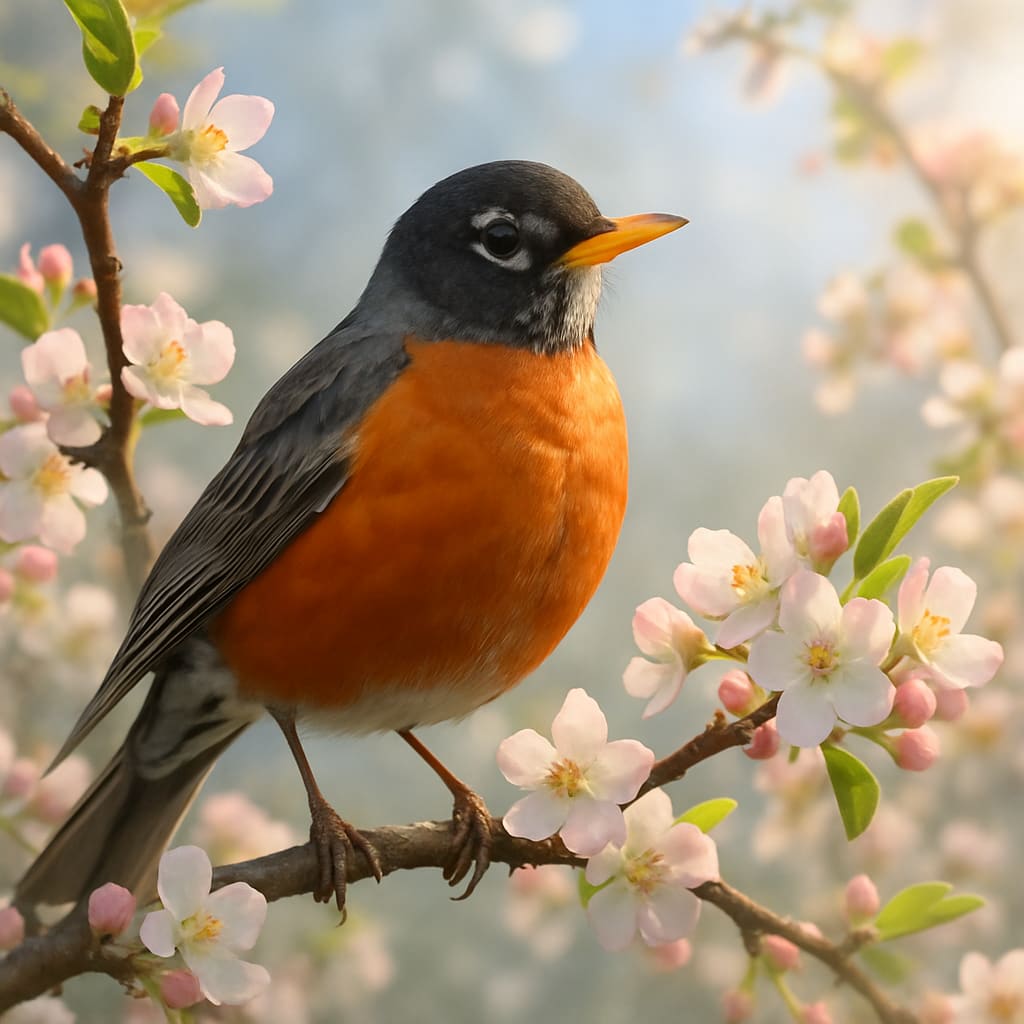
When you think of spring in North America, what comes to mind? Blossoming trees? Morning light? Perhaps, above all, the familiar call of the American Robin — that cheerful, whistling song that gently reminds us: "Winter is over. Life begins again."
Known for its burnt-orange breast, sweet voice, and hardiness, the American Robin is more than just a backyard bird. It’s a symbol, a survivor, and a deeply woven thread in the story of nature, seasons, and human emotion.
A Familiar Face in Every Yard
The American Robin (Turdus migratorius) is one of the most recognizable birds across the U.S. and Canada. A member of the thrush family, it has:
- A distinct reddish-orange chest
- A grayish-brown back
- A yellow beak and white eye-ring
Whether hopping across a lawn in search of worms or perched on a tree branch singing its famous dawn chorus, robins have become part of the American visual and auditory landscape.
Unlike some elusive species, the robin is confidently present — it’s a bird you see, hear, and grow up with.
🧭 Where It Lives, and Why It Matters
From Alaska to Florida, the American Robin thrives in a wide range of environments:
- Forest edges
- Urban parks and backyards
- Grasslands and farmlands
- Even mountainous regions
What makes them special is their adaptability. As long as there’s a patch of soil to pull worms from and a tree to nest in, the robin is content.
Its presence often mirrors the health of local ecosystems. If robins are singing, it’s likely the earth is alive beneath them.
🐛 The Worm Hunter.
Few birds are so closely associated with a single food source as the robin is with the earthworm. Watching one tilt its head to "listen" for movement underground has almost become a classic American nature moment.
But robins are omnivorous. Besides worms, they eat:
- Insects
- Caterpillars
- Berries (especially in fall and winter)
- Fruit from trees like crabapples, cherries, and serviceberries
In colder months, they’ll travel in flocks of hundreds, feeding on berry trees in urban areas, sometimes in plain sight.
🏡 Home Builders of the Backyard
American robins are among the first birds to nest in spring. A female robin builds a neat, cup-shaped nest out of grass, twigs, and mud — usually nestled on a horizontal tree branch, window ledge, or building ledge.
She lays 3 to 5 beautiful blue eggs, often described as "robin's egg blue" — a color now iconic in design and fashion.
Both parents feed the chicks once they hatch. Within two weeks, fledglings leave the nest. Remarkably, robins often raise 2 to 3 broods per season.
🎵 A Song Worth Waking Up For
The robin’s song is one of the most beloved in North America.
Their call — a mix of clear whistles and chirping phrases — usually begins before sunrise, giving them the title of “first singer of the dawn chorus.”
For many, this bird doesn’t just mark the start of a day… it marks hope. A new beginning. A fresh cycle.
It’s no wonder Native American tribes and early settlers alike associated the robin with renewal, patience, and joy.
❄️ Survivors Through the Seasons .
Although commonly thought of as a “harbinger of spring,” robins don’t always migrate far south. Many stay throughout winter, especially in urban areas, where fruiting trees and water sources remain available.
During migration, robins can travel up to 200 miles in a single day, forming large flocks and riding thermal currents northward.
They are resilient — facing changing weather, human expansion, and environmental pressure — yet they continue to thrive.
🧠 Smarter Than They Seem .
The American Robin is not just charming — it’s intelligent.
- They have strong spatial memory: returning to the same nesting spots each year.
- They can recognize human faces and will often react differently to familiar versus unfamiliar people.
- Some studies suggest they may even mourn lost chicks, standing silently by empty nests.
Their behavior reminds us: birds are not machines. They are feeling creatures in tune with their world.
⚠️ Threats in a Modern World .
While still abundant, robins aren’t free from danger:
- Pesticides and lawn chemicals can poison the worms they eat.
- Glass windows pose a significant collision risk, especially in cities.
- Cats — domestic or feral — kill thousands every year.
- Habitat loss threatens breeding areas in some regions.
Fortunately, public awareness is rising. Many are planting native berry trees, reducing chemical use, and building bird-safe spaces in yards and communities.
🌱 The Symbolism of the Robin
More than biology, the robin is a spiritual and cultural symbol.
- In literature, it represents renewal, rebirth, and the arrival of something better.
- In dreams and folklore, a robin’s song is often seen as a message from the beyond — a sign of hope from a loved one lost.
- In poetry, it’s the bird that keeps singing when the snow melts and the cold is gone.
Its arrival each spring isn’t just natural — it’s emotional.
💬 A Bird We Should Never Take for Granted
The American Robin is a reminder that ordinary doesn’t mean insignificant.
It is everywhere — and yet, every time it sings, it brings something ancient and comforting back to our hearts. In an age of disappearing species and shrinking green spaces, the robin continues to sing — boldly, beautifully, and with purpose.
So next time you hear that familiar call in the morning…
Pause.
Listen.
Smile.
Because that song?
That’s hope, flying on orange wings.
About the Creator
Hassan
Nature lover & storyteller 🌿✒️ Sharing the beauty of birds, wildlife & emotional journeys through words. Let’s fly together through stories that touch the soul. 🕊️✨
The Growl Only I Could Hear
My town was the sort where nothing happened. Law enforcement was bored, and as a result, parking tickets were pretty common. It was the sort of town where the only skatepark didn’t have anything more interesting than a half-pipe, and not more than six feet at that. It didn’t even have walls. And it was right across from a horse pasture, with an old folks’ home a block up and the elementary school a block down.
By ThatOne_Girl4 days ago in Fiction


Comments
There are no comments for this story
Be the first to respond and start the conversation.