
Well, here I am again.
In one way, it seems like I haven’t seen this classroom for ages. In another, I shut my eyes for a second, opened them, and bam-o. Summer’s over, and I’m here among an energetic new batch of twelve-year-olds who still get excited about the first day of school because they haven’t hit the rebellious stage of puberty yet. They’re eager to see their friends. To get into a new routine. To possibly learn something.
And to hear the story about The Closet.
Its door is flung open like it always is the first day of school. Skeptic yet half-believing kids peer into it. One cowering girl wraps strands of yellow hair around a nervous finger as she stares, eyes frightened and unblinking. A tough-looking boy lounges in his chair, pretending to not care and yawning in a pitiful attempt to impress the girl sitting next to him with his aloofness. That girl ignores him and leans forward, intent on the closet’s open door. She grips her pencil in a boa constrictor-like squeeze.
The first question is always the same.
“Is it true? Did a teacher really get murdered in there?”
I don’t catch who asks it, but it doesn’t matter. The reply is stock. “So they say. Her name was Mary Turnball. They found her stuffed in there the first day of school, a knife stuck in her back.”
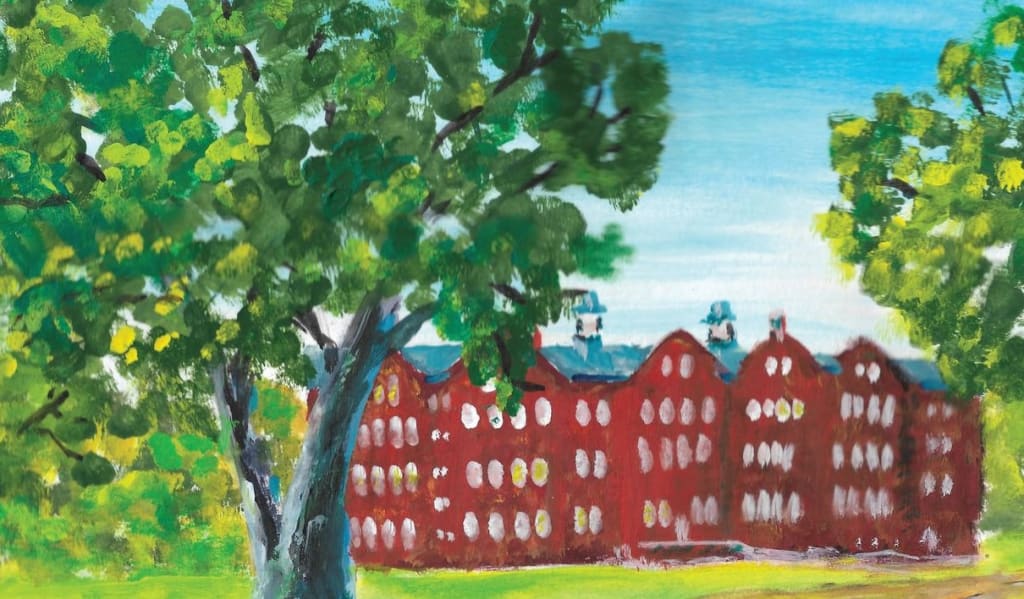
Every student gasps except the tough-looking kid, who rolls his eyes. The murder is the only interesting story associated with this crumbling pile of bricks we call Ferryville Junior High. And these kids are morbidly excited because they’re the lucky few who get to spend most of their school year in the “Murder Room”. And on the first day of school, the teacher assigned to this classroom is obliged to rehash the details and answer all questions if she holds any hope of refocusing her new students to the task of learning something constructive.
The ritualistic questions begin.
“Who did it?”
“When did it happen?”
“Did they ever catch the killer?”
And the formulaic answers follow. “No, they never caught him. But Mary Turnball died fifty years ago today…”
Wow. Has it really been fifty years?
“…and some say that her husband, Matthew Turnball, did it. But he was never convicted. No solid evidence. And they say…”
The students rip their gazes away from the closet and clamp their eyes on the storyteller.
“…they say Mary Turnball’s ghost is still trapped in there. And every year, on the first day of school, she reappears. See those marks on the closet wall?”
Eyes swivel back to the closet. Kids involuntarily rise out of their chairs, like marionettes on strings, and glide forward to get a better view.
“Every year, on the first day of school, the scratch marks appear. They’re gone by the end of the day. Her last attempt to escape her murderer…”
We all peer at the marks. Because they are there. Faint but obvious on the faded yellow paint—the one concrete proof these kids have that a slain teacher’s ghost does appear in this closet every year. That she does make a desperate attempt to claw away from her attacker. Year after year it happens.
But I don’t ever remember making those marks.
I only remember waking from whatever trance I stay in the rest of the year and staring out the closet at a mass of new students peering back at me. Through me, rather, because they can’t see me, but I sure see them. Their shining faces are so…alive. And the teacher always reclines at her desk, a puzzled smile clinging to her face because although she doesn’t quite believe it, even she can’t logically explain away those claw marks. This year that woman is a doppelgänger of me fifty-years ago. Young and fresh. Eager to teach and eager to learn. She has dreams beyond this classroom, I’ll bet. Like I once had.
The yellow-haired girl has now twined a clump of hair so tight around her finger that its tip is turning purple. “Why would Mr. Turnball want to kill his own wife?”
The teacher shrugs. “Well, if you believe the stories, Mary Turnball was exceptionally brilliant. She invented a device that would make them rich. And he wanted the money for himself. So, he killed her and stole the idea.”
“Bastard,” the girl with the pencil breathes.
The teacher ignores her remark. In my day, that kind of language would have earned that kid an hour standing in the corner with a dictionary balanced on her head.
They’re inching closer to the closet. The teacher continues in a theatrical whisper. “Until her murderer is brought to justice, she’s bound to come back every year. To remind everyone of her gruesome death. And that the killer is still on the loose.”
“What did she invent?” the tough boy, who now doesn’t look so aloof, asks.
A wistful smile crawls onto the teacher’s lips. “Well, Mary Turnball loved boats. She loved to sail, she loved the sea. I’m that way too. I was in the Coast Guard before I became a teacher.”
Young eyes stare at the adult with a new respect.
“She invented a piece of equipment that helps aid ship navigation. Most ships still use it. But the story is that her husband killed her and took the credit. And it made him a millionaire. He, of course, insisted that the invention was his idea and he never would have murdered his dear wife. And there’s no real way to disprove it.”
The tough boy’s face softens. “So the poor teacher…she’s bound to suffer for all eternity? Is that how it works?”
They’re practically in the closet now. The girl clutching the pencil pokes it through the doorway, and I shrink back…not that it matters. I won’t feel it, no more than I can feel the shelves piled with books or the teacher’s coat hanging neatly on its peg.
I wish I could feel it. It’d be nice to touch something. To experience texture again. Hardness and softness. Or warmth and cold. All I experience in this waking time are hazy thoughts, a dreamy awareness. And a slight curiosity, wondering what the kids will say this year. Their clothing styles may change, and their haircuts, and even their slang, but each new batch of students never fails to ask interesting questions.
“I bet he did it,” the tough boy says. “He stole her idea and hacked her to bits.”
That’s true. Well, except the “hacked to bits” part. One excruciating stab, a sudden brightness, and that was it. Until the next first day of school, when I blinked into my ghostly existence for the first time.
“If he did it,” the girl with the pencil says, “and she’s doomed to haunt the closet until her killer is brought to justice, then what will happen next year?”
The teacher shifts in her chair. “What do you mean?”
“They’re tearing the school down, aren’t they? That’s what my mom said. They’re building a new one on the other side of Ferry River. What will happen to her then? She won’t have a closet to haunt.”
A prickling sensation begins to crawl up my nonexistent spine.
What will happen to me then?
The yellow-haired girl yanks her finger forward and the hair unravels. “She’ll be stuck in limbo.” She raises the purple finger to her lips and nibbles on an already frayed fingernail. “’Imbo for ’tern’ty.”
And I shudder. For the first time this closet feels like a suffocating coffin. All these year I’ve gazed out of it, bemused at the young faces staring so intently in, but what if those faces disappear forever? And all that is left when I wake each year is black nothingness? Is that what I’m doomed to see…to feel…for all eternity?
“Maybe we can save her,” the tough boy says.
The teacher smiles. “What do you mean?”
His eyes are bright now, sparkling. He’s a thinker, the smartest kid in the class I’ll bet, underneath all that pretend aloofness. “What if those scratch marks on the wall mean something?”
We stare at the marks again. Do they mean something? Was I not quite dead when that bastard of a husband slunk away, his plastic-wrapped boots muffling his presence, his gloved hands leaving no fingerprints? Did I scratch out a clue? They make no sense, those marks. In my dying delirium I scribbled out something entirely indecipherable.
Or is it? I peer at them, and the scratches start to take on a hazy meaning. The teacher gets out of her chair, moves to the closet, and scrutinizes them too. I can visualize the neurons in her brain firing away as she rubs her chin. No cold gold band grips her ring finger. Good for you, lady. Keep your ideas for yourself.
“If you tilt your head sideways,” she says, “they look like Morse code.”
The yellow-haired girl’s teeth rip out a bit of fingernail. “What’s ’at?”
“A code they used long ago, before computers were invented. We still use it in the Coast Guard.”
“What does it mean?” the girl with the pencil says.
“Well, those scratches…they look like this.” The teacher crosses the room, grabs a marker, and transcribes the scratches to a marker board:
_____ _____ _____
“Two dashes and one dash,” she whispers. “M and T.”
The tough kid sucks in his breath. “Matthew Turnball.”
A cold quiet fills the room. If I still had a heart, it would be beating madly.
The girl with the pencil scratches her temple with it. “Someone must have thought of that before.”
No, I want to scream. In fifty years, no. Not until this minute.
The yellow-haired girl stops chewing her fingernail. She reaches into the closet and touches the marks. “If she was alive enough to write it in Morse code, why didn’t she just scratch his initials in English?”
Good question, kid. Why didn’t I? Maybe it was the only language that made sense to my dying brain. A desperate S.O.S. from a ship lost at sea.
“Is he still alive? Her husband?” the girl with the pencil says.
The teacher nods. “He lives in a mansion in the heights above the river.” She takes out a cell phone and snaps a picture of the marks on the wall. “I’ll send this to my boyfriend at the police station. He might be interested in this.”
The tough boy frowns. “But will it save her? If we tell everybody, will she be at peace?”
The teacher gives him a sympathetic look. She’s the sensible type. She’s doing this to humor the kids more than anything. She still doesn’t quite believe in ghosts.
But the girl with the pencil, the one he was trying to impress, touches his shoulder. “I think maybe now she will.”
Their faces begin to dissolve. The teacher opens her mouth to say something, but I don’t hear her words. I glance at the wall. The scratches have faded away. Like they do every year.
But next year, maybe it will be different. Next year, when they raze this school to the ground, maybe I won’t wake to cold darkness in an unknown place. Not if those kids can convince someone of his guilt. Instead, I’ll walk in a land that’s warm and bright. Or I’ll sail on an endless sea, with cool spray kissing my face and sunshine sparkling on the waves. I’ll miss their faces, all those curious kids. But it’ll sure be nice to never see this closet again.
About the Creator
Nikki Bennett
I am an author of mainly middle grade and young adult novels, as well as an artist and freelance editor. I have several novels published through Firedrake Books, available on Amazon.
www.bennettcreativeservices.com
Reader insights
Outstanding
Excellent work. Looking forward to reading more!
Top insights
Compelling and original writing
Creative use of language & vocab
Excellent storytelling
Original narrative & well developed characters
Keep reading
More stories from Nikki Bennett and writers in Fiction and other communities.
The Twitching Hour
If you’re a New Orleans native wrestling with spiritual questions, you’ll find the answers at the House of Madame Benoit, Interpreter of Dreams. The house sits in a forgotten alley, the only backstreet in the French Quarter that curves and twists instead of running in a straight line. There’s something unsettling about the twists, like if you dare walk down them you might never find your way out. Tourists tend to avoid the alley without even knowing why. Which suits us locals just fine.
By Nikki Bennett4 years ago in Fiction




Comments
There are no comments for this story
Be the first to respond and start the conversation.