Historical
An Uncrowned King Chapter 3 Part 4
Once more Cyril drew dark inferences from his brother’s words, but he made no remark, and at the appointed time they presented themselves in Madame O’Malachy’s salon, where a most cordial welcome awaited them. They were the only guests, and it fell naturally to Caerleon to escort his hostess to the table and to sit beside her, a privilege for which he was not as grateful as he ought to have been, for he could hear Cyril and Nadia wrangling busily throughout the meal. Guessing that his brother was treating Mdlle. O’Malachy to a little fin de siècle philosophy, he had no difficulty in imagining the light in which it would strike her, and his anxiety to hear what she was saying in reply distracted his attention a little from her mother, who conversed vivaciously in French, addressing him as “mon cher marquis” in a way that reminded him vaguely of the Molière he had read when at school.
By Sydney Grier4 years ago in Fiction
An Uncrowned King Chapter 3 Part 5
“Well, it seems that the O’Malachy was, as he said, one of the Sarmatian leaders, and he gave the Scythians so much trouble that they were ready to go any lengths to get rid of him. They tried fair means and they tried foul—open attacks, and bribes, and attempted assassination, but it was all no good. At last—I don’t know whether it was a lucky guess, or whether something showed them his weak point—they thought of working upon his susceptibilities. They had a decoy handy, Mdlle. Barbara Platovska, a young Sarmatian lady, brought up in Paris and trained in Scythia. She had done a good deal of work for them already, and she was as plucky and as wily as she was beautiful, so that she was a valuable instrument. Well, they sent her off with a free hand, and a pardon for O’Malachy, signed by the Emperor, in her pocket, together with a promise of employment for him in the Scythian army. Mdlle. Barbara lays her plans, and presently, travelling by night through a forest where the rebels had one of their camps, she falls into their hands. There was some talk of shooting her at once, for her face was unmistakable, and they all knew what harm she had done to their cause; but she singled out O’Malachy, and threw herself at his feet and demanded his protection. You wouldn’t find many Irishmen who would refuse to help a pretty woman in such a plight, and O’Malachy pulled her behind him, and told the rest to come on. They nearly got to blows, but at last they agreed to give the girl some form of trial, and they carried her off to their headquarters. Naturally O’Malachy kept close to her on the way, and she used her opportunity so well that before the journey was over he was head and ears in love with her. He soon discovered that the rest were determined to kill her, and the very first night that he had the chance he helped her to escape from the ruined tower in which she was imprisoned, and escorted her back to her friends. Up to that time he fully meant to go back and give himself up to his comrades, but now was Mdlle. Barbara’s chance. She never let him alone on that journey, until she had got him to promise to come in with her and surrender. He must have been pretty sick of the Sarmatians altogether—they were rather a shady lot, always quarrelling and fighting among themselves—and there was nothing to be made out of their job, and he was in love as well, and he thought she loved him, so he consented. He got his pardon and his post in the Scythian army, and he meant to get Mdlle. Barbara. But when he went to claim her she met him as she had done the other men she had betrayed, turned her back on him and told him that no traitor should ever be her husband. But she had tried that trick once too often. He had her against the wall with a revolver to her head in an instant, and then and there he made her promise to marry him. And that wasn’t all, either. He took her to the table, still with the revolver pointed at her, and made her write out and sign an account of the scene. Then he let her go, but she married him the next week. You see he could have ruined her with that paper. If it had once come to her employers’ ears that she had lost her nerve, and yielded to threats, they would never have made use of her again. Perhaps, too, the O’Malachy’s style of wooing pleased her, or she may have had a soft place for him in her heart all along. At any rate, they married, and went into partnership, and you see what a happy couple they are.”
By Sydney Grier4 years ago in Fiction
An Uncrowned King Chapter 2 Part 4
After this hospitable intimation, the travellers held back no longer, and speedily found themselves established in most comfortable quarters, for the landlord was delighted not to be compelled to turn away such promising guests from his door. Nothing was too good for them, and they went to bed well content, after commissioning the host to procure horses in the morning for their intended ride to Château Temeszy.
By Sydney Grier4 years ago in Fiction
An Uncrowned King Chapter 2 Part 3
Thanks to Caerleon’s foresight in not sending word to his friend of their intended visit to Hungary, the tour was carried on in a very leisurely fashion indeed, and the brothers lounged through Europe, to use Cyril’s phrase, by unfrequented routes, spending now a day and now a week in old half-deserted towns, left high and dry by the stream of modern progress. There was nothing very inspiriting in such travelling to men who were neither antiquarians nor photographic maniacs; but Caerleon had a vague idea that he was improving his mind by visiting the scenes made famous by old German history, while Cyril was as well content to put in his time on the Continent in this way as in another. The person who suffered most was Wright, the groom, who found himself debarred in most places from communion with his kind owing to his ignorance of the language, and he rejoiced unfeignedly when the course of his masters’ wanderings brought them at last to Janoszwar, the town that lay nearest to Count Gyula Temeszy’s castle.
By Sydney Grier4 years ago in Fiction
An Uncrowned King Chapter 2 Part 2
In this way the matter was settled, and a few days later the two brothers left Llandiarmid for London, where Caerleon did his best to make a satisfactory disposition of his rather complicated affairs, and Cyril went round to say good-bye to his lady friends. Cyril was a very popular young man in London society, where he had found a footing as soon as he left Eton. He had slipped out of sight for a short time as unpaid attaché in the British Embassy at Pavelsburg, but the Scythian winter proved too severe for him, and he was invalided home, to take up a pleasant existence about town, while assuring every one that he was only waiting until a suitable post should offer itself for his acceptance in some more genial clime. As a poverty-stricken younger son, he was free from the pursuit of the match-making mothers and daughters who had made Caerleon’s life such a burden to him. No one wanted to marry him, and, fortunately for himself, he felt no particular desire to marry any one. The part he had chosen in the Human Comedy was that of the Laughing Philosopher, and he played it with complete satisfaction to himself and to his world. He was a universal favourite among the ladies, helping the elder ones to arrange their cotillons and organise their charity bazaars, while for the younger he designed costumes for fancy balls, and was always ready to suggest new ideas for any scheme of pleasure. With men he was not quite so popular. Those who did not know him well regarded him as entirely a ladies’ man, while some few who had penetrated more deeply into his character were a little afraid of him, and half suspected him of hiding deep designs under a mask of frivolity. This was not the case, however. Cyril was fully conscious of his own powers of mind, but he had no scruple as to using them to smooth his path in society until some more important object should come in his way.
By Sydney Grier4 years ago in Fiction
An Uncrowned King Chapter 2 Part 1
A year had passed, and the situation in Thracia remained unchanged. The search for a king initiated by M. Drakovics had not yet proved successful, but the Provisional Government was still in office, and the Thracians lived and throve under a regimen of what their enemies called autocracy washed down by draughts of rhetoric. M. Drakovics alone, against whose life two further attempts had been made, looked out ahead with troubled eyes, and yearned for the tall Englishman who had seemed likely to prove such an efficient coadjutor in his task of governing.
By Sydney Grier4 years ago in Fiction
An Uncrowned King Chapter 1 Part 3
In justice to the journalist, it must be said that the account of the “interview” was very short, consisting chiefly of the true statement that Lord Usk had kept his own counsel and declined to discuss the subject; but the foreign editor and his subordinates supplied a concise account of Thracia and its history and revolution to fill up the space, and to gratify the interest and curiosity of the British public, which developed both these qualities very largely on the morrow.
By Sydney Grier4 years ago in Fiction
An Uncrowned King Chapter 1 Part 2
“It was connected with your own election to the Legislative Assembly, was it not?” asked Usk. “It was, milord. I had been absent from my country for many years, owing to my having once taken part in a meeting of those who wished to bring about a reform by means of constitutional agitation. I was a young man when I threw in my lot with the reformers, and had just begun to practise at the bar, but I was obliged to leave Thracia, and sacrifice all my prospects. My years of exile were not wasted. I travelled, I worked, I associated with earnest men—and I found my country a byword everywhere. At last I could endure it no longer, and I made up my mind to set on foot one more effort to stir up my compatriots to a sense of their degradation. I returned to Thracia, and found myself received with joy, yet with fear, by my old friends and by the younger generation of patriots that had sprung up. Once more we set ourselves to form a constitutional party, and to educate public opinion. Our objects were simple,—the dismissal of the Scythians who had been thrust into public offices, the reform of the whole corrupt administration, the discontinuance of the system of borrowing, and the gradual repayment of our debt to Scythia out of the money saved by reducing expenses and gained by the proper development of the country. We were quite ignorant of the extent to which our views found favour among the people, but we determined upon a bold stroke—in order both to advertise our programme and to show us how we were supported. The Elections were approaching, and we resolved to contest every seat for which we could find a candidate. The Administration was utterly taken by surprise, but its members perceived that their salvation lay in striking at once, and they chose to begin with me. I was elected by a large majority for the constituency to which I offered myself, but my election was declared void by a Government decree, and a fresh poll was announced. Troops were drafted into the town, nominally to preserve the peace, in reality to force my constituents to vote for the Government candidate, and vast numbers of persons crowded in from the country districts, drawn by the prospect of a tumult. I was passing through the market-place when a band of my supporters called upon me for a speech. Then, milord, I felt a strange fire seize me. I remembered the effect, long before, of my speech to the meeting for taking part in which I was exiled. I remembered that in my days as barrister I had often moved the court to tears and to indignation. It was merely a flash of memory, but with it came the impulse to act. I sought a place from which to speak—I climbed upon a country cart—I spoke—I heard the people shouting—the Government agent ordered the soldiers to arrest me—I saw them pushing their way through the crowd—they closed round me, dragged me down—I appealed to the bystanders—I was rescued—I spoke again, and raised the cry of Reform. Before I knew what had happened I was at the head of a revolution, the people had put themselves under my guidance, the troops had joined us, the Government agent was seeking the means for flight. By my orders he was captured and lodged in prison—I seemed to perceive at once what was to be done. The telegraph-office was seized, no message allowed to be sent but by my authority. To each of our candidates for the Assembly I telegraphed what had happened, and his orders. A brief pause to concert my plans with my chief supporters, and we were in motion again. The news spread through the country like wildfire; in a short time the whole army was with us, and the people were thronging to us in enormous numbers. We marched to Bellaviste, and entered the city without striking a blow. When we laid before the king our demands for a change of Ministry and a new constitution, he preferred to abdicate rather than grant them. We were nothing loath, and he has retired to the south of France on a suitable income. A provisional government was formed, and has remained in power, supported by the whole force of the national sentiment, for nearly a year. The success of our movement was due to its spontaneity. If we had prepared for it, Scythia would have gained some inkling of our plan, and might have out-plotted us, but she could not without any excuse interfere with the accomplished fact. In the very first moment of our freedom we ranged Pannonia on our side by making overtures to her for the conclusion of a commercial treaty which had hitherto been hindered by the intrigues of Scythia. To Scythia we were able to guarantee, through the good offices, secretly exercised, of Pannonia, the regular payment of her interest, and the gradual extinction of the debt itself, while the dismissed officials received honourable terms. It was not easy to arrange all this, for at first we found it difficult to obtain money, and the Thracians are hot-blooded and had much to avenge, but I would not remain at their head except with their promise to acquiesce in my decisions. Balancing Pannonia against Scythia in this way, we have passed through a year of national life, although Scythia refuses to recognise us, and has worked upon our suzerain, Roum, to withhold from us up to the present time the right we claim of choosing our own form of government.”
By Sydney Grier4 years ago in Fiction
An Uncrowned King Chapter 1 Part 1
“After question-time, the First Lord of the Treasury rose to make a statement with regard to the course of public business, the salient feature of which was the announcement that the Government found themselves compelled to appropriate all the time of private members during the remainder of the session. We understand that this action on the part of the Ministry has aroused strong feeling on both sides of the House, particularly among those members who have charge of private bills. One of the supporters of the Government who has been very hardly treated is Viscount Usk, whose bill for permitting peers to become candidates for seats in the Lower House, on relinquishing their right to a seat in the House of Lords, had obtained the first place in the ballot for Tuesday next.”
By Sydney Grier4 years ago in Fiction
The Ridge: The Whisper of the Leaves - Chap. 29
It turned out that Gerald was as good as his word…..this time. Lampkin came back Sunday night with a couple of ham sandwiches and tea his wife had made and let Gerald wolf these down before he began to grill him. And grill him he did.
By Dan Brawner4 years ago in Fiction
The Ridge: The Whisper of the Leaves - Chap. 28
It had been almost a week since anyone had seen Marshall and Edna was on the verge of crying again. Since James’ death and Marshall’s disappearance, it seemed like that was all she wanted to do. Most of the time, though, she didn’t succumb to the urge. Carl tried to put up a strong front for her and the rest of the family, but she knew that he was hurting just as much as she was.
By Dan Brawner4 years ago in Fiction
The Ridge: The Whisper of the Leaves - Chap. 27
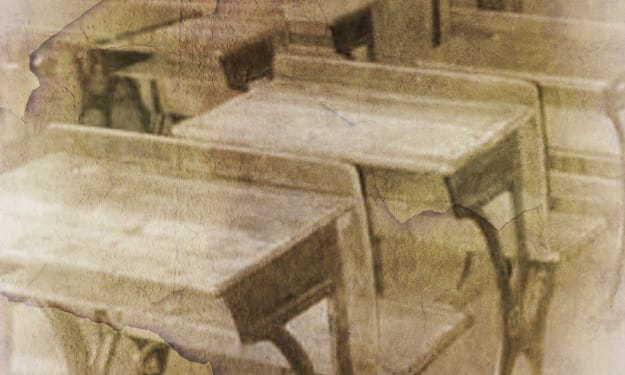
Monday, March 15 The people of New London, Texas were proud of their new High School. It was quite simply, the biggest and finest building in the area. Laid out in the form of an “E”, it was 253 feet long, fifty-six feet wide and three stories tall. The construction was of steel, brick and mortar, and was destined, as the contractor put it, to “still be standing a hundred years after we’re all dead.” Everything about it was as state-of-the-art as an oil rich town could make it.
By Dan Brawner4 years ago in Fiction