
The Tuesday It Rained Inside
We Opened Our Umbrellas at the Dinner Table

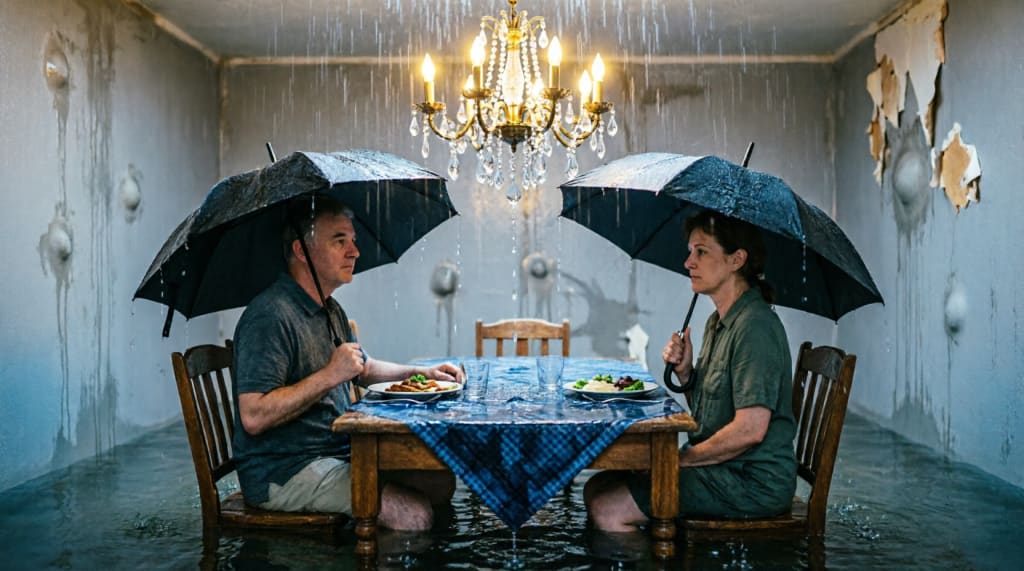
The first drop landed in my mashed potatoes with a soft plip.
I didn't flinch. I didn't look up at the ceiling. I simply scooped the wet potato into my mouth, chewed, and swallowed. It tasted like starch and cold water.
"Did you call the plumber about the sink?" Arthur asked. He was cutting his steak. The knife scraped against the plate, a sharp, ceramic sound that cut through the quiet hum of the refrigerator.
"Yes," I said. "He said he'd come Thursday."
"Thursday's good," Arthur said. "Thursday works."
Above us, the ceiling groaned. It was a deep, wooden sound, like the house was settling into its own grave. Another drop fell. This one hit the rim of my water glass, sending a tiny ripple through the still liquid.
I kept my eyes on my plate. The peas were bright green against the white porcelain. They looked alive. Everything else felt very dead.
"Pass the salt, please," Arthur said.
I reached for the shaker. My hand trembled, just once. I steadied it against the tablecloth. The tablecloth was blue, checkered, something my mother had given us for our fifth anniversary. It was damp now. A dark spot was spreading near the center, where the rain was falling hardest.
"Here," I said.
Arthur sprinkled salt over his steak. He didn't brush the water off his forearm. He didn't wipe his sleeve. He just cut another piece of meat and put it in his mouth. He chewed with his mouth closed, just like he always did. Just like he'd been taught was polite.
The rain picked up. It wasn't a leak anymore. It was a storm.
I could hear it hitting the hardwood floor in the hallway, a rhythmic tapping that sounded like fingers drumming on a desk. The sound of waiting. The sound of something inevitable approaching.
"Did you hear from your sister?" Arthur asked.
"No," I said. "Not since Christmas."
"She's busy," he said. "Work is hard this time of year."
"Yes," I said. "Work is hard."
A drop ran down my nose. I didn't wipe it away. I let it hang there, cold and heavy, until it fell onto my lap. My pants were dark with moisture. I could feel the cold seeping through to my skin, but I didn't shift in my chair. I didn't excuse myself to get a towel. To get a towel would be to acknowledge that the house was filling with water. To acknowledge that the ceiling was gone, or broken, or never there at all.
We had agreed, years ago, not to talk about the things that broke. We fixed them silently, or we walked around them, or we pretended they were furniture.
"More wine?" Arthur asked. He held the bottle. His hand was dry. I wondered how.
"No," I said. "I'm driving tomorrow."
"Right," he said. He set the bottle down. It made a wet thud on the table. "Safety first."
The light fixture above us flickered. It was an old chandelier, brass and crystal, something we'd bought at an estate sale because we wanted to feel like people who owned estate sale things. Water dripped from the crystals, tinkling like tiny bells. Ting. Ting. Ting.
It sounded like laughter.
"Did you finish the report?" I asked. My voice sounded flat. Muffled by the sound of the rain.
"Almost," Arthur said. "Just the summary left."
"Good," I said. "Good."
The water was rising. I could feel it around my ankles now. My socks were soaked. The cold was creeping up my shins, biting at my calves. I should have been shivering. I should have been standing up, shouting, running for the door.
But the door was far away. And the dinner wasn't finished.
Arthur cut the last piece of his steak. He speared it. He ate it. He placed his knife and fork together on the plate, parallel, at the four o'clock position. He was done.
"Delicious," he said.
"It was," I agreed.
The rain was heavier now. It wasn't just drops; it was sheets. The air smelled like wet plaster and old dirt. The checkered tablecloth was saturated, clinging to the wood. My plate was floating, just slightly. I held it down with one hand.
"Did you lock the car?" Arthur asked.
"Yes," I said. "I locked it."
"Good," he said. "You never know around here."
Around here. As if the storm was outside. As if the world beyond our walls was the dangerous place, and not the dining room where we sat, drowning in silence.
I looked at Arthur. Really looked at him. His hair was plastered to his forehead. His white shirt was translucent, clinging to his shoulders. He looked like a man who had walked through a hurricane. But his eyes were dry. His expression was calm. He was looking at me with the same mild, polite interest he'd worn for ten years.
"Are you cold?" he asked.
"A little," I said.
"I'll turn up the heat," he said.
He didn't move. He stayed in his chair. The water was up to his knees now. I could see the dark stain of his trousers. He didn't seem to notice. Or he noticed, and he decided it didn't matter.
"Thank you," I said.
"You're welcome," he said.
A crystal fell from the chandelier. It hit the table and shattered. We both ignored the sound. We ignored the shards of glass mixed with the water on the tablecloth. We ignored the fact that the wall behind him was beginning to buckle, the drywall softening like wet bread.
" Dessert?" Arthur asked.
"I'm full," I said.
"Right," he said. "Leftovers for tomorrow."
"Yes," I said. "For tomorrow."
We sat there for a long time. The rain didn't stop. It couldn't stop. It was coming from everywhere now—the walls, the floor, the space between us. The room was a lake. The chairs were boats. We were captains of a sinking ship, discussing the weather.
I thought about standing up. I thought about screaming. I thought about grabbing Arthur's hand and pulling him out of the water, out of the house, into the dry, normal night.
But if I stood up, the spell would break. If I acknowledged the water, I would have to acknowledge why it was there. I would have to say that the roof wasn't the problem. I would have to say that we were the problem.
That the leak started in the silence between us, years ago, and it had been growing ever since.
So I stayed seated. I folded my napkin. I placed it beside my plate.
"Thank you for dinner," I said.
"Thank you for cooking," Arthur said.
He stood up. The water rippled around his waist. He walked toward the kitchen, his shoes making a squelching sound on the floor. Squelch. Squelch. Squelch.
He didn't look back. He didn't offer me a hand. He just walked into the dark hallway, where the rain was louder, where the water was deeper.
I stayed at the table. I opened my umbrella. It was black, compact, the one I kept in my purse for emergencies. I clicked it open. The fabric snapped taut above my head.
It didn't stop the rain. Water still dripped through the gaps in the seams, running down my face, onto my shoulders. But it was something. It was a shield. It was a ritual.
I looked at the empty chair across from me. I looked at the plate with the floating peas.
"Thursday," I said to the empty room. "The plumber comes Thursday."
The rain answered. It hammered against the umbrella. It filled the room. It filled my lungs.
I closed my eyes. I listened to the sound of the house breathing, wet and heavy and alive. I waited for the water to stop. I waited for the sun to come back. I waited for normalcy to return.
It didn't.
But I stayed dry enough. Under the umbrella, in the dark, at the table.
I waited for Arthur to come back. I waited for him to ask me about my day. I waited for us to pretend that we weren't drowning.
Because that's what we do. That's how we stay married. That's how we stay here.
We open the umbrellas. We eat the cold food. We talk about the weather.
And we don't look up.
About the Creator
Edward Smith
I can write on ANYTHING & EVERYTHING from fictional stories,Health,Relationship etc. Need my service, email [email protected] to YOUTUBE Channels https://tinyurl.com/3xy9a7w3 and my Relationship https://tinyurl.com/28kpen3k
Keep reading
More stories from Edward Smith and writers in Fiction and other communities.
The Ghost in the Phone
There is a specific frequency to silence. It's not the quiet of an empty room. It's the quiet of a connection that is open but unanswered. It's the hum of the line after the music stops, when the system says, "All representatives are busy," and then just… lets you hang there.
By Edward Smith3 days ago in Fiction
Staying sane in the insane world.
”It is no measure of health to be well adjusted to a profoundly sick society.” Jiddu Krishnamurti This quote has been one of my favourites since the moment I first laid my eyes on it. To me, it cuts right through the fog of the illusion of normality that permeates our lives. And since I am someone who has never felt (well) adjusted to this society, Krishnamurti’s words gifted me with the realisation that there isn’t anything inherently wrong with me.
By Eva Smitte7 days ago in Humans



Comments
There are no comments for this story
Be the first to respond and start the conversation.