
Silent Struggles and Nigerian Roots
A Tapestry of Resilience and Identity

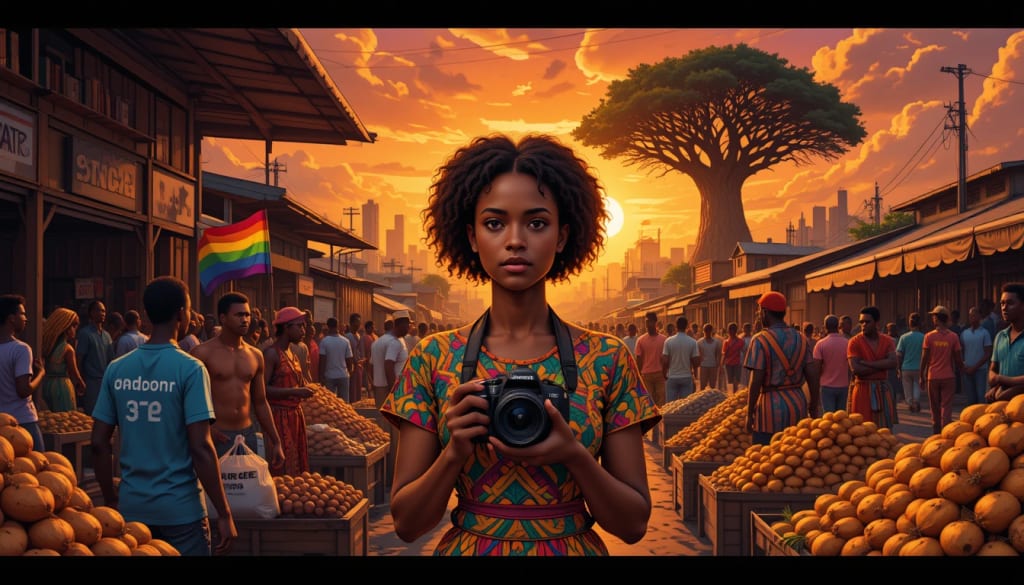
In the bustling streets of Lagos, Nigeria, in 2023, Amara stood at the edge of Yaba Market, her camera slung over her shoulder. At 27, she was a freelance photojournalist, capturing stories that the world often overlooked. Her latest project was personal—a documentary on the silent struggles of Nigeria’s queer community, a group forced to navigate a society where their existence was criminalized under the 2014 Same-Sex Marriage Prohibition Act. Amara’s own identity as a bisexual woman fueled her passion, but it also made her work dangerous. Her Nigerian roots, intertwined with her love for her culture and her fight for justice, were the threads that wove her story.
Amara grew up in a close-knit Igbo family in Enugu, where tradition was sacred, and silence on certain topics was expected. Her mother, Ngozi, ran a small tailoring shop, stitching vibrant ankara fabrics into dresses that told stories of celebration. Her father, Chukwu, was a history teacher who filled their home with tales of Nigeria’s past—stories of resilience, from the Biafran War to the fight for independence. But Amara’s own truth, her attraction to both men and women, was a story she kept locked away. Coming out in a country where same-sex relationships could lead to 14 years in prison was not an option.
Her journey into activism began in university, where she met Kemi, a bold literature student who ran an underground book club for queer Nigerians. In a cramped apartment lit by a single bulb, they read Audre Lorde and James Baldwin, their whispered discussions a rebellion against the world outside. Kemi became Amara’s first love, and together they dreamed of a Nigeria where they could live openly. But when Kemi was outed by a vengeful ex, she faced violence and fled to Canada, leaving Amara with a broken heart and a burning resolve.
Now, in Lagos, Amara channeled her pain into her work. Her documentary, Silent Struggles, aimed to amplify the voices of queer Nigerians—market traders, artists, students—who lived in the shadows. She met Chidi, a transgender tailor who crafted gender-neutral clothing in secret, and Aisha, a lesbian poet whose verses were shared only in private WhatsApp groups. Each interview was a risk, conducted in hidden safe houses or coded messages. Amara’s camera became her shield, capturing resilience in every frame.
One evening, while filming in a small bar in Ikeja, Amara met Tunde, a straight ally and community organizer who ran a youth empowerment program. Tunde’s warm smile and easy laughter disarmed her. He wasn’t part of the queer community but understood their fight, having lost a cousin to anti-gay violence. “We’re all human, Amara,” he said over a shared plate of jollof rice. “Your fight is mine too.” Their friendship grew, a partnership of mutual respect. Tunde helped Amara access communities wary of outsiders, while she taught him to see the world through her lens—where every face held a story.
The work wasn’t without cost. Amara faced threats—anonymous calls warning her to stop, a brick thrown through her apartment window. Her mother, sensing her stress but unaware of the full truth, urged her to focus on “safer” stories. “Why do you always chase trouble?” Ngozi asked, her hands busy with needle and thread. Amara wanted to tell her everything—to explain that this wasn’t just a project, but her life. Instead, she smiled and said, “I’m just telling the truth, Mama.”
The turning point came during a raid. Amara was filming a secret Pride gathering in a rented hall when police stormed in, batons raised. Heart pounding, she hid her camera under a table, but not before capturing the chaos—friends dragged away, their faces etched with fear and defiance. Tunde, who’d been helping with security, pulled her to safety through a back exit. In the alley, gasping for breath, Amara realized the footage could expose the brutality—or put her in greater danger. Tunde squeezed her hand. “You decide what to do with it. I’m with you.”
She chose to release the footage anonymously, sharing it with international human rights organizations. The video went viral, sparking global outrage and putting pressure on Nigeria’s government. But it also made Amara a target. She went into hiding, moving between safe houses, her camera still in hand. In those quiet moments, she reflected on her roots—the Igbo proverb her father loved: “A tree does not move unless its roots are strong.” Her culture, her family, her love for Nigeria—they were her strength, even as she fought its injustices.
Months later, at a clandestine meeting in Abuja, Amara reunited with Chidi and Aisha. They screened Silent Struggles for a small group of activists. The room was silent, then erupted in applause. Chidi, tears in his eyes, said, “You’ve given us a voice.” Aisha handed Amara a poem titled “Roots Unbound,” its lines celebrating their shared fight. For the first time, Amara felt her work had woven her struggles into something larger—a tapestry of hope.
In 2025, Amara sat in a London café, now an exile after fleeing Nigeria. Her documentary had won an international award, but the cost was steep—she hadn’t seen her family in two years. Yet, through encrypted calls, she learned her mother had watched the film. “I don’t understand everything,” Ngozi said, her voice trembling, “but I’m proud of you.” It wasn’t acceptance, not yet, but it was a start.
Amara’s story, like Nigeria itself, was complex—woven with pain, pride, and the unyielding strength of her roots. Her silent struggles had found a voice, echoing far beyond the streets of Lagos.
About the Creator
Shohel Rana
As a professional article writer for Vocal Media, I craft engaging, high-quality content tailored to diverse audiences. My expertise ensures well-researched, compelling articles that inform, inspire, and captivate readers effectively.
Keep reading
More stories from Shohel Rana and writers in Fiction and other communities.
Echoes of the 1980s Pride
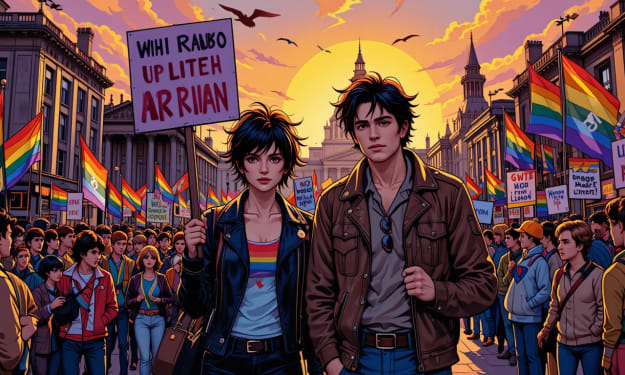
In the heart of London, 1984, the air was thick with the tension of change. The miners’ strike had gripped the nation, pitting working-class communities against a government determined to break their spirit. Meanwhile, in the vibrant underbelly of the city, the LGBTQ+ community was carving out spaces of resistance and celebration, their voices rising against a society that often silenced them. This is the story of Aisha, a young lesbian activist, and Tom, a striking miner from a small Welsh village, whose unlikely alliance would echo through the decades.
By Shohel Rana7 months ago in Fiction
Guttersnipe
My grandmother kept pigeons on the roof of our row house in Baltimore. Not the fancy kind—just city birds, gray and purple and blue, with eyes like drops of oil. She called them her “sky-rats.” Every morning she’d climb the pull-down ladder in the hallway, the one with the missing third rung, and I’d hear the scrape of the aluminum door, the flutter, her low murmuring in Polish.
By Nwama Godspromise 5 days ago in Fiction


Comments
There are no comments for this story
Be the first to respond and start the conversation.