
Echoes of the 1980s Pride
A Journey of Courage and Solidarity

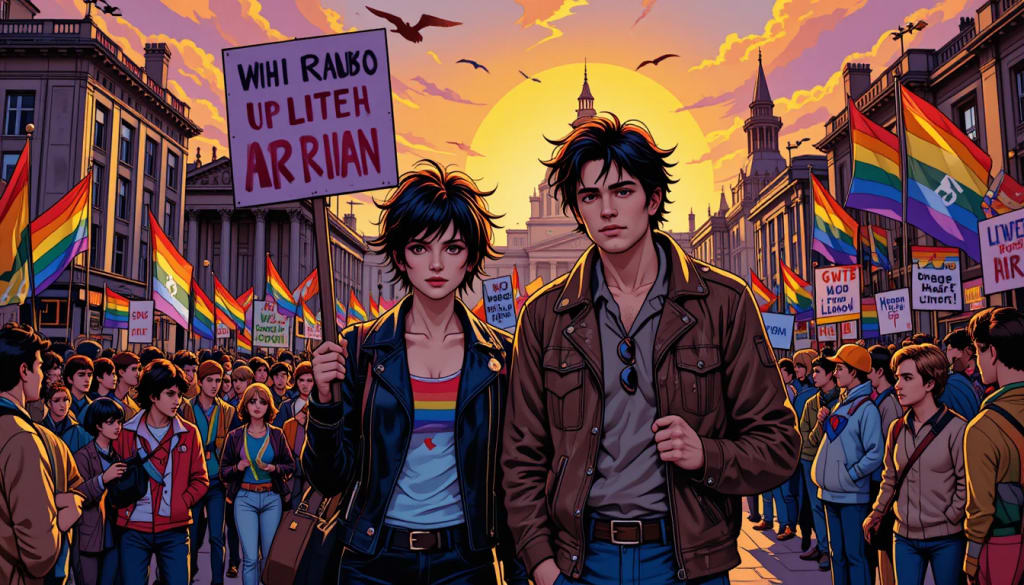
In the heart of London, 1984, the air was thick with the tension of change. The miners’ strike had gripped the nation, pitting working-class communities against a government determined to break their spirit. Meanwhile, in the vibrant underbelly of the city, the LGBTQ+ community was carving out spaces of resistance and celebration, their voices rising against a society that often silenced them. This is the story of Aisha, a young lesbian activist, and Tom, a striking miner from a small Welsh village, whose unlikely alliance would echo through the decades.
Aisha stood outside the Electric Ballroom in Camden, her leather jacket adorned with badges proclaiming “Gays Against Pit Closures” and “Pride Not Prejudice.” Her short-cropped hair and defiant stance marked her as a regular in the queer punk scene, where music and rebellion intertwined. At 22, she’d already faced her share of battles—family rejection, police harassment, and the constant fear of Section 28, a looming law that threatened to erase her community’s visibility. But tonight, she was buzzing with purpose. Her group, Lesbians and Gays Support the Miners (LGSM), was organizing a fundraiser, and the energy in the air was electric.
Inside, the venue pulsed with life. Drag queens in glittering gowns shared the stage with folk singers strumming protest anthems. Aisha scanned the crowd, her eyes landing on a group of unfamiliar faces—rough-hewn men in worn jackets, their accents thick with the lilt of the Welsh valleys. They were miners, invited by LGSM to the fundraiser. Among them was Tom, a 30-year-old father of two, whose broad shoulders and calloused hands spoke of years underground. He looked out of place, clutching a pint, his eyes wary but curious.
Their first meeting was awkward. Aisha approached Tom’s group, offering flyers about LGSM’s mission. “We’re raising money for your strike,” she said, her voice steady despite the nervous flutter in her chest. Tom nodded, unsure. “Never thought I’d be in a place like this,” he admitted, glancing at the sequined performers. “But we’re grateful for any help.” Aisha smiled, sensing an opening. “We’re not so different, you know. We’re both fighting for our lives.”
Over the next few weeks, Aisha and Tom’s paths crossed repeatedly. LGSM’s fundraisers grew, drawing crowds from both communities. Aisha learned about the miners’ struggle—the pit closures that threatened entire towns, the police brutality, the hunger that gnawed at families. Tom, in turn, listened as Aisha spoke of her fight for acceptance, the raids on gay bars, and the fear of being outed in a world that equated her identity with shame. Their conversations, often over cheap coffee in smoky cafés, revealed shared threads: the pain of being misunderstood, the strength of community, and the courage to stand tall.
One chilly November evening, Aisha invited Tom to a Pride march. He hesitated—his village was conservative, and he’d never met an openly queer person before moving to London for the strike. But curiosity and gratitude won out. As they marched through Trafalgar Square, banners waving and chants of “Solidarity!” ringing out, Tom felt something shift. He saw Aisha’s fierce pride, her refusal to hide, and it stirred a respect he hadn’t expected. “You lot don’t back down, do you?” he said, half-laughing. Aisha grinned. “Neither do you.”
Their alliance wasn’t without tension. Some miners were uneasy about LGSM’s support, whispering about “poofs” and “weirdos.” Aisha faced pushback too—some activists questioned why they were helping “macho” miners who might not return the favor. But Aisha and Tom persisted, building bridges. When LGSM visited Tom’s village, they were met with suspicion at first. Yet, as the night wore on, shared stories and pints broke the ice. A miner’s wife, Mary, taught Aisha a Welsh folk song, and Aisha reciprocated with a punk anthem. Laughter filled the community hall, a fleeting moment of unity.
The turning point came in 1985, when the miners’ strike ended in defeat. Tom returned to his village, heartbroken but resolute. Aisha, meanwhile, faced the passage of Section 28, a crushing blow to her community. Yet their bond endured. Tom organized a group of miners to attend the 1985 Pride march, their banners reading “Miners Support Gays.” The sight of burly men chanting alongside drag queens and activists brought tears to Aisha’s eyes. It was a testament to the power of solidarity, a reminder that their struggles were intertwined.
Years later, in 2014, Aisha and Tom reunited at a screening of Pride, a film that told their story. Now in their 50s, they sat side by side, marveling at how their small acts of courage had rippled outward. Aisha, now a community organizer, had seen her fight bear fruit in marriage equality. Tom, retired from the mines, had become an advocate for workers’ rights. Their friendship, forged in the crucible of the 1980s, remained a beacon of hope.
The echoes of their pride—of standing together against all odds—resounded still. They had shown the world that love, in all its forms, could build bridges where none seemed possible.
About the Creator
Shohel Rana
As a professional article writer for Vocal Media, I craft engaging, high-quality content tailored to diverse audiences. My expertise ensures well-researched, compelling articles that inform, inspire, and captivate readers effectively.
Keep reading
More stories from Shohel Rana and writers in Fiction and other communities.
The Reader’s Haven
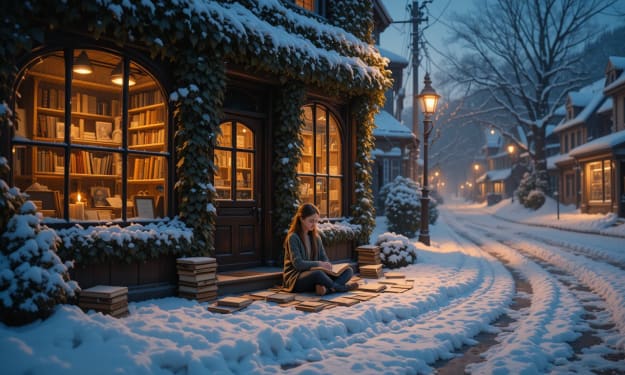
In the town of Frostvale, nestled in a valley where winter lingered like a guest who wouldn’t leave, books were a fading memory. Once, Frostvale had been a place of stories, its library a beacon for poets and scholars. But the mill closed, the trains stopped, and the library burned down in a freak fire when Esha was a child. Now, the townsfolk clung to routine—work, eat, sleep— their lives as gray as the snow that piled against their doors. Books were relics, stashed in attics or traded for firewood, their pages forgotten.
By Shohel Rana7 months ago in Fiction
1960’s Out Side Loo
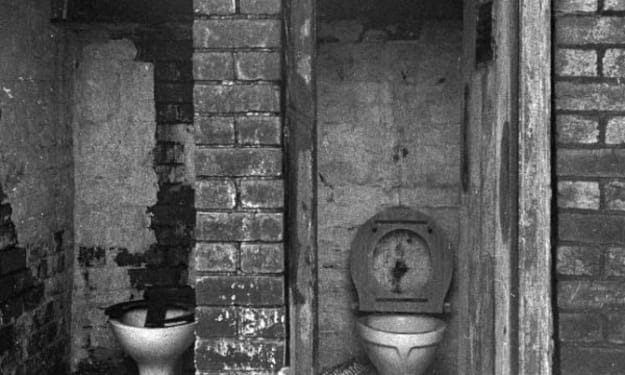
How often do we take for granted the comfort of the things we have in 2020? I remember my childhood and visiting my aunty and uncles with my Mam. I also have memories of living with my granddad in an old two-bedroom terraced house, the worst memory being the outside toilet (the loo to the younger readers). In some places we would visit, Mum would tell me beforehand, “Don't ask to go to the toilet; it's bloody filthy in there. You will catch something.”
By Marie381Uk about 17 hours ago in Fiction
Ludacris and Nelly draw backlash over bookings at MAGA-coded music festival
Ludacris and Nelly headlining a mostly right-wing event is good for them. It’s also great for the genre of hip hop. The two rap veterans have showcased their talents on other stages. Why can’t they perform for mostly MAGA folks and grab that bag?
By Skyler Saunders6 days ago in Beat


Comments
There are no comments for this story
Be the first to respond and start the conversation.