
She Built Her House from Paper Birds
Where Dreams Took Flight and Walls Whispered Secrets

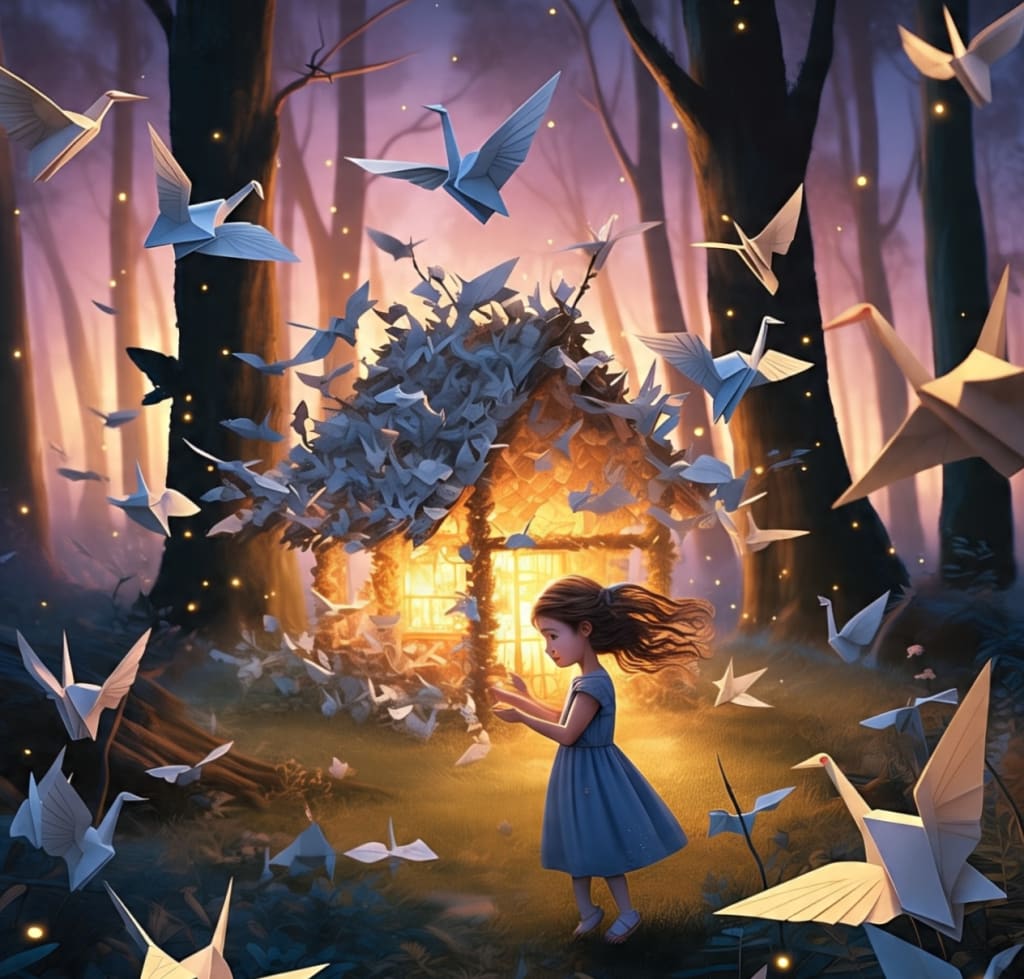
In a forgotten corner of a forest that was neither marked on maps nor touched by machines, there stood a house like no other—a delicate structure built entirely from paper birds.
It belonged to Elira, a woman whom the nearby villagers spoke of in whispers and wonder. Some claimed she had lost her mind after a great tragedy. Others believed she was a witch. The truth was far more intricate—like the folds in the wings of the birds she crafted.
Elira had once lived in the world beyond the trees, in a town filled with the noise of expectations and the concrete weight of sorrow. After her parents passed in a fire that consumed their family home, Elira was left with ashes and an aching silence. In that silence, she found her solace in origami—folding her pain into tiny paper birds. Each fold calmed her, each crease held a memory she couldn’t bear to forget.
One day, she walked into the forest and didn’t return.
But she didn't disappear. She transformed.
At first, she pitched a tent in a clearing where the light trickled down like golden threads. Every night, she folded paper birds—some large, some small, all carrying a story. Slowly, those birds began to stack around her, forming walls. She discovered that if she whispered to the birds while folding them, they remembered. She could still hear her mother’s lullabies echo in their wings, her father’s laughter fluttering beneath their tails.
And so, Elira built her house—not from stone or timber, but from memory and magic.
The walls were made of a thousand paper cranes, each one inscribed with dreams she’d once held. The roof was shaped by phoenixes, folded from crimson paper that shimmered like flames, shielding her from storms and sorrow alike. Her windows were open frames draped with strings of doves, white as clouds and always fluttering in the wind, yet never flying away.
Strangely, the paper never tore. Rain passed through without dampening a single wing. Snow melted before touching the eaves. The birds moved slightly, as if breathing, alive not in flesh but in purpose.
Children from the village would sometimes sneak into the edge of the woods to try and glimpse the house. Some said they saw the birds fly and return. Others claimed they heard music coming from the house, like a lullaby carried by wings. No one ever dared to enter.
Except for Mara.
Mara was a girl who had lost her voice after her brother died. Grief had stitched her lips with invisible thread. She wandered into the forest one autumn morning, chasing a paper crane that danced through the breeze. It led her, as if knowing her story, to Elira’s clearing.
The old woman opened her arms and welcomed Mara inside.
The paper birds did not judge. They whispered to her in quiet rustles, and in their presence, Mara didn’t need to speak. She simply listened.
Elira handed her a square of paper—sun-colored, soft to the touch. “Fold your feeling,” she said gently. “You don’t need words.”
Mara folded. Her fingers trembled, but with each crease, something inside her began to shift. She folded her sorrow, her loneliness, her memories. By the time the crane was finished, her tears had dried, and something lighter settled in her chest.
The bird flew from her palm and joined the others in the house, slipping perfectly into the eave as if it had always belonged.
That day, Mara found her voice not in speech, but in creation. She visited Elira every week, learning to fold her grief, her love, and her hope into birds that soared without wings. With each visit, her voice grew stronger, until one day, she laughed—and it echoed like bells among the paper walls.
Years passed. The villagers noticed changes. Children began folding cranes instead of throwing stones. Teenagers ventured into the woods not out of fear, but curiosity. Elira’s house became more than legend—it became a sanctuary.
Then, one spring morning, Elira folded a final bird.
It was black, made from paper that shimmered like midnight. She placed it at the peak of her roof and whispered, “Take me where I belong.”
As the wind picked up, the house of birds lifted into the air. Slowly, gently, it rose above the trees. The birds that made the house didn’t scatter; they carried it, as if honoring the woman who had given them purpose.
Mara stood in the clearing, tears on her cheeks—not of sorrow, but gratitude.
Elira was never seen again, but her legacy remained. The clearing became a place of pilgrimage for those carrying sorrow too heavy to bear alone. And Mara—now a grown woman—taught others how to fold their stories into paper birds.
They say if you’re quiet enough, you can still hear the rustle of wings in the wind—and the walls of a house that once whispered secrets, taking flight once more.
---
About the Creator
Mati Henry
Storyteller. Dream weaver. Truth seeker. I write to explore worlds both real and imagined—capturing emotion, sparking thought, and inspiring change. Follow me for stories that stay with you long after the last word.
Keep reading
More stories from Mati Henry and writers in Fiction and other communities.
TUS NUA - ch 53
TUS NUA – ch 53 New Beginnings – Mia and Midnight (*)(*)(*) Finola knew Ali’s brother-in-law needed to put his mind at rest. She fed her arm through his and led him outside. “We’ll sit here. If you like, I can put a block around us so our conversation will be private.”
By Margaret Brennanabout 21 hours ago in Fiction
The Flight That Sparked a Superpower Crisis
In the tense atmosphere of the Cold War, intelligence gathering was considered vital for national security. One of the most dramatic episodes in this shadow war occurred in May 1960, when an American U-2 spy plane took off from Peshawar, Pakistan, on a mission to photograph sensitive Soviet military sites. The flight ended in disaster when the aircraft was shot down deep inside Soviet territory, triggering a major diplomatic crisis between the United States and the Soviet Union and further intensifying their already hostile relationship.
By Irshad Abbasi 4 days ago in Fiction
Guard Your Battery
Why are some people so attractive just by standing there? It’s not because they are "likable," but because they don’t need everyone to like them. I realized later that truly charismatic people allow themselves to be criticized, but they never criticize themselves. They never try to please the world; instead, the world stops to watch them.
By Emily Chan - Life and love sharing5 days ago in Poets


Comments (1)
oh Fine ,, Hi support me.