

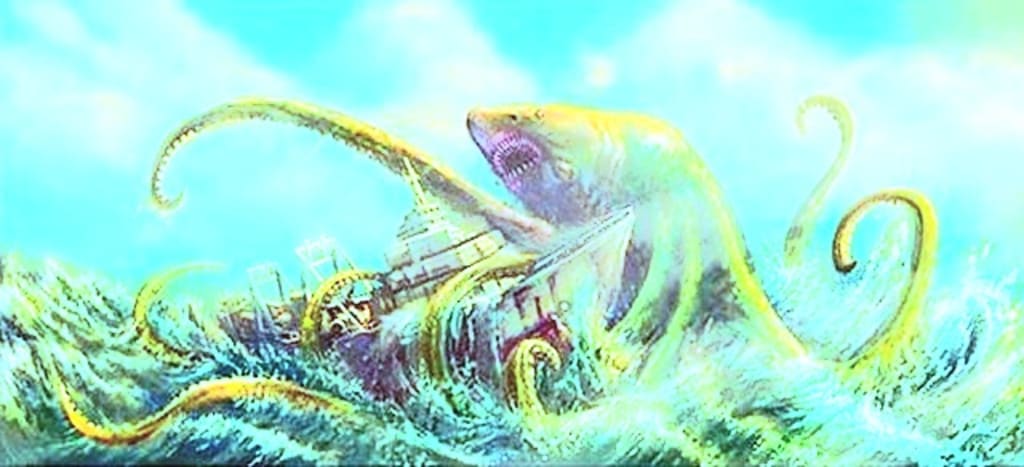
Sea monsters are mythical or legendary creatures that are said to inhabit the world's oceans, seas, and other bodies of water. These creatures have been depicted in various forms throughout history, from ancient folklore and mythology to modern popular culture.
Some sea monsters are described as huge, tentacled creatures with immense strength, such as the Kraken of Nordic mythology or the giant squid of modern legend. Others are more humanoid in form, such as mermaids or sirens, who are often depicted as beautiful and seductive but deadly creatures who lure sailors to their doom.
Despite their mythical origins, sea monsters have captured the imagination of people throughout history, and many legends and stories have been passed down through the ages about encounters with these creatures. While most modern scientists dismiss the existence of such creatures as purely fictional, many continue to be fascinated by the idea of sea monsters and their place in our cultural imagination.
ABOUT SEA MOSTERS IN THE SCRIPTURES:
Sea monsters have been described in various scriptures throughout history and across different cultures. These creatures are often depicted as enormous, frightening beasts that dwell in the depths of the sea and pose a threat to sailors and travelers.
In the Bible, the Book of Job describes a creature called Leviathan, which is often interpreted as a sea monster. The description of Leviathan is highly symbolic and metaphorical, but it is generally agreed that the creature is meant to represent the chaos and danger of the sea.
In Greek mythology, there are many sea monsters, including the Kraken, a giant squid-like creature that is said to drag ships and sailors to their doom. The Odyssey by Homer also features several sea monsters, including Scylla, a six-headed monster that devours sailors, and Charybdis, a whirlpool that can swallow entire ships.

In Norse mythology, there is a sea serpent called Jormungand, which is so large that it encircles the entire world and bites its own tail. It is said that when Jormungand releases its tail, it will signal the beginning of the end of the world.
Sea monsters have also been described in other cultures, such as the Chinese Dragon King of the Sea, the Scottish Loch Ness Monster, and the Native American underwater panther. While the descriptions and beliefs about these creatures may vary, they all share a common theme of the danger and mystery of the deep sea.
LEVIATHON : THE KING OF OCEAN
Above all of them The Leviathan is considered the most powerful, most terrifying, and most dangerous creature no human can stand in front of the LEVIATHON.

The Leviathan is a sea monster mentioned in the Bible, specifically in the book of Job. In the text, the Leviathan is described as a fearsome creature that cannot be tamed or defeated by humans. It is often interpreted as a symbol of chaos and evil, representing the uncontrollable forces of nature.
In some traditions, the Leviathan is also associated with Satan or the Devil, and is seen as a metaphor for the power of sin and temptation.
Outside of religious texts, the Leviathan has also been featured in various works of literature and art, where it is often depicted as a massive sea serpent or dragon-like creature. In some stories, it is portrayed as a fearsome beast that terrorizes sailors and sinks ships, while in others it is a more benevolent creature that can be befriended or even ridden.
Overall, the Leviathan is a fascinating and enduring symbol that has captured the imaginations of people throughout history.
I hope this story helps you learn something about the ancient sea mages. Follow me for more interesting stories like this. Thank you.
About the Creator
Jio jeba
I am a writer born brighter.😁💝
Hey everyone, I think you like my poems and lines, but I want to tell you the truth: I am using some AI to make every line of my poetry perfect.
Thank you, and have a nice day.
Bomb Strike
It was the year 2027, and the world never imagined something like this would happen. A missile struck the United States. But it did not hit where experts had expected. It was not Washington, New York, or Los Angeles. Instead, it struck a small coastal town somewhere in the northeastern United States, between Maine and Delaware. No one knew exactly where it landed, and no one understood why.
By Zakir Ullaha day ago in Fiction
Guard Your Battery
Why are some people so attractive just by standing there? It’s not because they are "likable," but because they don’t need everyone to like them. I realized later that truly charismatic people allow themselves to be criticized, but they never criticize themselves. They never try to please the world; instead, the world stops to watch them.
By Emily Chan - Life and love sharing4 days ago in Poets


Comments (1)
Good