


YouTube Audio Version
In the early 1960s, Stanley Milgram conducted experiments to see whether people would continue to inflict painful electrical shocks if ordered to do so. This fictional story draws inspiration from that experiment. However, none of the characters or events are meant to represent what occurred.
Robert answered an advertisement asking for subjects to participate in a memory experiment. He wanted to use the money to buy his wife, Jill, a dozen red roses for their anniversary. As he sat in the waiting room, he imagined the moment he’d present her with the bouquet: Jill would beam with delight, throw her arms around him, and give him a long, heartfelt kiss. He rarely splurged on something so extravagant, but Jill adored flowers—especially roses.
When the staff finally escorted him into the lab, Robert was struck by how professional everything looked. The researchers wore white coats over dress shirts and ties. A large scale sat in the corner, and the offices were pristine. But the experiment itself was peculiar: he was instructed to administer a series of increasingly strong electric shocks to another participant in the next room every time that person answered a question incorrectly. Robert couldn’t see how this would improve anyone’s memory, but he trusted that the professors knew what they were doing.
Robert thought, that’s why they’re teaching at a university, and I’m just a simple bricklayer.
The third time Robert pressed the switch, he heard a low groan from the other side of the wall. Alarmed, he glanced at the administrator, but the man showed no concern.
“Hey,” Robert said. “You might want to check on the other guy.”
“Please continue,” the administrator replied calmly.
Robert swallowed hard and asked the next question. When the subject got it wrong, Robert administered a higher-level shock. This time, the groan was louder.
“I think he might be hurt,” Robert said. “You better check.”
“The experiment does not cause permanent damage,” the administrator said. “Please continue.”
Robert followed instructions, and with the next three shocks, the subject’s cries escalated to full-blown screams. Robert’s hand was trembling, and beads of sweat formed on his forehead. He turned to the administrator again. “I don’t know about this. I think that guy has had enough.”
“Please continue.”
Robert shook his head. “I’m telling you—this ain’t right.”
“I take full responsibility,” the administrator said. “Please continue.”
“You take responsibility; this is on you?” Robert glared at the administrator and wiped his brow.
“I take full responsibility. Please continue.”
Robert delivered two more shocks, each one punctuated by agonized screams from the other room.
“I’m stopping.” Robert put his hand on his own chest; his heart was racing.
“The experiment requires you to continue.”
Robert’s hand trembled, but he pressed the switch again. The subject let out a piercing scream, begging for it to stop.
“Did you hear that! He wants to quit.”
“You must continue. I take full responsibility.”
Robert bit his lip and administered the final, highest-voltage shock.
“That concludes the test,” the administrator said.
“I can’t believe you made me do that.” Robert’s head sank, and he slumped in his chair.
The door to the other room opened, and a man came out smiling. He patted Robert on the back.
“I’m sorry. I don’t know why I kept going,” Robert said. “Are you okay?”
“Relax, I’m an actor. None of those shocks were real.”
Robert’s eyes widened. “Oh, thank god. I thought I was hurting you real bad.”
“You were the subject of the experiment,” the administrator said.
Robert glared at the administrator. “You guys put me through hell. I hope it was for a good cause.” Robert glanced at the other man. “Are you sure you’re okay?”
“All play-acting. I’m fine.”
The administrator made a few notes and said, “We were testing how far you were willing to go.”
“I guess I failed.” Robert lowered his head and bit his lip.
“There is no failing. We are studying human nature. You did fine.” The administrator handed Robert his money.
“It doesn’t feel that way.”
#
Robert sat in his car for an hour. If you had asked that morning if he would ever do anything like that, he would have said never. But he did it; he objected a few times, but he did it.
Buying the roses for Jill cheered him up, and he had a big smile when he walked into the kitchen and said, “Happy anniversary.”
It was just as he had imagined; Jill’s face lit up, and she threw her arms around him. She kissed him several times and stood in the middle of the kitchen, hugging her husband.
“Robert, the flowers are beautiful. But how can we afford them?”
With Jill’s arms still around Robert, he told her the whole story. As the story went on, Jill’s embrace of him weakened, and halfway through, she let go of him and took a step back.
“It’s okay, honey. I felt bad at first. But seeing you so happy, it was worth it.”
“Robert, I don’t know how I feel about this. Even though he was screaming you kept going?”
“I had to for the experiment. And he was only acting.”
Jill took a few steps back. “What if it was me? Would you have done what you were told?”
“Of course not.” Robert tried to hug Jill, but she pushed him back. “Let’s put the roses in water. Aren’t they beautiful—just like my wife.”
“I can’t take those flowers after what you did to get the money.”
“Honey, I felt bad about it. But it was a scientific study. No one got hurt.”
“Robert, how could you do something so cruel?”
“I don’t know. It surprised me, too. But they kept saying I had to continue. And I agreed to do it.” Robert’s eyes glassed over. “Please don’t look at me like that. I did it for you.”
Jill ran out of the room.
#
Robert drove back to the college and went to the professor’s office. He had the roses with him. The professor was about to leave.
“Are you a student of mine? If so, my office hours are over. You can stop back next Tuesday.”
“No. I’m not a student. I’m a subject from your memory experiment.”
“I have an administrator running that experiment. I trust he paid you.”
“Do you know what’s going on with that experiment?”
“Of course I do. I watch every session through a one-way mirror. I recall you now.”
“Do you recall me asking if I should stop? Do you recall my hand shaking? Do you recall me sweating?”
“All perfectly normal reactions. Most of the subjects exhibit high levels of stress.”
“With the money, I bought these flowers for my wife.” Robert threw the flowers on the professor’s desk. “She doesn’t want them. She thinks I’m a monster.”
“We have gotten a few reports like that. We are going to advise the subjects not to discuss the experiment with their wives. It’s really quite fascinating. Well, I must be going.”
“That’s it. What do I tell my wife.”
“Tell her that most subjects complete the experiment. You are no different than the majority of people. I must be going.”
“Would you go all the way? If you thought you were inflicting pain, would you stop?”
“If people are asked beforehand. Most say they will stop, but few do. Myself, I believe I would not get past the first few levels.”
“But you sit behind your one-way mirror, watch people in distress, and let it continue.”
“That’s different.”
“How?”
“I’m doing it for science.”
“So, the ends justify the means.”
“I didn’t say that. I have a responsibility to the University to complete the experiment.”
“The only difference is that you have a different master than your subjects.”
“You’re twisting my words. I want you to leave my office. And take your flowers with you.” The professor handed Robert the roses and turned toward the door.
Robert tossed the roses in a trash can and watched the professor rush out of the building.
Stanley Milgram’s experiment remains controversial. It led to a careful examination of the ethics involved in human studies.
About the Creator
Steve Lance
My long search continues.
Keep reading
More stories from Steve Lance and writers in Fiction and other communities.
Veil of Subconscious Awakening
Images slide behind my eyelids like film cadres, bursting with meanings. In one moment, I’m speeding down the highway, making the speedometer swing wildly like a frantic pendulum. The next moment, I’m plunging from a falling plane, slowly crashing earthward. At home, I meet black cat’s green, googly eyes staring at me from the cavernous hollowness of the kitchen. When I turn for a moment, it disappears, and all I can see is a pair of blue suede shoes set up against the wall. I pick them up and put them on. When I glimpse at them again, they’ve become black as night, making me blink and flinch.
By Moon Desert7 days ago in Fiction
The Men in Black
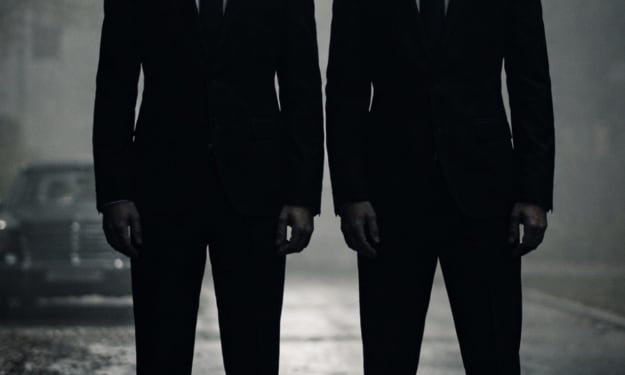
The Men in Black The first time I saw them I thought it was a joke. Two men in black suits perfectly pressed standing in the shadows of the streetlamp outside my apartment. I had never seen them before. No one had. And yet there they were waiting. Their eyes were flat too calm like they had seen everything and nothing at once.
By Marie381Uk 3 days ago in Fiction
When the Shelter Closes
Across the street from my house, a man slept under a tree, his dog by his side. My first, naive thought: he must be traveling through. But he kept coming back, often sleeping there during the day. Then it hit me—that person might not have a home.
By Bride of Sound4 days ago in Humans



Comments
There are no comments for this story
Be the first to respond and start the conversation.