
Robinson Crusoe
The OG Influencer Who Invented Isolation Before It Was Cool
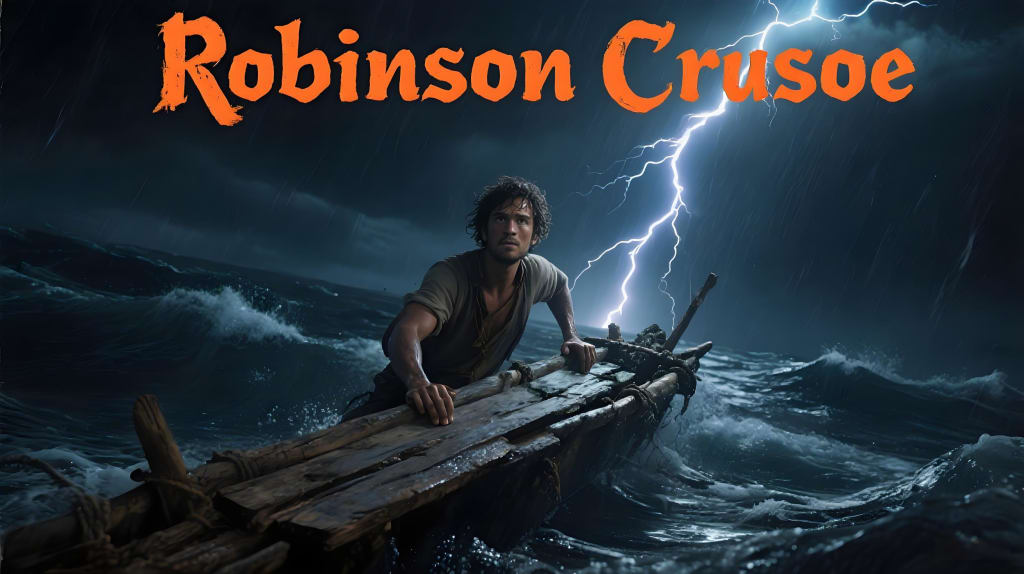
A Stand-up Style Satirical Review of Daniel Defoe's Classic
Ladies and gentlemen, gather around. Today we’re diving into the literary treasure chest to talk about a man who did social distancing before it was trendy. A guy who turned being shipwrecked into a full-time lifestyle brand. Yes, I’m talking about none other than Robinson freaking Crusoe — the ultimate minimalist, survivalist, and unintentional king of island-core aesthetics.
Let’s get this straight: Crusoe wasn’t stranded. He was freelancing.
Chapter 1: The Dude Had Red Flags From Page One
So Robinson’s first bright idea was to run away to sea… even after his dad gave him the classic “middle-class stability” TED Talk.
His dad: “Son, stay here. Be average. Live a balanced life.”
Crusoe: “Hmm, average sounds boring. Let me go almost die on a boat instead.”
This man rejected middle-class comfort the same way millennials reject 9-to-5s — loudly, with ambition, and without insurance.
Chapter 2: And Then He Said, “Let’s Do Colonialism!”
After a series of bad life choices (a.k.a. pirate kidnappings, slavery, and investing in Brazilian plantations), Crusoe ends up on an island because his ship pulls a Titanic. And what does our man do? He immediately claims the island. No Google Maps, no Zillow, no native consultation — just pure British confidence.
If white male entitlement were a sport, Crusoe would have gold medals in every event.
He builds a hut, fences in animals, bakes bread, and basically colonizes the entire beach like it's his personal WeWork. Who knew colonial capitalism starts with a coconut and some PTSD?
Chapter 3: Cast Away, But With Less Volleyball and More Guns
Let’s be honest — this book is Cast Away with fewer emotions and more gunpowder. Robinson Crusoe builds furniture, tames goats, reads the Bible (obviously), and writes in his journal because he’s both lonely and extremely into content creation.
He’s basically the original YouTuber:
Title: “I Survived 28 Years Alone on an Island — You Won’t Believe What Happened Next!”
Thumbnail: Him holding a musket, shirtless, with a coconut wearing sunglasses.
Sponsored by: British imperialism.
Chapter 4: Enter Friday — The First Unpaid Intern in Literature
Then comes Friday, aka the guy who saves Crusoe’s life and immediately signs up for a lifetime subscription to being a sidekick. Friday doesn’t question anything. He just agrees to everything Crusoe says, like an iPhone user accepting Terms & Conditions.
Crusoe teaches him English, Christianity, and how to say “Yes, master.” I mean... was there an HR department on the island? Because Friday deserves at least dental.
It’s basically the origin story of every problematic white savior film ever made.
Chapter 5: 28 Years of Solitude or: How I Learned to Love My Own Voice
The man spends twenty-eight years alone and somehow never questions his sanity. Me? I spend 28 minutes alone and start talking to my fridge. But Crusoe? He’s journaling, farming, and practicing colonialism like it's his therapy.
By the end of the book, he’s created a tiny, problematic civilization with him as the CEO, Friday as the unpaid intern, and some goats as middle management.
Chapter 6: Inspirational Takeaways (a.k.a. the Chicken Soup Part)
Now, here comes the 35% chicken soup moment:
Robinson Crusoe may be a walking red flag of imperialist ideology, but he also shows something strangely powerful: human resilience. He’s proof that even when you’re left with nothing — no Wi-Fi, no takeout, no TikTok — you can still build something.
He’s messy. He’s a bit of a colonizer. Okay, a lot. But he survives. He learns. He adapts. And maybe that’s why we still read him today.
Because deep down, every one of us has our own desert island — a situation where we feel stranded, lost, out of place — and we wonder: “What do I do now?”
Crusoe’s answer is: "Start building. Just don’t forget to bring your goat."
Final Thoughts: Should You Read This Book?
Absolutely. Just remember:
It's not a vacation novel.
It’s got more theology than Tinder.
And it has more imperialism than an 1800s history textbook.
But it also has one man who tries (and fails, and tries again) to make life work with nothing but grit, guilt, and an unreasonable amount of rope.
Read it for the chaos. Read it for the cringe. Read it so you can feel better about not doing your laundry for three days. Because at least you didn’t try to conquer a beach.
Robinson Crusoe: The ultimate vibe of “I’m not lost. I’m just... exploring aggressively with colonial undertones.”


Comments
There are no comments for this story
Be the first to respond and start the conversation.