
REVOLUTION OF HEARTS
And thus, in a world divided by caste, love is sacrificed, leaving only the echoes of a love that can never be.


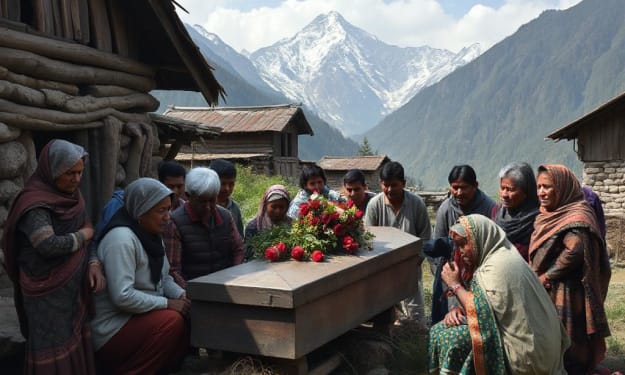
In the heart of a small, rural village in Nepal, under the shadow of the monarchy’s harsh rules, two souls are bound by love but torn apart by the walls of society. It is the 1950s, and the caste system rules every aspect of life. The idea of love beyond one’s birth is still a distant dream.
Laxmi Neupane is the epitome of grace and beauty, the beloved daughter of a wealthy Brahmin family. Her family commands respect, their house filled with opulence, and their place in society remains unshakable. Laxmi’s future is mapped out for her — an arranged marriage to a man of her caste, a life dictated by duty and tradition. She is a prisoner of her own privilege, her dreams of love tightly bound by the expectations placed upon her.
Across the village, Bhim Bahadur Sarki, a young man from the Dalit community, lives a life far removed from Laxmi’s. His family crafts weapons — an occupation considered dirty and degrading by the Brahmins. But Bhim’s mind is sharp, his ambitions vast. Unlike many of his caste, he refuses to accept the confines of his social position. He is drawn to the ideas of revolution, of change, of a future where people like him can live without fear, without shame. But above all, Bhim is bound by a love he can neither escape nor embrace.
From childhood, Laxmi and Bhim have shared a quiet love. They play in the fields, sharing laughter, and dreaming of a future that feels as distant as the mountains themselves. They never speak of it — the love that can never be. They know the rules. Laxmi’s world is one of Brahmin privilege, and Bhim’s is one of untouchability. Even as children, they know that no matter how deep their feelings run, they can never cross the boundary set by caste.
As they grow older, the world around them grows colder. Laxmi’s family begins preparations for her arranged marriage, a union with a well-to-do Brahmin boy who fits the mold of what is expected. Laxmi, bound by duty, tries to suppress the love that has bloomed in her heart for Bhim, but the harder she tries, the stronger the ache becomes. She can never have him. She can never defy the family she loves.
Bhim, on the other hand, becomes more restless. His involvement in the growing underground resistance movement against the Panchayat is his act of defiance, his protest against the world that seeks to keep him in his place. He wants freedom, and he wants to be with Laxmi. He dreams of a time when the chains of caste will be broken, when love can exist without the heavy hand of society crushing it. But he knows it is a dream, a dream that can never come true.
The tension between love and duty becomes unbearable for both. Bhim, torn between his loyalty to the revolution and his love for Laxmi, finds himself entangled in dangerous situations. The authorities are closing in on him, and the weight of his love for her becomes a bitter reminder of the life he can never have.
Laxmi, watching from the sidelines, knows what is coming. Her family finds out about her feelings for Bhim, and the storm of anger and shame breaks upon her like a thunderclap. The villagers, led by Laxmi’s family, ostracize Bhim. The Brahmin elders threaten to excommunicate her family, casting them out of the village forever. The whispers of shame grow louder, and Laxmi’s world begins to unravel.
Then comes the breaking point. The village elders, desperate to protect their status and reputation, offer Laxmi a choice: marry the man chosen for her or watch Bhim die. The threat is clear — if she defies her family, they will destroy him. Her love for Bhim is clear, but so is the ruthless power of caste. In that moment, Laxmi realizes that her love is not enough to overcome the world that binds her.
With a heart shattered by duty, Laxmi agrees to marry the man her family has chosen for her. She sacrifices her heart, her love, for the sake of her family and the man she will never love. The wedding is arranged, the dates set, and as the day approaches, Laxmi’s heart turns to stone. Bhim, knowing he can never change her fate, disappears into the revolution, his heart breaking as he vanishes into the night.
The day of the wedding arrives, and Laxmi stands at the altar, dressed in the finery of her family’s choice. The man beside her is a stranger, a man she does not love. But her mind is not on him; it is on Bhim, who will forever remain a distant dream, a love unfulfilled.
As she looks out at the crowd, Laxmi feels the weight of her decision. She has lost everything — her love, her future, and the one person who has made her believe in the beauty of love beyond caste. The wedding is not a celebration, but a funeral for a dream that has never stood a chance.
In the silence of her heart, Laxmi whispers the words she can never say aloud: "I love you, Bhim. Always."
And thus, in a world divided by caste, love is sacrificed, leaving only the echoes of a love that can never be.
About the Creator
Roshan Chauhan
Writer chasing meaning through story. I share fiction, personal musings, and ideas that linger. If it makes you feel or think, I’ve done my job.
Keep reading
More stories from Roshan Chauhan and writers in Fiction and other communities.
THE PRICE OF HOPE
The morning sun bathed the terraced hills of the village in golden light. Fields of ripening maize stretched across the slopes, and small houses made of stone and mud dotted the landscape. The village, isolated from the bustling cities of Nepal, was quiet except for the occasional chirp of birds and the soft breeze that swept through the valley. For as long as anyone could remember, this land had been a place of toil, of simple living, and, for many, of silent despair.
By Roshan Chauhan11 months ago in Fiction
Bomb Scare
It was 2027, and the world never thought it would happen. A missle hit the United States, but it wasn't where they had anticipated. A little town in the northeast was hit by a missile strike, they didn't know why, and they didn't know exactly where it hit, but they did know it was a coastal community, somewhere between Maine and Delaware.
By Gregory Payton7 days ago in Fiction


Comments
There are no comments for this story
Be the first to respond and start the conversation.