
Red Star Kachina
A father's letter to his daughter, after the deluge.
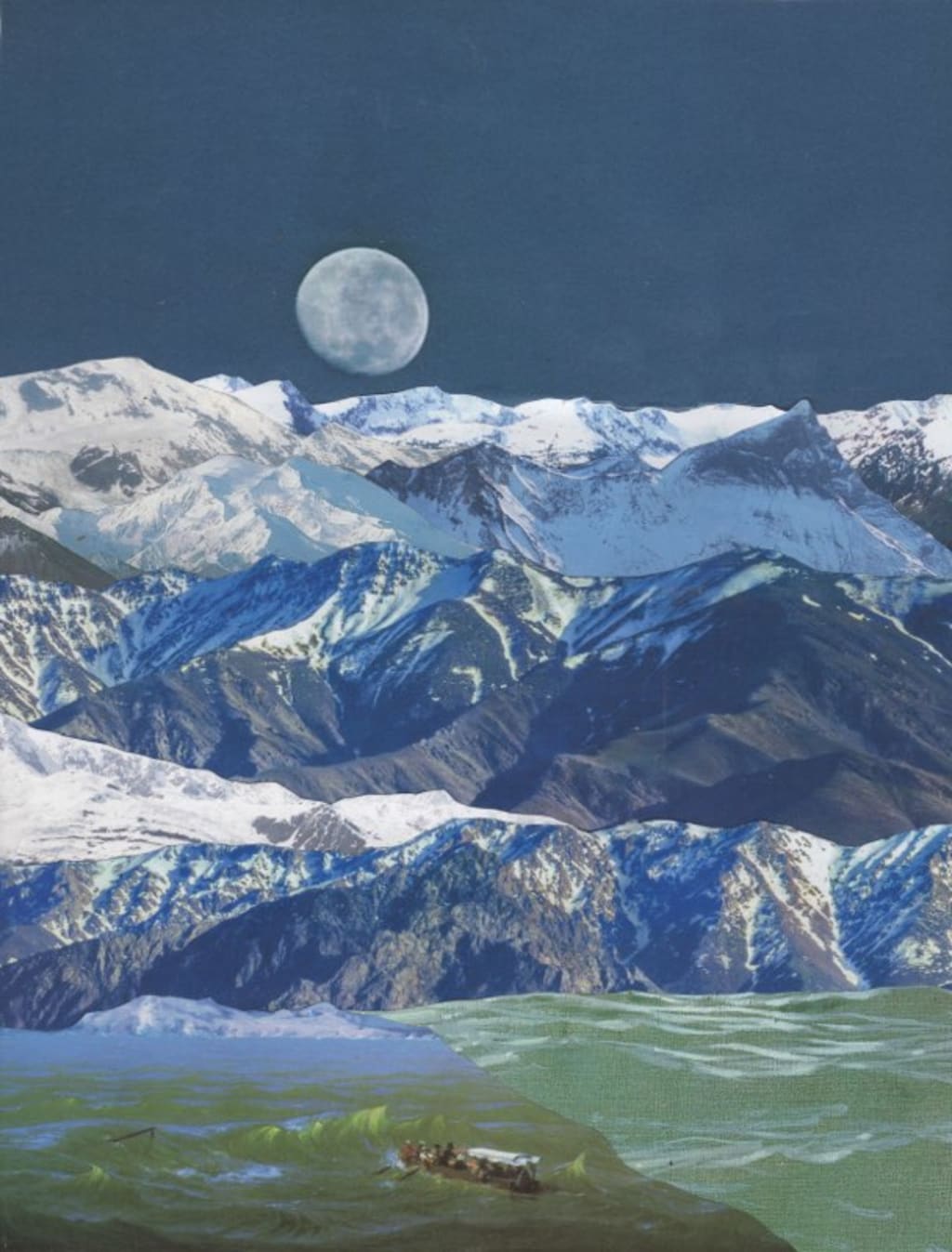
I hope you never read this.
I hope that by the time you’re old enough to understand what these words mean, I’ll be the one to have taught them to you. I hope that when you think of Dr. Gonsalves, it’s as the nice old man in the turtleneck who lives down the hall. I hope that if you ever do hear about this mission, you’ll understand why I had to take such a risk.
That’s the thing about hope. The more absurd it becomes, the more you find yourself talking about it.
You’re going to hear that this was all inevitable. That the Earth was always going to get warmer; that the permafrost was always going to melt; that if not the Casaubon expedition, some other team of polar scientists would have discovered the prehistoric plague oozing out from the thermokarst; that if not Craig Howlett, some other member from the expedition would have broken quarantine and become patient zero for the Easter Virus.
Well, it wasn’t. None of it was, no matter how comforting it may be to chalk everything up to fate instead of our own choices. It didn’t take a prophet to see what was going to happen. We all watched Hurricane Esteban obliterate Manila and Jakarta in the span of a few days. We allowed the new aristocracy to flee from Silicon Valley, Manhattan, and D.C. to their mountain fastnesses in Colorado, New Zealand, and Chile, while encampments that sprawled for miles outside every major inland city grew larger with each passing day. When South African border guards opened fire on refugees from Senegal and Nigeria, we told ourselves that it couldn’t happen here. When U.S. troops trained their guns on the famine caravans from the south, when they unleashed the hunter-killer fleet against rescue boats in the Pacific, we convinced ourselves it was a brutal necessity. Then they turned the drones on striking workers, on the March for Water protests, on seemingly any group with an “anti-growth agenda.” For most of my adult life, it felt like all I could do was bear witness.
By the time we lost Louisiana and Florida, you couldn’t have scripted better conditions for a pandemic. So many people huddled into so little space, with practically zero infrastructure and at best makeshift sanitation. Your mother can explain the details when you’re older, but suffice it to say that what the virus began, the decontamination protocols finished. If there’s a silver lining, it’s that the situation broke down too quickly to go nuclear. Dr. Fournier estimates that there might still be a few million of us left.
This is where I have to brag about your mother, since God knows she won’t do it herself. The Hermitage would still be an idle dream without her. She spent years recruiting sympathetic scientists, securing the dead tech we used to collaborate, masking our communications, expropriating the funds we needed to build the facility, and convincing the architect, Svensen, to oversee its construction. Your home may not look like much—a bunch of reinforced concrete tunnels, labs, and gardens in the heart of a mountain—but it’s almost as much of a miracle as you are. Your friends and neighbors are the world’s brightest minds in hydroponics, water filtration, medicine, food preservation, solar and electrical engineering, geophysics, botany, and about a dozen other fields. Along with their families, they managed to navigate through the chaos to make it to the rendezvous undetected. We’d done the impossible. We'd finished Phase One intact.
And then, a few days ago, we received a message from Dr. Gonsalves, the man who developed the first COVID-35 vaccine. He was at the top of your mother’s initial list for the Hermitage, but back then he told us he couldn’t risk moving his lab, not even when the Easter Virus reached Seattle. Now he was requesting evacuation from his research facility at Bell Station. We debated his plea for hours, but in the end, it was the historian who asked the obvious question of these scientists: if we sequester ourselves in this glorified bunker without any goal but waiting out the apocalypse, how are we different from the trillionaires in their isolated fiefdoms? Nobody had an answer for me.
Your mother fought like hell to keep me from volunteering, but I know she understands why I have to go. As much as I’ll advocate for the value of a liberal arts education, I’m expendable compared to people like her. And as gifted as the Hermitage’s microbiologists are, we need a virologist of Gonsalves' caliber if we ever hope to develop a vaccine. Svensen and O’Neal’s husbands volunteered to round out the team. They’ve both received the same arms and survival training as I have, and from a practical knowledge standpoint, they're as expendable as I am. We call ourselves the Plus-Ones.
The three of us aren’t far now. We sleep by day and travel by night, which entails its own risks. A few days ago, somewhere outside of Spokane, I barely caught O’Neal before he slipped into a mass grave two stories deep. We’ve been lucky, though. We’ve only spotted one drone so far, and our equipment—purifiers, rebreathers, filters, batteries—is still functioning optimally. God willing, so is everything in the pack we brought for Gonsalves.
Whenever we stop to rest, I check the signal from Bell Station. I stare and wonder if the indicator light will stop blinking. I wonder if the virus will get there before we do, and if Gonsalves will do the right thing if that happens. I focus on the signal until my eyes go blurry and my thoughts recede into my stomach and I can pass out for a few hours. When I wake up, I think of you.
There are so many things I want to share with you, sweetheart. Bowie, Rilke, Ellington, Le Guin, Butler, Baldwin. Marx, if your mom will let me. I want you to know that there was magic and wisdom in the old world, enough to outshine the horror, at least for a while. But I have to do this first. Before I met your mother, I spent my entire life alone, isolated, a helpless spectator. I’m through bearing witness. I’ll do everything it takes to give you a chance at life in the sunlight.
If...if you do end up reading this letter, though, I have a few things to ask of you. Unfair, I know. First and most importantly, take care of your mother for me. She’s been strong enough to build this ark, but she’s going to need all the love you can give her. Enjoy the blueberries whenever she brings them home from Hydroponics. They’re her favorite, and it means more than you know.
Second, be kind. You’re going to grow up surrounded by some of the smartest people alive, and I know you’re destined for special things. But the Hermitage is going to require plenty of kindness and decency to go along with all the brainpower, or else we’ll end up right back where we started. Have the courage to be gentle. Have the strength to forgive. That may sound easy enough. Believe me, it isn’t.
Third is something I want you to remember. Something you have to remember. I don’t have much in the way of worldly treasures for you to inherit, and my knowledge pales in comparison to the others’. Consider this my family bible, my handcrafted antique, my heart-shaped locket to give you. It’s a simple fact: before we ruined it, people made this world. People can make another one. A better one.
I love you, Kachina. I always will.
About the Creator
Walter Lane
I'm a writer in Birmingham, Alabama.
Keep reading
More stories from writers in Fiction and other communities.
Lavender Orphan Love Spell
Bertie The children at Chandler Home Orphanage were not allowed to talk to the gypsies. It had been over a year since the last time they set up their caravan at Anson's Rock in the woods south of the Chandler Home campus. That was the spring of 1922.
By John R. Godwina day ago in Fiction

Comments
There are no comments for this story
Be the first to respond and start the conversation.