

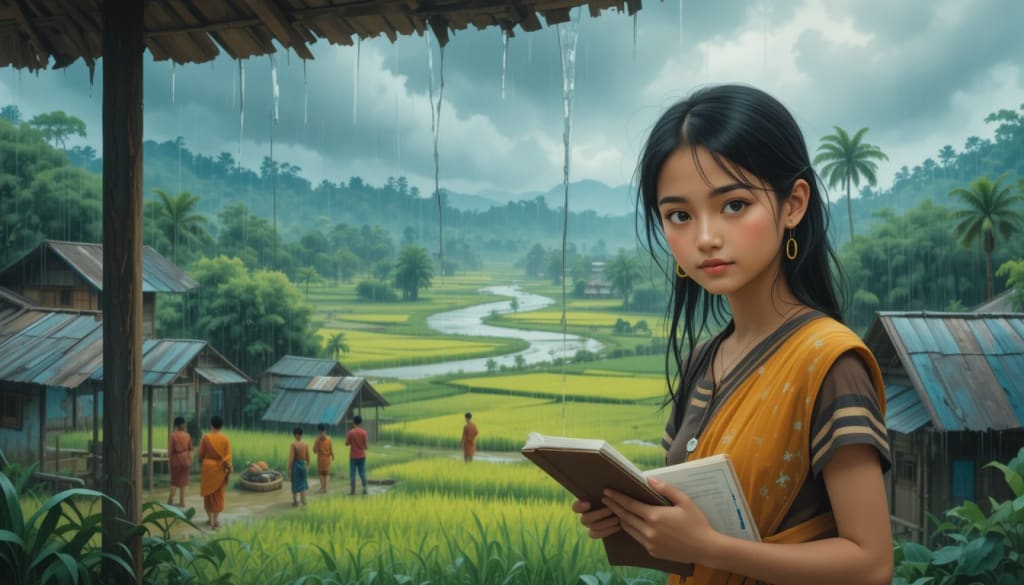
In the monsoon-soaked village of Shantinagar, Bangladesh, in 2024, the rain was both a blessing and a curse. For 16-year-old Runa, it was the rhythm of her life—each drop on the tin roof of her family’s small home a reminder of their fragility and resilience. The rains brought life to the rice paddies but also threatened to wash away everything her family had fought to hold onto. This is the story of Runa’s quiet courage, her dreams, and the community that became her shelter.
Runa lived with her mother, Ayesha, and younger brother, Imran, in a modest house on the edge of the village. Their roof, patched with plastic and hope, leaked during the heaviest storms, forcing them to sleep under umbrellas and pray for clear skies. Ayesha worked as a seamstress, her fingers calloused from stitching jute sacks, while Runa balanced school, household chores, and dreams of becoming a teacher. Her father had left years ago, chasing work in Dhaka, and his absence was a wound they rarely spoke of.
Shantinagar was a place where survival demanded grit. The village, nestled between the Brahmaputra River and sprawling wetlands, faced yearly floods that tested its people. Yet, it was alive with color—women in vibrant saris, children chasing kites, and the call to prayer mingling with the patter of rain. Runa loved the chaos of it all, but she carried a weight: the fear that her family’s fragile roof, both literal and metaphorical, might collapse under the next storm.
Her refuge was the village school, where Ms. Farida, a kind but stern teacher, saw Runa’s potential. “You have a sharp mind,” Farida told her, handing back a dog-eared copy of Tagore’s poems. “Don’t let the rain drown your dreams.” Runa clung to those words, scribbling her own poetry in a notebook she hid under her mattress. Her verses spoke of rivers that carried hope, of roofs that held despite the storm.
One evening, as the monsoon raged, Runa met Tariq, a 17-year-old fisherman’s son who delivered fish to the market. His easy smile and stories of the river drew her in. Tariq dreamed of studying engineering in Chittagong, but his family’s boat, their livelihood, was rotting from years of wear. “The rain gives us fish but takes everything else,” he said, helping Runa patch her roof during a rare break in the clouds. Their friendship grew in stolen moments—shared mangoes under a banyan tree, laughter over Imran’s antics, and quiet talks about futures they barely dared to imagine.
The village faced a crisis when the river swelled, flooding homes and fields. Runa’s house was spared the worst, but the school wasn’t. Its roof caved in, scattering books and desks in muddy water. Farida rallied the community, but funds were scarce. Runa, heartbroken at the thought of losing her sanctuary, proposed a plan: a fundraising event with poetry readings, music, and a market stall to sell Ayesha’s stitched goods. Tariq offered his family’s boat to ferry supplies, his hands steady despite his own worries.
The event was a gamble. Runa, shy but determined, stood before the village, her voice trembling as she read her poem, “Raindrops on a Fragile Roof.” It spoke of resilience, of dreams that held fast like the roots of a mangrove. The crowd—farmers, weavers, children—listened in silence, then erupted in applause. Ayesha’s eyes glistened with pride, and even Imran, usually restless, sat still. The event raised enough to start repairs, but more importantly, it wove the village closer together.
But the rains didn’t relent. A late-season storm hit, fiercer than any before. Runa’s roof finally gave way, water pouring in as Ayesha scrambled to save their belongings. Tariq arrived, soaked and breathless, with neighbors in tow. They worked through the night, moving Runa’s family to the community center and salvaging what they could. In the chaos, Runa found her notebook, its pages soggy but intact. She clutched it, a symbol of her unbroken spirit.
The storm’s aftermath revealed deeper cracks. Tariq’s boat was damaged beyond repair, crushing his family’s income. Runa, seeing his despair, shared her earnings from the fundraiser, insisting they rebuild together. “We’re like the mangroves,” she told him. “We bend, but we don’t break.” Tariq, moved by her kindness, vowed to help her family in return.
With Farida’s guidance, Runa applied for a scholarship to a teaching college in Dhaka. Her application included her poetry, each line a testament to her roots and resolve. When the acceptance letter arrived, the village celebrated, their cheers louder than the rain. Ayesha, once skeptical of Runa’s dreams, stitched her a new bag for the journey, her hands trembling with emotion. “You’re our roof now,” she whispered.
In 2025, Runa stood at Dhaka’s train station, her bag slung over her shoulder. Tariq, who’d found work repairing boats, saw her off. “Write about the river,” he said, grinning. “And come back to fix our roofs.” Runa laughed, promising to return. As the train pulled away, she watched the rain streak the windows, each drop a note in the symphony of her survival.
Shantinagar’s fragile roofs still stood, patched by community and courage. Runa’s story, like the rain, was both gentle and fierce—a reminder that even the most delicate structures could endure with love and grit.
About the Creator
Shohel Rana
As a professional article writer for Vocal Media, I craft engaging, high-quality content tailored to diverse audiences. My expertise ensures well-researched, compelling articles that inform, inspire, and captivate readers effectively.
Keep reading
More stories from Shohel Rana and writers in Fiction and other communities.
The Lizard Man's Tale
In the heart of the Louisiana bayou, where the cypress trees draped their moss like mourning veils, the legend of the Lizard Man whispered through the humid air. It was 2025, and the small town of Bayou LaCroix clung to its secrets as tightly as the swamp held its waters. This is the story of Eli, a young journalist, and the enigmatic figure known as the Lizard Man, whose tale would unravel the town’s hidden truths.
By Shohel Rana7 months ago in Fiction


Comments
There are no comments for this story
Be the first to respond and start the conversation.