


The first night the board came out, the house was a jar with its lid twisted loose.
We’d eaten cereal on the couch because Mom couldn’t bring herself to dirty a pan, then washed the bowls while our feet slid on the linoleum where the dishwasher had once dripped. Dad would have fixed the leak without YouTube, without a manual, just a wrench and that chuckle that warmed the kitchen more than steam. The month after the funeral, the maintenance man replaced the gasket and offered condolences like a coupon. The leak stopped, but the kitchen was still cold.
Mom went to bed early she said her eyes were burning. I knew she meant her memories. I sat up with the TV on mute and scrolled old photos of him grinning in his navy sweatshirt, cheeks windburned from Little League practices where he pretended to be a dragon and chased me and my friends around the dugout. I watched the slideshow until my throat felt like a knuckle and the house settled into that late hush where pipes whisper and wood speaks its hidden language. The kind of quiet that has a pulse under it.
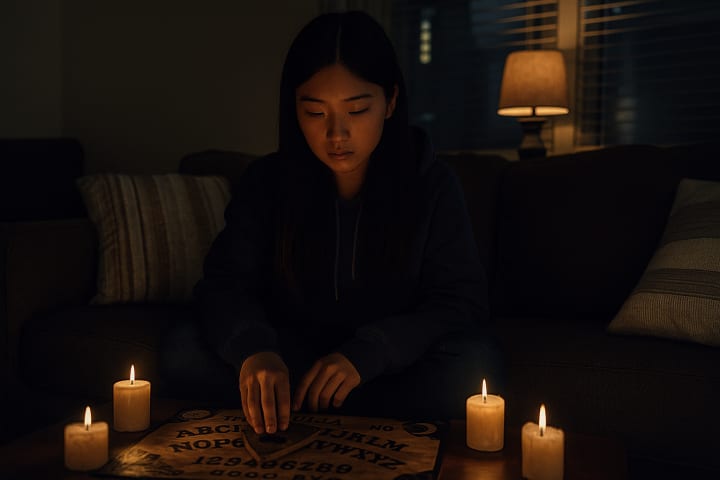
The Ouija board had been a joke at first. Macy brought it over in a tote bag with gummy worms and one of those sour sodas she knew my mom hated. “Late-night séance,” she whispered, waggling her eyebrows. “We’ll ask your dad if there’s Wi-Fi in heaven.” I can tell she was uneasy about it but she didn’t bother me about it “Funny,” I said, but I took it from her, my fingers tracing the alphabet, the moon, the sun, the YES and NO like they were braille. When she went home, I slid the board under the couch. The first night I used it alone, Mom’s room snored with the white noise machine, and I could hear the faint rush of her breath beneath it like a river under ice. The board went on the coffee table. I turned off the TV because it made the room too crowded; just the lamp over my shoulder and the streetlight drawing squares on the floor through the blinds.
I placed the planchette on the board, a heart-shaped lens with its little glass eye. “Dad?” I whispered, and my breath fogged the glass. “If you’re here… I just want to know if you’re okay.” Silence answered me, the kind that makes you realize silence is never true. My fingers rested on the planchette. I didn’t push. I didn’t even want to push. I wanted to be pulled.
“Can you knock,” I said, half-embarrassed, half-dead serious, “so I know it’s you?”
Nothing.
Nothing, and then three soft taps from the wall behind the couch. Not the house settling. Not a pipe. Not the random tick of baseboard heat. These had a rhythm. A shape to them. Small knuckles testing a door. I froze so hard my bones creaked louder than the sound.
“Dad?” My voice broke open. “Dad, is that…”
Tap. Tap. Tap.
Little tears jumped onto my lids like startled fish.
“Are you okay?” I asked the planchette, because my mouth had decided the little glass eye was his.
The planchette didn’t move it barely drifted across the board. Against my fingers, under my fingers, I asked “1 tap for no and 2 taps for yes”. Tap. Tap The lamp buzzed and my heart broken and rejoicing at the same time. I wanted to throw my arms around the air to hug him one last time.
“Are you with us?” I asked.
The knock came again one…two. Not spooky. Not even startling anymore. It felt like the inside of a hug. I cried so hard I laughed. “I missed you,” I said, and I pressed my cheek to the table and let the tears roll into the wood like watered plants. My dad is here.
I didn’t tell Mom; she was already uneasy about it. I can’t tell her just yet well at least not that night. I put the board away under the couch and slept in my bed knowing my father was there. In the morning mom smiled tight and asked if I wanted waffles and to please take the trash out on my way to the bus. I said yes and yes and yes to everything she wanted. I don’t know how to explain it to her; she would want to know he’s here with us.
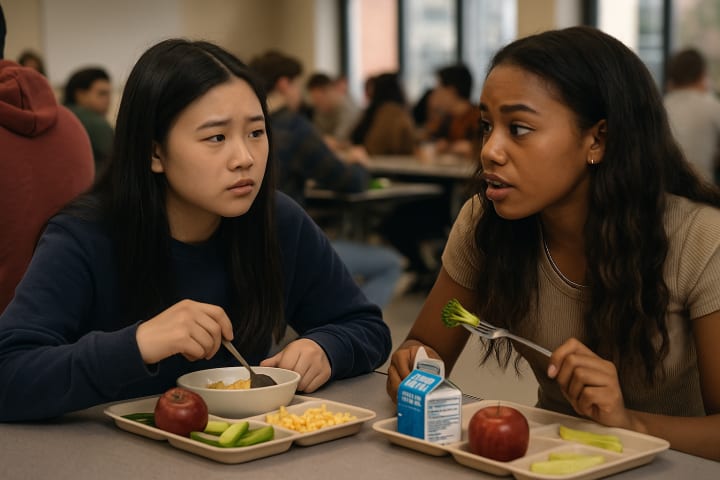
At school, I told Macy. Her eyes went a size up. “Get out.”
“I swear. He knocked.”
“Like, on the wall.”
“Three times. Twice.”
“Damn.” She stretched the word until it felt like a bridge we were daring each other to walk across. “We’re hanging out tonight, right?”
I didn’t answer. Part of me wanted to bring everyone I knew to the living room and say, “Listen!”. Listen to my father being here; still. But another part of me felt possessive and small and suspicious that maybe tenderness didn’t survive translation into a crowd. Yes I wanted to hang out with my friends but I have my dad back; sort of.
That night, I talked to the board for hours about everything they’ve missed; from school drama and mom.
Tap. Tap. Tap.
I shivered and smiled.
For a few nights it was sweet like that. I didn’t even ask questions most of the time. I would lay on my bed reading, and from the wall near the headboard came the soft murmur of three knocks. I would brush my teeth and hear them gentle against the tiles behind the mirror. Once, in the shower, with the water loud like thin rain, I heard them muffled and brave against the wall where the pipes carried warm metal breath. I laughed then, ugly-sniffling, rinsing shampoo from my eyes, and said, “Pervert,” my dad used to tap the bathroom door to rush me in the morning and I had that again. The knocks came again, amused…tap, tap, tap…as if the air itself had shrugged. It was as if grief could tease you back. I slept deeper than I had since we’d buried him; I felt healthier again.

But what I hadn’t realized was that the thing about a ‘knock’ is it need for attention and attention is a bell you keep striking, listening for a purer tone.
I started leaving the board out even when Mom was in the shower; I wanted to find a way to welcome her in. I lit the candle that came in the box, and the little planchette eye would fog and clear with my breath, as if it were breathing too. The knocks came, steady as a heartbeat at first, then more often. A flutter of three when I sat, and another if I stood up. A flurry when I cried, a quiet when I didn’t. I kept the blinds half-open, because the dark outside felt like a mouth, and our house was a tooth in it.
After 3 weeks I noticed the knocks came not from the living room wall but the hallway, then the corner near the vent, then the baseboard by my foot. I laughed and said, “You’re getting good at this,” Y E S and NO. I leaned forward; I couldn’t tell when the planchette would move but what does it matter we were communicating and the house held its breath with me for dad.
Tap. Tap. Tap. That’s his “hello” or “hey”
A pause, and then the sound again, closer. Tap. Tap. Tap.
“Okay,” I whispered. “I’m listening.” Maybe I’ll be able to hear his voice soon.
The knocks moved through the walls like a creature peering through rooms as if the house itself were swallowing and my father’s hands were inside its throat. They stopped behind the headboard. I waited, smiling. Minutes passed. The candle tunneled. I heard a tiny scratch deep in the wall, like a mouse dragging a nail.
“Dad?” I said. “Are you okay?” I’m not sure why this one scared me.
The planchette didn’t move. The candle guttered. The knocks didn’t come and the silence grew teeth. I told myself not to be dramatic. The next morning, I stood in the kitchen with a bowl of cereal and said to Mom’s back, “Do you ever hear, like, tapping in the walls?”
She stiffened. Her hand froze over the spoon drawer. “Not really, what kind of tapping?”
“I don’t know. Like… the house. You know.”
“Houses make noises,” she said carefully. “Wood expands and contracts. The pipes…”
“Yeah,” I said, too quick. “I know.”
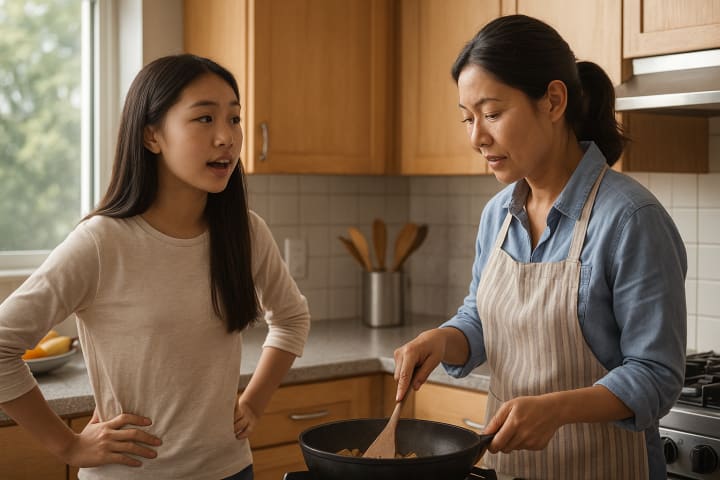
She looked at me then in that precise way that mothers look when they know something wordless is happening and everything in them wants to name it, frame it, fix it; but can’t. She smiled. It showed the effort. “I could call someone to look at the vents,” she offered.
“It’s fine.” I said
I didn’t touch the board that night. I did my homework in bed and kept my earbuds in until the batteries died. I told myself if I didn’t listen for a knock, there couldn’t be one. When I finally lay down in the dark, it was as if the house scooted closer.
Tap. Tap. Tap.
Soft at first, then louder. The pattern adjusted two quick, one hard. The sound came from the wall inches from my head, and it had a meaning to it I didn’t understand, the way birds speak a language we almost recognize. I rolled over and stared at the wall in the dark.
“Dad?” I whispered, half-hope, half-warned.
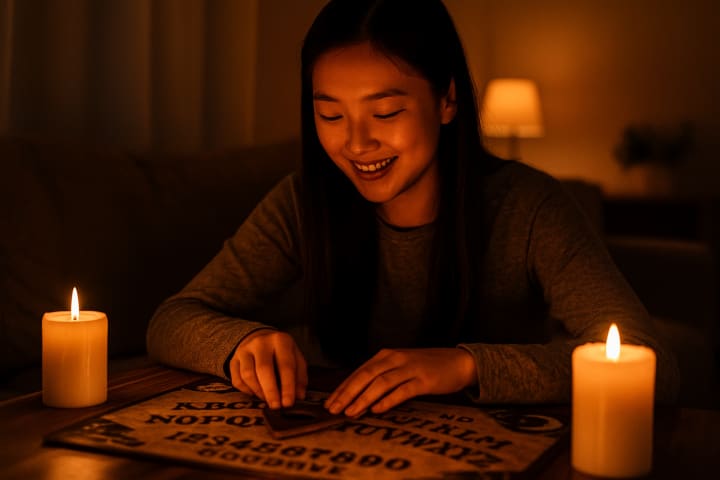
Tap tap. TAP.
My breath snagged. “Dad, that’s too loud,” I said, as if volume were rudeness. The wall knocked again. TAP TAP TAP. In the next room, I heard the hum of the white noise machine and the small, dear snort of Mom turning over.
“I’m going to sleep now,” I said, as if I were checking out of a conversation that had turned awkward.
The knock came once, softer. Tap.
I told Macy everything the next day at lunch, whispering into the apple I didn’t eat. She chewed her peanut butter sandwich like it was beef.
“Okay, so I love you,” she said, “but this is either your grief, or your house is haunted.”
“Thanks for the clinical options.” I replied.
“You want me to come over tonight? We can do the board together. If it’s really your dad, he’ll knock for me too.”
I hesitated. The knocks had been ours. “Okay,” I said.
We sat in my living room at nine with the candle burning low, our fingers on the planchette, our knees touching. The board gazed up at us the way lakes gaze up at kids daring each other to jump.
“Mr. Ooi,” Macy said solemnly, “If you’re here, can you knock?” We waited. My tongue went dry from being nervous in my own mouth.
Silence.
I swallowed. The planchette didn’t move. The house was the kind of quiet that made you check if you still had a heartbeat. “Dad?” I tried, softly. “It’s me.”
Nothing.
Macy gave me a look I hated. Pity chewed the corner of her mouth. “Maybe he can only, like, manifest for you? Because you’re close?”
“Maybe,” I said, my face burning. I put the board away and the candle out and wanted to peel my skin off and start new. We watched a dumb show until she went home. I sat in the living room alone for twenty minutes, refusing to listen. In my room, I put a pillow over my head and breathed cotton.
At 2:13 a.m., the knock came…three times at the headboard, a heartbeat apart. I sat up so fast the pillow flew. “Dad, that’s not funny,” I whispered, and the word funny was the wrong shape in my mouth just flopping there like a fish on tile.
Tap. Tap. Tap.
“Please,” I said. “If it’s you, just… knock once.”

Silence. And then one knock, firm. TAP.
Relief opened like a parachute. “Okay,” I breathed. “Okay.”
The next morning, Mom made pancakes like it was a holiday. She was smiling again, and the light through the kitchen window made a gold rectangle on the table, and for a moment it felt like the board had returned him to us in the only way the world allows like warmth, like sugared bread, like the plan to get through. I told myself the knocks were good. I told myself the knocks were mine.
They kept coming. Always when I was alone. In the bathroom when the mirror fogged. In my room when I turned off the lamp. In the hallway when the nightlight threw a pale coin on the floor. Something about their rhythm changed. They sped up. They sharpened. The silence between them thinned, like the pauses were parched and the knocks were drinking them. I didn’t sleep. When I closed my eyes, the sound lived there like a phantom tapping at the back of my skull. At school, I nodded off in geometry and dreamed a maze of hallways that folded into each other like throat cartilage.
On Friday, Mom knocked on my bedroom door (an ordinary knock, part of the family of sounds that mean safety) and sat on my bed. She smoothed my comforter with her palm, a gesture that had soothed me when I was six and had no power now.
“Mrs. Callahan from down the block said…” She paused, chosen words like bitter candies on her tongue. “She said she’s worried about you. That she saw you outside at two in the morning, in your pajamas.”
“I was just getting the mail,” I lied. I was scared but how can I tell her I let a ghost into the house.”
“At two in the morning.”
“I forgot earlier.”
Her smile hurt. “Honey, I think maybe this…” She stopped, started again. “Losing your dad has been… more than either of us knows how to do. I made you an appointment with someone. Just to talk.”
“I don’t need a therapist.”
“No one needs one,” she said gently. “But it can help.”
“I’m not crazy.” I barely chirped.
“Grief isn’t crazy.”
“I’m NOT grieving!” I heard how stupid it sounded. How childish. I felt myself become both.
Her eyes filled and didn’t spill. “Okay,” she said. “Okay. You’re not.”
I went because I didn’t have the energy not to. The therapist’s office smelled like peppermint tea and beige. She had a dish of smooth river stones on the table and offered me one. I chose a dark one the size of a starling’s heart.
“What do you miss most?” she asked, and the question undid me, simple as a zipper. I told her about waffles and car rides and the way Dad would hum a song without knowing the lyrics and how his eyes crinkled. I didn’t mention the board. I didn’t mention the knocks. I didn’t want the sound to be cheapened into “hallucinations” or “manifestations of loss.”
For two weeks, I went and the knocks slowed; then thinned until they were a story I told myself when my other stories were too sharp to hold. I slept, and sleep felt like the mercy it’s advertised to be. I walked to school without raw eyes. Macy and I did homework and baked cookies that oozed into each other until they were one giant cookie.

On a Thursday in late October, Mom had the late shift. She kissed the top of my head at five and left the smell of her lotion on my hair.
“Lock the door,” she said. “Text me if you need anything.”
“I will.” We were our own small army then and winning.
I watched a stupid movie and texted Macy and folded laundry; which felt like a hymn to ordinary life. At ten Macy left, I brushed my teeth and crawled into bed with a book I didn’t care about. The house was quiet in a way that made me grateful. My lamp hummed.
Tap.
I sat up. The book slid to the floor.
Tap. Tap.
A pause, as if something inside the wall had turned its head to listen for me.
“Dad?” I whispered before I could stop myself. “I thought you… I thought we…”
TAP. TAP. TAP.
Louder now. The sound came from the exact point behind my headboard where the paint always looked slightly darker, the way a healed bruise never truly returns. I swallowed. My mouth tasted like pennies.
“Stop,” I cried. “Please stop.”
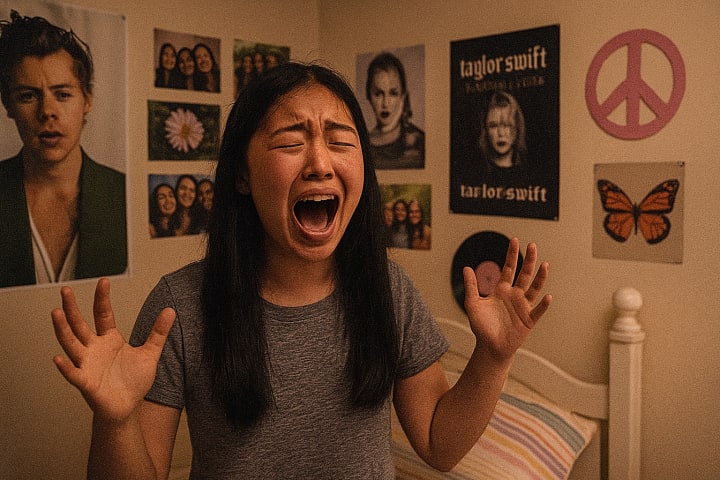
The knocks came faster, as if the wall itself had started shaking. TAP TAP TAP! The sound tunneled into the plaster, carried through studs and ribs; filled the space above my ceiling like wings. I backed up until my shoulder blades met drywall. The knock came in answer to my bones.
I couldn’t breathe.
I ran.
Downstairs, I flung the deadbolt, yanked the door open and stood on the porch in my socks, shaking in the cool night. The porch light blinded me to the yard. The street was empty except for the slouch of our trash can and the ripple of leaves in a wind. My phone was in my hand.
Mom picked up on the second ring. “Baby?”
“Come home!” I choked.
“What happened?”
“Please.”
I heard the soft thunk of her panic setting down her coffee cup. “I’m on my way. Stay on the line.”
“I’m outside.”
“Stay outside.”
I wanted to be brave, to be the girl who marches back in and says, This is my house! I couldn’t make my feet move.

When Mom pulled up, she saw her fourteen-year-old girl trembling on a porch, snotty, barefoot, spooked by her own heart. She wrapped me in her arms and said the only true thing anyone says at midnight “I’m here. I’m here. I’m here.”
She called in sick the next day, and we ate toast and watched the weather and didn’t mention the board sitting under the couch. At noon, she texted a friend if Angelica’s daughter whose 17 and asked if she could sleep over tomorrow night while Mom worked the evening shift. Angelica texted back a string of hearts and a “Of course” and a “Girl, I got you.”
“You don’t have to…” I started.
“I know,” Mom said. “But I want to.”
My room became a place for daylight only. That night I slept on the couch with the TV on, and the house was calm. The next morning, the quiet felt clean like it had just learned how. I told myself it was done. That the talking had untied the knot grief had tied in my chest. That Dad had stopped knocking because he trusted me to live.
Angelica’s daughter Layla arrived in a flurry of bangles and jokes, wearing perfume that made the house smell like a department store where we could have afforded anything if wishing were a credit card. She was younger than Mom in a way that meant she wore eyeliner and said “girl” a lot and danced in the kitchen when the microwave dinged.
“You gonna be okay with me?” she asked, ruffling my hair.
“I’m not five.”
“Good, because five-year-olds are jerks.”
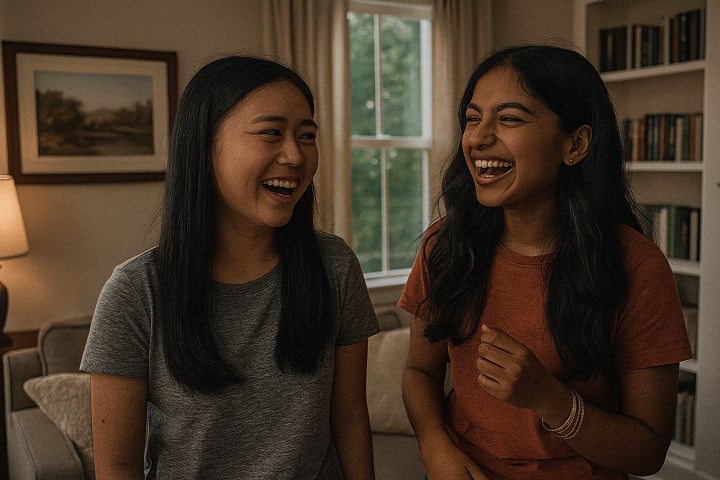
Mom laughed and for a moment we were a sitcom where the problem would be solved in twenty-two minutes. We watched a movie while I pretended to do homework on my bed, headphones on, more to stop my ears than to welcome sound. The house breathed, a normal thing, and each small creak made my shoulders jump.
At nine, Mom left. She kissed us both, said, “Lock the door,” said, “Text me,” said, “No scary movies,” which Layla immediately violated. We watched something dumb and gory, and I told myself that if I could handle this fake blood, I could handle anything real.
At eleven-fifteen, Mom texted “Almost home! Ice cream after?” Layla texted a gif of someone dancing. We didn’t notice the smell at first. Just a sweetness in the air that didn’t belong; then the living room felt… wrong. It was as if someone had moved the furniture a half inch, the way a picture frame looks drunk when it’s slightly crooked.
“Do you smell that?” I asked.
Layla sniffed. “Is that… Chanel? Did you bathe in my perfume when I wasn’t looking?”
I shook my head. The scent sharpened lipstick, waxy and sweet, the way department stores overdo. We looked at each other.
“Ummm Wendy,” Angelica said carefully, “did you leave the bathroom window open?”
I shook my head again. She stood up and picked up Mom’s good flashlight from the drawer; the one Dad used to keep in the garage. We checked the bathroom. The window was shut. The mirror had a smudge I didn’t own.
“Okay,” Layla said. “We’re going to sit on the porch until your mom gets home.”
We did. We locked the door and sat on the step, the way people sit when they’re waiting for fireworks or an ambulance. When Mom’s car pulled in, my chest relaxed so fast I almost felt high. She was smiling. She had that look people get when they’ve decided this is solvable. “Ice cream?”
We went to the little place by the highway and ate out of the same sundae dish like we were in a commercial for families that had made it. We laughed more than the situation earned. It felt like we were feeding something besides ourselves; a small god whose name was Normal.
When we came home…the house was wrong.
Not crooked. Not shifted. Violated.
The living room had turned inside out. Cushions gutted. Drawers yanked and belched. Family photos pulled from frames and scattered like shucked skins. The kitchen chairs lay on their sides. The lamp over the couch had been unscrewed so that the bulb dangled like an eye. And on the wall over the TV, in a screaming trail of lipstick, five exclamation points bloomed around four words: WILL YOU MARRY ME!?

Layla grabbed my hand. Mom’s breathing changed. She reached behind the door for Dad’s old aluminum bat, the one with the scuffed grip where his thumb had loved it into a groove.
“Stay behind me,” she said. Her voice had no room for anything but obedience.
We moved through the house like a unit. Bathroom… empty, except for the perfume ghost. Mom’s bedroom…sheets rucked, drawers open, perfume bottle on its side like someone had drunk from it and been disappointed. Kitchen…trashed, silverware spilled like metal rain. The hallway to my room was a throat we were walking down. The bat gleamed. Layla whispered a prayer I didn’t know she knew. My room looked normal. This made it worse. My bed was made. The book I hadn’t finished lay open-faced and the wall by the headboard looked the same. “Okay,” Mom said. “Okay. We’re calling the…” She didn’t finish. From the closet across the hall; there came a bang.
We froze.
Mom lifted the bat. She stepped toward the closet. The door bulged. Then it kicked outward so hard it yelped. A lean figure lurched into the hall in a spray of makeup and breath.
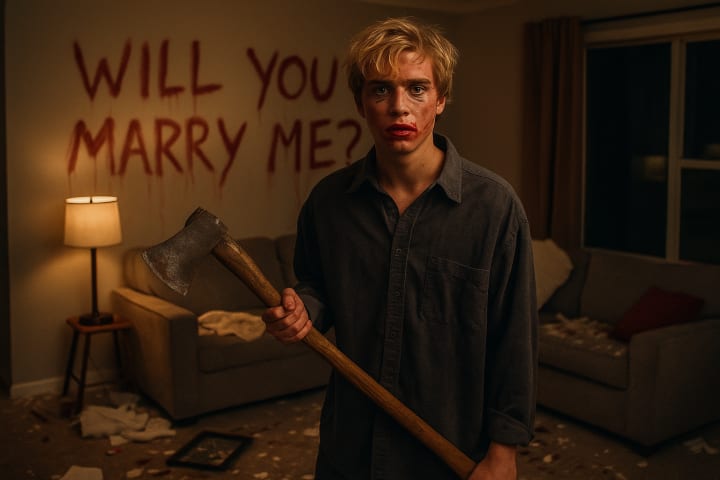
He was a boy, maybe fifteen, maybe sixteen, in my father’s clothes. The pants swallowed his legs like a mouth. The belt hung around his hips, looped twice, the leather tongue flapping like it had something to say. He wore my mother’s red lipstick smeared past his lips, circles of her blush high as fever; he resembled a boy I went on a date with before but gave me the chills. It can’t be him. In his hand was the axe from the shed, the one with a blade Dad had kept too sharp out of habit. The his eyes were bright, like he had swallowed a light bulb and it had turned on.
We screamed. All three of us, a chord that shivered the plaster.
He screamed back, a sound that had no business in a human throat. He swung the axe into the doorframe as if the house itself had wronged him. Splinters flew. Layla pulled me. We ran up the stairs, stumbling, swearing, gasping. Mom slammed my bedroom door and shoved my dresser against it. She didn’t cry. She didn’t shake. Her face was the face of a woman who has been handed too many impossible things and has decided to be bigger than all of them. The axe hit the door. Boom. We jumped. Boom. The wood around the lock began to flower into cracks, petals of destruction peeling open. His breath came through the split like a hot animal.
“I called the police,” Layla lied. She hadn’t; she was looking for her phone. I looked at my bedroom window and without another thought…I wasn’t thinking. I wasn’t not thinking. My body made a decision my mind apologizes for later. I cranked the window up. The night blew in. It smelled like frozen dirt. The roof sloped gentle toward the porch, a pitch we had warned me about since I was little. It might as well have been a cliff.

When I hit the ground I realized I had an endless pain shooting through my knees. My sneakers scuffed shingle. The cold made my eyes water. I scooted, slid, dropped to the porch, sprinted. Our neighbor’s house had their porch light on because they were old and always expecting to need to see. I banged their door with my fists, with my voice, with my entire small life. “911 how can I help you?” The dispatcher’s voice was calm “Stay on the line,” she said. “Officers are on their way.” I can hear the axe hit again with Layla and mom’s screams. The dresser shuddered. Mom’s arms were braced against it. Layla grabbed the lamp, the pointless weapon of people who don’t have weapons. I looked at the window from outside.
The police came in six minutes. It was the longest thing that had ever happened and also it evaporated. When we walked back to the house behind them, I expected to see an axe embedded in my bedroom door like a movie still. The door was scarred. The dresser was shoved crooked. The house was panting. But there was no boy.
They cleared the rooms, the closets, the basement. “If he ran, he ran fast,” one officer said. Another crouched and studied the carpet like he could read its nap. “Where’d he come from?” he muttered, mostly to himself. “You say the closet?” He swung it open and ducked his head inside, tapping the ceiling with his knuckles. He eased his fingers along the molding like it might take his pulse.
“Over here,” the third officer called from the hallway. We followed him to the linen closet on the other side, the one we kept sheets in and nothing else. He had pulled the lower shelf out. Behind it, the wall was not a wall. It was a panel, and the panel was hinged.
The officer slid his hand along the edge. It popped inward with a complaint. He pulled. The panel swung open, and the house opened its mouth.

Behind the false wall was a space the size of a coffin. Dust curled in the flashlight beams like startled ghosts. A narrow tunnel ran sideways into the dark. The smell that came out was a mix of old wood, old sweat, and a new, hot thing that made me swallow. The officer wrinkled his nose and motioned with his chin.
“Get me another light,” he said. The beam slid across the tunnel. It lit a nest a ripped sleeping bag, a torn pillow, a pile of snack wrappers, a library book stamped MISSING, Dad’s old flannel jacket, folded with a care that made my skin crawl. There was a small pile of stolen treasures below it: trinkets, a lost earring, the spare key that had gone missing two months ago. And there, on the floor of the cavity, in a ring cut into the plywood with a dagger or a penknife, were the letters O U I J A the board’s name, carved as if a child had repeated a word until it lost its meaning. Nearby, in crayon, a proposal scrawled and crossed out, and under it, in a different hand, small and neat…knock when she asks.
I couldn’t breathe properly. Air had to be convinced to go in. Behind me, I felt Mom tense, as if the holding in her muscles could hold this back too.
The third officer wriggled himself into the tunnel, cursing softly when he scraped his shoulder. He moved a few feet and stopped. “Lord,” he said. His light found another set of hinges. He put his shoulder into it. The wall on the other side shifted and opened into the space behind my bedroom. He pushed. The beam sliced across studs and insulation, across the back side of my headboard like a fossil. There were scratches there at a height that matched a kneeling teenager. Marks. A path of knuckles pressed into drywall so often they had polished it. And a small hole, no bigger than a quarter, where the paint had given up. The boy had put his eye there, to watch. He had pressed his ear to it, to listen. He had lived in the walls.
I was under the ceiling, under the house, under the ocean. The room tilted and righted. I understood, then like a problem where the numbers suddenly reconcile. The knocks, always when I was alone. The perfume, the lipstick. The ghost that wasn’t. The roof of the world had just been hinged and lifted, and under it was rot and a bed and the exact shape of the thing you fear when your mind tries to explain your fear.
The officers cleared the tunnels. They found a path through the insulation to the crawl space behind the hallway and another to the closet where he’d waited. They found a watch I’d lost and a hair ribbon of Mom’s and a wrapper from the gummy worms Macy had brought over the first night. They whispered to each other in cop-voice, the tone people use to keep fear where it belongs.
They didn’t find him.
He had gone through a vent, maybe, to the attic and out, or down into the crawl space and under the porch and away. They’d get dogs in the morning, they said. They’d canvas the neighborhood. They’d sit a car at the curb all night.
Mom sat on the couch and put her face in her hands. Layla stood at the window and watched the police lights paint the street blue and red like a patriotic disaster. I sat on the floor, knees to my chest, and thought, Dad tried to say listen. Or someone did. Or something that had learned me from the inside had decided that the way to own me was to echo my ache.
The Ouija board was under the couch. I pulled it out and put it on the coffee table. Mom looked up “What are you doing?” she asked, hoarse. “I don’t know,” I said. It was the truest thing I’d said in weeks. The board looked stupid now. A toy. A square with letters, owned at Halloween by children and in the daytime by dust.
“Dad,” I whispered, and the word hurt.
Nothing answered. The room felt like a place after a show is over and the chairs are empty. I had wanted so badly for the board to be a bridge that I had offered myself as the toll. Grief makes bargains. It signs its name on strips of paper and plants them in the walls, where boys can find them and carve them into wood.
I slid the board to GOODBYE, goodbye to the tunnel, to my own delicious idea of magic. I blew out the candle. Smoke wrote its language in the air and then translated itself into nothing.
We slept at Angelica’s that night, in the morning; there were donuts nobody ate. The police knocked at nine with news that meant nothing. They’d found a disturbed piece of fencing under the house; where they found a school ID. It was Nick? I remembered him we went to a diner after school. He’s 16 but he was so strange, he scared me. I never saw him again after that. They would keep us posted but I’m sure we should fine. Meanwhile, we should consider a contractor to seal the panels, alarm sensors, a dog. The list of protections lengthened until it was a spell. Mom hired a guy named Luis with quiet hands. He pulled the panels and replaced them with studs and drywall he sealed and painted. He found other small wounds in the house and dressed them. When he put his palm against the new walls, he smiled like a doctor who knows the infection will stop.
The knocks didn’t come again. At least not from the walls.
But grief keeps a hand. It knocked inside me in the old rhythm, reminding me that absence can learn to speak. I went to therapy. I told her all of it from the boy, the board, the lipstick, the axe; and she didn’t tell me I was foolish. She said we invite what we need. We don’t get to choose who shows up. We get to choose what is allowed to stay.
Sometimes, at night, the house settles. It groans. It sighs. Wood remembers the tree. I lie in bed and listen. I think of a boy in the dark carving letters he didn’t understand into a floor that wasn’t his. I think of my father laughing in a dugout. I think of my mother with a bat and a bravery she never asked to own. When the quiet gathers itself like a cloak around me, I whisper out loud, because it helps “I’m listening.”
And if something knocks…my heart, the wind, a squirrel on the roof I answer the thing that matters, the only thing I can. “I know,” I say. “Me too.”

Last week, Macy came over with popcorn and a horror movie everyone was talking about. We watched it with the lights on. When the haunted house on the screen started to bang and cry, we looked at each other and rolled our eyes a little, both of us braced and weirdly buoyant.
I realized if you listen hard enough to a house, all you really hear is yourself deciding to live in it. We sealed the panels, installed the sensors, bought a lock for the shed. Mom keeps the bat near the door, a talisman we joke about when we can. Angelica and Layla checks in with a text that is mostly emojis and means she will be thinking of us until every bone in her body no longer knows our names. The police never found the boy. The rumor becomes a rumor of a rumor, and then it floats down the block.
At night, for a second my body would try to return to the girl with her hands on the planchette, asking for a knock, hungry enough to feed anything. I put my hand on my chest and counted three beats with my fingers. Tap, tap, tap. The language I was learning to speak didn’t need walls to carry it. The house, that night, was just a house. But I stood in the hallway for a minute and pressed my ear to the paint, the way a child listens for the ocean in a shell. There was only the thick quiet of a home that had been made safe by hands and screws and the decision to say no to the wrong kind of magic.
“Goodnight,” I said to the wall.
Nothing answered, which is how I knew we were safe.
Tap. Tap.
About the Creator
Cadma
A sweetie pie with fire in her eyes
Instagram @CurlyCadma
TikTok @Cadmania
Www.YouTube.com/bittenappletv
Becca
"Everything is so... flat." Denille said stupidly as she looked around her new neighborhood. She looked around at the muted desert where even the smallest sign of life seemed to have given up. The plant life was shrubs that were half cooked by the heat and where there should have been a lawn, a mess of white rocks laid glistening in the sun. Even the sky looked stretched thin, like the sun had ironed it smooth. She’d moved from Riverside, where at least there were hills, but here in Barstow, everything felt baked and brittle.
By Sara Wilsona day ago in Fiction
The Mermaid Who Was Mourned
The yearly Mourning Procession was one of the most important gatherings of the Nesirkie Merpeople. The event was their way of paying homage to a fallen sister who would never have a resting place in the sea. To the Mer, this was a fate far worse than death itself.
By Justiss Goode4 days ago in Fiction
Unofficial Challenge: Black History Celebration
Forward: February 28th, 10:53 PM, EST... The final hour of Black History Month, 2026. Hello fellow writers. I've had this challenge waiting in my drafts for most of the month. But I held off on publishing it, until now.
By Sam Spinelli6 days ago in Writers


Comments (2)
Omgggg, that boy was soooo creeepppyyyy! I initially thought that Wendy summoned an evil spirit that was pretending to be her dad. But wow, what a plot twist. Nick sure was a disturbed boy. Hope they find him and get him the help he needs. Loved your story!
Ohhh wow! I love how you wove everyday details into something uncanny—it makes the whole thing believable, which makes it even scarier. That last lipstick message on the wall felt like a perfect gut-punch. 💖