
The City that Weighed Nothing
short story about nothing with impact


The lanterns of Lumen were said to be the brightest in the world. They burned without smoke, without wick, without heat, and, if you believed the Magistrates, without consequence. At dusk, when the lamplighters made their rounds, the city slipped from gold to pearl, from visible to precise, and every edge gained a clean outline of door frames, cobbles, faces and laws.
Shadows, people liked to say, had no weight. You could fall through one and feel nothing. You could fold one into your pocket and carry it all day without strain. The Magistrates declared it again at spring festivals, stamping the proclamation onto honey-cakes and announcements: SHADOWS ARE NOT REAL THINGS. The words broke like sugar on the tongue. They were meant to melt.
Iri learned early to keep their head tilted when walking. Not because of the light but any child in Lumen could navigate brightness; because of the tug. Their shadow behaved like an extra limb: not in shape (it kept to the usual outline) but in insistence. When the sun leaned a certain way, the shadow thickened, pooling like ink, and if Iri stepped carelessly they would stumble, as though tripping over a rope.
“It’s in your mind,” the schoolmaster would say, when they paused in the courtyard to rub at their shin. “The limb you feel is an idea. Ideas don’t push back.”
Grandmother Tether, who stitched soles by the river’s edge, would spit and answer, “Everything that lasts is an idea. Bridges. Marriage. Taxes.” Then, softer, she would press her palm to Iri’s sternum and murmur, “Your shadow sings because others hummed it into being. You can’t unhear a chorus by telling it to hush.”
The hum followed Iri everywhere. Through the market, where vendors arranged persimmons so their bruise-sides faced the sun. Past the copper gate that marked the Guild District, where lamplighters wore blue-glass badges like new moons on their chests. Over the tilting planks of Halfdeck, where the river had bitten the city and the city had raised a makeshift scar. In each place, the shadow made its own negotiations. It pooled when a shopkeeper’s gaze fixed on it; it thinned when a neighbor laughed low and warm. It never left. If Iri lifted their hand to test the edge of a beam, the shadow lifted too and grazed a counter-ledge, an almost-touch that felt like the memory of pain.
When Iri turned nineteen, the Lantern Guild opened apprenticeships to the public; an event that happened every third decade, as predictable as a comet and just as the mythological was in effect. “We’ll take three,” the Town Bell announced. “Exams will be held Midsummer. All are welcome to sit.” The Magistrates had insisted on the wording: All. It rang like a kindness.
Iri had wanted the lamplight since they were small. Not the power of itthough power was threaded into every lamp-post like silver wirebut the intimacy. Lamplighters moved through the sleeping city the way thoughts moved through a dreaming head. They could bring brightness to a corner no one visited, and that corner would become visible for one night: a loose nail gleaming, a child’s chalk drawing returning like a ghost. The job meant tending to everything that almost vanished.
Grandmother Tether laughed when Iri told her. Then she wiped her hands on her apron and laughed again, the laugh of someone who has bitten a tough seed and enjoyed the surprise. “You’ll need a lantern that tells the truth,” she said.

“Isn’t that what they do?” Iri asked.
“They make the truth look clean,” Grandmother said. “That’s different.”
Iri studied. The Guild sold handbook reprints—cheaper editions that smeared ink onto fingertips. Iri read about refraction, about candle-temper and the mathematics of shadow-length according to season. They learned the names of every lamp: Crowned Owl, Monk’s Jaw, Bluefish, Hive. They learned, with a sting that raised their shoulders to their ears, that some lamps refused to hold steady for certain hands. “Static anomalies,” the handbook called them, and blamed humidity. There was a section on how to report anomalies without assigning blame. A section on how to answer questions about anomalies in a way that reassured the public while maintaining “the principle of weightlessness.”
That spring, the Magistrates passed the Refraction Statute. It was written in mirror language: whatever you saw was not what was meant. It forbade citizens from “introducing phantasmal explanations into civic discourse” and warned against “shadow-talk”—their phrase for any mention that a person’s shadow might affect how the city treated them. “The statute is for everyone’s comfort,” the Bell said. “We will no longer tolerate rumors about immaterial effects.” Bakers stamped the new decree onto early cherries and sold them sticky with law.
The afternoon before the exam, Iri brought Grandmother Tether a lantern they had built from scraps. It was ugly; they loved it. The case was brass from discarded hinges. The lens was river-bottom glass, polished until it forgot where it had been. Inside, a filament of braided hair—Grandmother’s, Iri’s, the stubs swept from children’s necks in summer—spiraled around a drop of night-flowers’ milk. “It won’t pass inspection,” Iri admitted. “But it does something I don’t have the right words for.”
“Show me,” Grandmother said.
They lit the lantern in the back room. Light poured out as if reluctantly informed that it was time to work. On the table lay Grandmother’s tools: awls and needles, a jar of glue that breathed in heavy, sweet gulps. Their shadows shrank and stretched across the workcloth. But where the lantern touched them, they changed. They went shallow as puddles. The air itself looked truer, threadbare in places. The table’s dent remembered a heel. A scuff shivered with the friction of an old argument. On the far wall, taped at child-height, a paper with Iri’s early letters glowed as if just completed, though those letters belonged to hands that were not as steady, eyes not as patient.
“Does it feel different?” Iri asked.
Grandmother lifted her palm. The light lay on it like a warm animal—no, that was wrong. It lay there like a gaze, the first kind that ever sees you. Grandmother’s throat worked. Her eyes filmed.
“I can breathe,” she said after a moment. “It’s like every part of the air admits what it is. Even what it is not.”
“What it is not?” Iri squeaked.
“Everything we call nothing has left fingerprints on us,” Grandmother said. “Your lantern makes the prints appear. Keep it on you.”
They tucked it beneath their jacket, where the badge would go if they earned one, and set out before dawn.
The exam took place in the Grand Hall of Lights, a building that knew it was important. Its doors were tall enough to let a whale through; its windows made fish of the public when they leaned in to see. The floor had lines etched into it like a map of a world that might exist if maps could force the world into agreement. “Candidates,” said the Master Lamplighter, “we welcome you. Lumen welcomes you. The light welcomes you.” He stood between two polished posts whose lamps had names Iri dared not utter. They were so clean it seemed immodest.

The exam had three parts. The first: assemble a standard lamp from laid-out pieces, in half an hour, while the oldest lamplighters looked on as if watching soup to see if it would boil. Iri’s hands remembered Grandmother’s whispered rhythms. They had built a lamp a hundred times in their head and twice in reality, under Grandmother’s sarcasm and blessing. They fastened the lens and tightened the small screws that were always half asleep. The lamp rose under their fingers as if to meet a touch that had been promised.
The second part calibrated the light so it fell evenly across a set of hurdles: a torn shawl, a polished bowl, a child’s scar. The shawl went first. It bloomed under the beam, every loose thread catching. The bowl, the scar: the beam made everything equal, and no one asked whether equality was fit for each. Iri watched the scar shine as bright as the bowl. Their own forearm throbbed where the light lay and hurried on.
The third part held a walk of the inner city route, a painted path on the Hall floor that simulated streets, alleys, bridges, with mechanical obstacles that an ordinary night might throw: gusts, unexpected applause, a cat carrying a bird’s whole hope in its mouth. “You will carry the standard lamp,” the Master said, “and it will respond to your step the way the city does—without malice, without favor. This is a city of laws.”
They carried the lamp. The lamp did not carry them.
Halfway through the route, just beyond a painted bar called The Publick, the lamp flickered. The Master made a note. Iri adjusted the wick dial, though there was no wick. The lamp hiccuped again. A gust blew. The lamp steadied for a moment as the wind shouldered the light aside, then guttered once more as if choking on an invisible swarm. The Master did not look up.
At the mechanical bridge over the painted river, the lamp dimmed enough that the obstacle’s clockwork gulls flapped to life, shrieking into the mimic dusk. The gulls were not real. The dimness felt very real. The left side of the painted path took on an extra step, an unnecessary curb, a kneel. Iri lifted their foot and found nothing, and in finding it, stumbled.
“Anomaly?” the Master asked. Not to Iri, but to the Hall.
The Hall offered its neutrality. “Humidity,” it said with its silence.
At the far end of the course, the lamplighters asked each candidate to kneel and cast their light beneath the model of the Guild’s copper gate. The gate had teeth. It ate light and returned it as a radiance that made everyone jawline-cut and unreal. Iri lifted the standard lamp. Their shadow, which had been trailing them like a dog that expected reprimand, stretched toward the gate and stopped. The light stopped with it, pulled like thread snagged on a splinter.
“Step forward,” the Master said.
Iri stepped. The step did not register. The floor was level and also not. They were a hair’s breadth from the threshold and also an alley away. The lamp’s beam splayed and wavered where everyone else’s had gone clean as a rule. It was the most minor difference—an almost—but the Master’s pen wrote the almost down. The difference would be called “nearly nothing.” The mark would say “insufficient.”
When they released the candidates into the main hall to wait for results, the air tasted like soap, like something had been washed that no one could agree required washing. People talked in small clusters about nothing at all. A boy with a freckled scalp remarked that the simulated cat had been cute. A girl with clean boots laughed too loudly. A pair of twins stood at the window and rested their foreheads against glass that did not support their weight and yet somehow did.
Iri drifted to the edge of the room and, without meaning to, lifted the lantern under their jacket. They should not have; they had no permit for it and no permission. But the room pressed down with its official nothingness, and they needed to breathe.
The Reachlight, because they had named it, secretly, and because every act of making needs a name and glowed in a way that did not impress anyone who wasn’t paying attention. It altered the color of nothing. It showed where the air had parted for someone else’s privilege. It lifted the exhausted tire-marks left by Look-How-Far-You’ve-Come and the slow drag of Maybe-You-Misread-It. It revealed new footprints overlaying old ones: an examiner’s habitual circle around certain candidates; the slight dilation of space allotted to badges that shone brighter; the faint, sticky residue of SHADOWS ARE NOT REAL THINGS on the walls, sweet, adhesive, and impossible to wipe away with soap.
It showed, too, that Iri’s shadow was thicker at the edges, as if stitched from a denser cloth. Not their fault. Not their doing. An inheritance shaped by choir-practices of people who had never consulted the ones they sang about.
The Reachlight didn’t accuse. It held facts up to themselves the way a lake holds a face. Iri tilted it and caught the copper gate’s reflection. There, the light did something else. It gathered. It leaned forward. It began to press.
Iri lowered the jacket and the feeling stopped. They hid the lantern as if it had spoken treason. Perhaps it had.

The results came. Names rolled out like paint. Sol, from the guild-ward…no shadow tug at all; accepted congratulations with a blush that seemed to speak for all the times blushing had earned him sympathy. A tall woman with scarred knuckles cried quietly as she read her passing mark. A third name Iri didn’t know made the board and fled the room, hands over mouth.
Iri’s name stayed in the chamber of their own chest. There, it gestured to all the moments that had almost shifted and had always, politely, stayed the same.
“Nearly,” the Master Lamplighter said when he reached them. “A very strong showing.”
“I stumbled once,” Iri said.
“You tripped over nothing,” the Master replied. “We can’t train you out of that.”
The exact conversation did not happen this way. Or it happened, and then the words evaporated the moment they hit air, because the Refraction Statute caught them and laid them out on clean plates and offered them as reassurance: Here is what was said, and it says nothing. Either way, Iri walked home holding a silence that tugged heavier than any lamp.
On the way, they passed the copper gate for real. It stood at the Guild District’s mouth, tall and toothy. Beneath it lay a smooth strip of stone known as a “safety threshold.” It was designed so that no one would ever feel it underfoot, so you couldn’t catch a toe or a boot-heel on it. The city had made everything smooth. They had sanded away every sharpness, claiming protection, declaring equal access, insisting the surface, at least, refused to harm.
Only the gate watched. Only: some bodies felt a step that others did not.
Iri stopped. Grandmother’s words lay against their ribs like a tool you forget you’re holding and then, suddenly, there it is in your hand.
They slipped the Reachlight out and cupped it. The gate’s teeth brightened. The smooth stone changed—not physically, nothing so crude—but the idea of smoothness rippled. The air learned and then tried not to know, which is what learning always does at first when the lesson is wrong in the mouth. The light lay across the threshold and made visible what had been practiced into invisibility: a hairline of drag, a sigh in the stone, a memory of selective weight. The gate had been calibrated to shadow-mass. Not officially. Not in writing. But some hand had made a choice a long time ago and the city had adopted that choice and called it nature.
A lamplighter on evening rounds glanced over. He opened his mouth and closed it. He saw the ugliness of Iri’s made lamp and the hidden badge-space where it sat, and looked away the way one looks away from grief that is not on the approved route.
Grandmother’s shop was warm with leather and the slow creak of good work. Iri shut the door behind them and did not know whether they wanted to scream or sleep.
“Tell me,” Grandmother said, and so Iri did, which made it as if the telling had happened before—the words fitting grooves worn by other words, other nights. “We expected this,” Grandmother said when they finished, but there was tenderness in it, a bit of glue in the throat.
“I thought the lantern would change their minds,” Iri whispered. “If they could see it.”
“Light makes some people squint,” Grandmother said. “They blame the sun for their headache.”
Iri set the Reachlight on the table. It cast a quiet ring, like the idea of a bell. “I don’t want to be a lamplighter anymore,” they said, and speaking it was like stepping off a curb that had always been there in the dark. Their shoulder dropped an inch. The weight went everywhere else instead.
“You wanted to walk the city and tend its almost-vanishing,” Grandmother said. “Did you mean only if they clapped for you?”
Iri swallowed. The throat is a busy road for decisions. “No.”
“Then walk,” Grandmother said. “Carry your unbeautiful light. Turn it on where they tell you nothing is wrong. Listen to the strange new air when it tells the truth that embarrasses it.”
They did. The next night, Iri went to Halfdeck and raised the beam beneath the rickety planks of the footbridge, and all at once every nail remembered the moment it had been hammered in sideways because the worker had been told, “Hurry, this neighborhood doesn’t need exactness.” The planks shivered with relief at being seen crooked. The bridge did not collapse. But a woman with a tired face stepped onto it and felt, for the first time, why her hip had hurt for years, and crossed with the care she’d been denied by someone else’s speed.
They took the light to the Cloth Ward, where shopkeepers had chalked numbers on fabric bolts that were not prices but politeness codes. Under the Reachlight, the chalk sighed louder than chalk should, like a summer memory, like a hand refusing to forget its own gesture. A boy come to buy a wedding shirt saw the sigh and crossed the street to a different shop, where he paid more and his sleeve did not pull at the seam when he lifted his hand to kiss his new spouse.
They brought the light to The Publick, where laughter piled up so high it made the rafters bow. The beam washed along the bar and found a sticky place where the barkeep’s smile always fell a fraction thinner. Nothing moved. No glass shattered. No confession rose like a fish. But a regular leaned back, startled by the way his own elbow had been claiming a kingdom, and he pulled it in, and space bloomed, enough for someone else to ease their ache against wood without apology.
They set the light, one night, at the edge of the copper gate and let it burn low through the evening. No lamplighter stopped them. The gate did not bite their hand. People stepped through. Some had always stepped through. Some always would. But here and there, there were bodies that hesitated, that had learned the city’s syllables for Not Your Place, and those bodies felt without knowing why, without reporting it to any office; a slackening. The step that had been demanded went optional. The knee that had learned kneeling as a precaution straightened an inch. The air tasted less like soap and more like early rain.
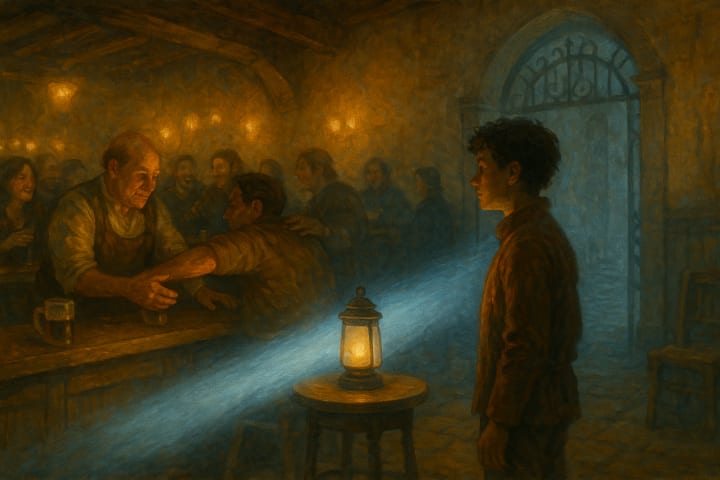
“It isn’t much,” their friend Sol said when he found them there, months later, lantern in lap, the beam at ankle-height like an old dog’s head leaning. Sol wore his blue-glass badge. He had been kind and careful since. He met them at markets and asked, “Where are you taking the light tonight?” as if discussing weather.
Iri tilted the lantern. Sol’s badge showed its real shine…brighter than it needed to be; bright enough to hurt a person standing in front of it if they were already squinting. “It isn’t enough,” Iri agreed.
“I didn’t say enough,” Sol said. He took one step. The gate did not notice him. He took another. The gate made room. He looked back over his shoulder and saw, perhaps for the first time, the way room-making cost nothing to those already in it and everything to those waiting.
“Do you want to carry it?” Iri asked, meaning the lantern. Meaning something else.
Sol reached, hovered, did not touch. His fingers cooled in the light. “Maybe I should feel the weight first,” he said.
They sat together as the moon dragged light around the city the way an oar drags a river. People came and went. Some glanced down and saw nothing at all. Some saw the way the stone remembered a rehearsed reluctance and were offended. Some did not see, but their bodies behaved as if something had loosened one notch.
A night patrol paused. The lamplighter at its center looked at the ugly lantern and then at Iri. “You’ve no permit,” he said, the way clouds say, I am clouds, what is it to you.
“It’s an idea,” Iri replied.
“Shadows are not real things,” the lamplighter said automatically, and rubbed two fingers together, as if they felt a residue no training could rid them of.
Iri nodded. “And yet.” They didn’t move to switch the lantern off. The lamplighter didn’t reach to do it for them. Both of them hovered near the action they might take and did not, and the not-doing became a shape that held for the width of an evening.
The city did not change. Of course it did. Both. Neither. It altered not in the way the Magistrates could measure…no number on a slate board, no law rescinded, no cake unstamped—but in the way a back loosens by degrees when someone stands behind it, not touching, and says, I am here until your spine remembers all the other times it was told to curve and forgives itself for bending. The Reachlight did not make new roads. It made a path through rooms where road-making happened later, after someone’s first fear unclenched.
Children grew, as children do, forgetting that they had learned anything, which is a sign they learned it well. These children crossed the copper gate and sometimes turned the light with Iri and sometimes did not. When they did not, they acted as if the light had already been turned, and the acting altered the way air prepared itself.
Grandmother Tether, who stitched until her fingers refused and then stitched with other parts of herself, died. It was a small death, which is to say the size of the city. Iri set the lantern at her bedside the week before, and the light lit up the face of a fear that had stood at the door pretending to be a polite messenger and told it, Stay, if you must; we will not pretend you are not here. The fear came in, which made it less impressive. It sat down and ran out of speeches. Grandmother said, “I can breathe,” and then did not need to.
At the funeral, the Magistrates sent a wreath with paper lilies that declared, WE VALUE ALL CITIZENS. The paper was fine, like a well-bred lie. Iri bent a petal and found within it a faint grit that sanded the tip of their thumb. They set the petal under the Reachlight. The grit gleamed. The words stayed. Both were true.
“I wanted to be a lamplighter,” Iri told the mourners, which was not part of the ceremony. “They said I tripped over nothing.” The room did not gasp. Rooms rarely do. But there was a hush, a pressure shift.
“I did trip,” Iri said. “Not over air. Over something invisible because it was made to be invisible. I have built a lamp that makes almost visible. You can borrow it.” They set the lantern on the table like bread.
People came to the table as if to pray, which is another kind of asking. A mother asked the light to show where her boy had learned to apologize for existing and the light walked over to the school’s doorway and rested there, warm as a first recognition. A mason asked it which stone he had placed slightly out of true years ago and the light laid itself along a seam that had always bothered him and he did not know why. A lamplighter—Sol—asked nothing, held his hand above the glass, and felt that hovering was, sometimes, a way of reaching.
There was no revolution. There were a thousand almosts. A clerk who stopped stamping SHADOWS ARE NOT REAL THINGS onto forms because the ink clogged his favorite pen and he suddenly liked the pen more than the stamping. A girl who learned to step through the gate at an angle that favored her weight, which was not a solution but was a way to get to work unbruised, which was also not nothing. A meeting where someone said “anomalies” and someone else said “effects,” and the table paused long enough to make room for a third word neither of them quite dared yet.
Iri carried the lantern into the Guild Hall one more time, years later, when the doors were open for a winter charity event. Nobody stopped them because events that stack chairs and pour weak tea tend to overlook small acts. In the Grand Hall of Lights, the simulated streets had been rolled away. The copper miniature gate sat in a corner with a banner draped over it, like a veiled god.
Iri switched the light on and let it hum.
The room altered. Not dramatically. Not enough to write an anthem. But the light showed where the etchings in the floor map were deeper along certain routes and shallower along others, as if blades had pressed harder where bodies did not match the maker’s favored shape. It showed the wall where the Refraction Statute’s words had soaked through the years like oil, leaving a shine that did not belong to integrity. It showed the platform where the Master had stood and how the step up to it had, for some, been taller.
The Master himself approached, older now, his moons dimmer, his gait cautious from a bad winter fall. He looked as if he wanted to say, “You cannot be here,” but the charity banners made every “cannot” sound ungenerous, so he said, “What is that?”
“A faulty lamp,” Iri said. “It makes the weightless heavy and the heavy small. It doesn’t fix anything.”
The Master stood close enough to feel the warmth on his shins. He rocked back a little. He looked down at his ankles as if he had never really seen them carry him. He did not apologize. He did not explain. He did not reach for the lamp, which would have been either too much or not enough. He hovered.
“I remember you,” he said after a long time. “You stumbled over nothing.”
Iri nodded. The lantern filled the pause with its low, persistent working. “It leaves bruises,” they said.
The Master left then, or stayed, or both; because important people have a way of doing both when a story asks them to move and they are not ready. The Hall kept being itself, which always had included the possibility of being more than itself.

Outside, the lamplighters did their rounds. Lumen burned like an orchestra: hundreds of notes that someone had once declared ornamental, now making the soundtrack of breathing. The streets went visible and precise. The lamp at Halfdeck’s bridge gleamed. The lantern at the gate—that unbeautiful, homemade thing—glowed near ankle height in a way that changed the ankle, which changed the posture, which changed the spine, which changed the way the throat carried a name. You could not see it from the Bell Tower. You could feel it if you stood at the threshold and took a breath.
The city kept saying, because it was the city, SHADOWS ARE NOT REAL THINGS. People kept living with the marks shadows left on them when other people’s lanterns had been turned a certain way for a very long time. And in a back room by the river, where stitches remembered instructions older than law, a Reachlight burned each night not as a cure, not as a shield, but as a hand held slightly above another hand, promising that even the almost-touch mattered.
When someone new came by and asked what the lamp did, Iri said, “It makes almosts show their teeth.” Sometimes the someone laughed. Sometimes they did not. Most of them, after a while, reached out; not to touch, never quite but to feel the warmth in the air and to realize, for the first time, that warmth is a kind of weight we give to one another, and that every time the world says it weighs nothing, it is measuring with the wrong scale.
And if the Magistrates asked for proof, for numbers, for charts that translated ache into acceptable units, Iri shook their head and kept walking. They had become a lamplighter in every way but the badge. Night after night, they tended the places where the city’s true shape almost showed where the idea of a thing did what all ideas do, eventually built a road where a bruised foot could step without stumbling, even if the signpost at the start still claimed there was no road at all.
About the Creator
Cadma
A sweetie pie with fire in her eyes
Instagram @CurlyCadma
TikTok @Cadmania
Www.YouTube.com/bittenappletv
Bomb Scare
It was 2027, and the world never thought it would happen. A missle hit the United States, but it wasn't where they had anticipated. A little town in the northeast was hit by a missile strike, they didn't know why, and they didn't know exactly where it hit, but they did know it was a coastal community, somewhere between Maine and Delaware.
By Gregory Paytona day ago in Fiction


Comments
There are no comments for this story
Be the first to respond and start the conversation.