
Nobody Knows
What are fire and ice but two halves of a whole?


A boy once drowned in the pond at the center of the Burning Woods.
It happened years ago, before the fires. The trees in the woods still had leaves then, and the pond was almost full, though the leaves were already browning and crisping and the water was retreating, inch by inch and day by day. The last of it went when I was a teenager, but by then I already knew the story of the drowned boy and the boats.
I was ten when my grandfather told it to me, and not allowed to go into the woods alone. You never knew when a maple or an aspen might ignite on its own and burn like a torch, perhaps set its neighbors alight and leave twisted black ruins that had to be cut down and dug up. There’d been talk about clearing the remaining trees as well, and eliminating the possibility of fire altogether, but we needed their roots to hold back the earth as it dried out and crumbled.
That was the state of things on the day Granddad took me to see the pond.
“It doesn’t look like a pond,” I said, wrinkling up my nose at the shallow pool of murky water that lay in the clearing, surrounded by wide banks of mud.
Granddad said that might be, but nonetheless I should stay far away from it.
“If something goes into that water, Jamie boy, it’ll vanish and never come back again.”
“How? It’s not even deep,” I said scornfully. “I bet it wouldn’t come up to my knees.”
“Deep or not, that’s the way it is,” Granddad said. “We used to sail toy boats there when I was your age, to test it. They’d float for a little while, and then they’d go under without a ripple and be gone, just like they were never there at all. No one knew where.”
“Well, maybe they stuck on something underwater,” I suggested, “or got a hole and sank.”
“We thought that too.” Granddad gazed out over the defunct pond. White flakes of ash from last week’s fire peppered the mud and formed scum on the water’s surface. “Sometimes we pretended there was some sort of creature in there that pulled them down, and it'd get us if we weren't careful, but we didn't really believe it."
"Yeah, cause there's no such thing," I said. I was a hard-headed realist for a ten-year-old. Growing up in a world on fire will do that to you.
"But one day," Granddad went on, "Jacob, one of the boys we played with, decided he would wade out there and bring his boat back before it could sink. We told him not to, but we were laughing. We thought it was all make-believe, remember. He splashed into the water—it started back behind where we’re standing, then, and it was lots deeper too—and he got out to about waist height. And then he disappeared.”
“Just like that?”
“Just like that,” Granddad said. His fingers twitched restlessly, and I knew he was looking for a cigarette. You couldn’t smoke out in the woods; it was suicide. “He didn’t splash or call for help, he just went down in a single plunge, and he was gone. They dragged the pond looking for him, of course, after we all ran screaming to our parents. Sent in an underwater drone too, and then ground-penetrating radar, in case his body had sunk into the bottom where it was soft.”
I pictured a boy lying half-buried in a bed of dark sediment, with a hundred capsized toy boats scattered around him like the wreck of the Titanic. “But they never found anything?”
“Not a trace,” Granddad said. “So you stay away from that water, Jamie, when you’re old enough to come here without me. Say you will.”
I said I would, but I thought when that time came, I’d try it for myself. I’d stand at the edge of the pond, where the ring of mud kept growing and drying and scabbing and cracking under a merciless sun that got hotter every year, and I’d launch a toy boat into the water and wait to see what happened.
Well, I never sailed that boat, but I never forgot Granddad’s story, either. As the years passed and the weather got hotter and the water shrank away, I waited to see if something of Jacob would turn up—maybe not his whole body, but a few bones, or the shorts and T-shirt he’d been wearing, rotted and slimy. But when the last of the woods had burned away and the pond had dried up to nothing, Jacob was still gone.
No one knew where.
---
They found a boy in the pond at the center of the Frost Woods once.
It’s been frozen over for years now, but I remember—just—when there was still open water in the middle, choked by a collar of ice that grew thicker as it stretched toward the shore.
My granddad told me that when he and his friends were young and the hole was wide enough, they’d go fishing there early on a frigid summer’s morning, bundled up in warm clothes and blankets, with folding chairs and hot chocolate to ward off the cold. He’d been warned by his father and grandfather not to go too close to the water; if he fell in, they said, he might slip under the edge of the ice and never be seen again.
“You’ll never have to worry about that, Jamie girl.” He patted my shoulder, his mittened hand making a whuff sound against my padded coat. “It’s only small anymore. Even a mouse could hardly fall in.”
“Did you ever catch any fish in it?” I asked. We’d been ice fishing together before, in lakes to the south where it was a little warmer, but not in the pond. If there were fish there, they’d been dormant too long to still be alive, even if you could cut an opening that went down far enough.
“No fish, but we did pull things out. Drink cans with funny names on them—Coca-Cola’s the one I remember, with a red and white design. Toy boats sometimes too, like little shipwrecks. We’d take those home and sail them in the bath. They worked like a charm once you let them dry out a bit.”
(They did. I found one of them in a box of Granddad’s things after he’d died and gave it to my girls. Seventy years later and it was still shipshape as new.)
“And the drowned boy?” I’d heard about the boy before, but never from someone who had been there. Granddad had always said I was too young for the story until then.
“We didn’t reel him in like a fish, if that’s what you’re thinking.” Granddad lit a cigarette and blew out a cloud of greenish, musty-smelling smoke, turning away so as not to get it in my eyes. “He was floating in the water when we came, face down, the way dead men float. But he wasn’t a man, he was even younger than we were, ten or eleven at most. Right out there.”
He pointed out over the sheet of ice that formed the pond’s surface, white and quiescent amongst the thickly clustered trees, to the dark blot that was all that remained of the hole. Even then, only ten years old myself, I could picture the ring of boys standing around it, their breath making clouds, their faces pale and shocked in the blue-grey light. I could see the younger boy’s body bobbing in the black water, arms drifting loose at his sides.
I shivered, but not because of the cold.
“The way he was dressed was something strange,” Granddad said reflectively. “I never wore clothes like that myself, I was born too late, but I’d seen them in pictures from old times. Short trousers and bare feet and a thin shirt with half sleeves, hardly any protection at all.”
“He might have taken his other clothes off,” I suggested. We’d been taught in my first year of school to look out for friends who started acting crazy and undressing in the snow, or trying to crawl into tiny spaces. It meant the inside of them was chilled, and they’d die if they weren’t brought to a warm place. “People do that sometimes.”
“It’s true, they do.” Granddad snuffed his cigarette out in the snow, made sure it was dead, and put the end in his pocket. “I don’t think it’s what happened to that boy, though. We didn’t want to touch him—"
"I wouldn't either," I said, wrinkling up my nose under my scarf.
Granddad laughed, softly. "But we ran to get help, and they pulled him out before he could go under again. Did everything they could to find his family—DNA samples in the ancestry databases, photos sent to cities he never could have traveled from on his own—but nothing ever came of it. It was as if he’d come from someplace else altogether.”
“And no one knew where?"
“No one knew where," he said. "No one at all."
About the Creator
Vanessa Gonzales
"Writing is the painting of the voice." - Voltaire
When I'm not writing, I take photos. You can see them here.
Keep reading
More stories from Vanessa Gonzales and writers in Fiction and other communities.
Guard Your Battery, Lose Your Humanity
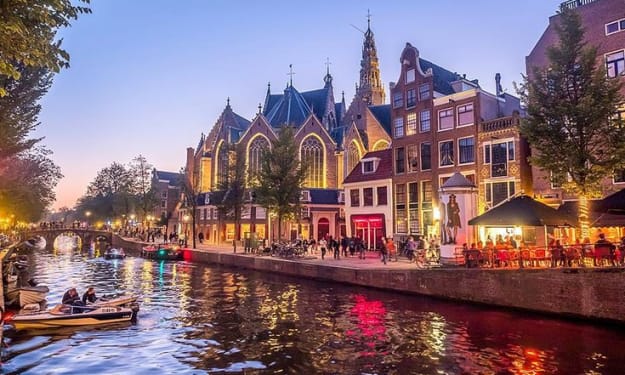
I used to think my phone was my lifeline. In Amsterdam, where rain slicks the cobblestones and bikes fly by like they're late for something important, my screen was the one constant: notifications buzzing through tram rides, endless scrolls while waiting for koffie at a brown café, quick checks at red lights on the Keizersgracht. It felt safe. Controlled. Connected. Until it didn't. By early 2026, I was exhausted in a way sleep couldn't fix. My anxiety had crept up quietly — heart racing in crowds, that low hum of dread when the battery dipped below 20%. I blamed the city, the weather, work. But deep down, I knew the truth: I'd outsourced my presence to a rectangle in my pocket. I was here, but never really here. So on a drizzly February morning, I made a rule that felt ridiculous: no phone in public for 30 days. Pocket, bag, or leave it at home — but never in hand when outside my apartment. If I needed directions or music, tough. The goal wasn't total detox; it was forcing myself to look up, be bored, and — if the moment felt right — talk to someone. One stranger conversation a day if it happened naturally. No forcing, just availability. What broke first was the fidgeting. Days 1–10: The Withdrawal Hits Hard The first week was brutal. At the Albert Cuyp Market, my hand kept reaching for my pocket like a phantom limb. Without the screen to hide behind, every line felt exposed. I noticed things I'd ignored for years: the way an old man feeds pigeons near the Nieuwmarkt, the precise rhythm of bike bells, the smell of fresh stroopwafels mixing with canal water. I also noticed people. Everyone else was doing what I'd been doing — heads down, thumbs moving. On the 2 tram toward Centraal, a carriage full of silent faces lit by blue light. No one spoke. No one looked up. It hit me: we're all in our own little bubbles, floating through the same beautiful city. By day 5, boredom turned into restlessness. Waiting for coffee at a spot on the Prinsengracht, I had nothing to do but watch. A woman in a red coat struggled with her umbrella in the wind. Our eyes met. She laughed first. "This weather," she said. I replied, "It builds character, right?" We chatted for two minutes about nothing — the rain, the best waterproof jackets. It felt awkward, electric, alive. That tiny exchange cracked something open. My anxiety didn't vanish, but it lost its grip for a moment. Days 11–20: The City Starts Talking Back Halfway through, the experiment shifted from punishment to curiosity.
By Shoaib Afridiabout 22 hours ago in Fiction



Comments
There are no comments for this story
Be the first to respond and start the conversation.