
No Thanks, I Just Like To Watch
A (Kinky) Literary Analysis on Charlotte Brontë’s Villette


It can be so easy to brush off literature written before the 1900s as overbearingly lengthy, pompous, boring, and torturous to read. However, with enough time, patience, and an annotated edition of the text, you would be surprised at what you find. For instance, there is a lot of sex and/or sexual themes in the Western Canon, especially during the Victorian era. It is subtle but it is there. Take for example Charlotte Brontë’s gothic novel, Villette.
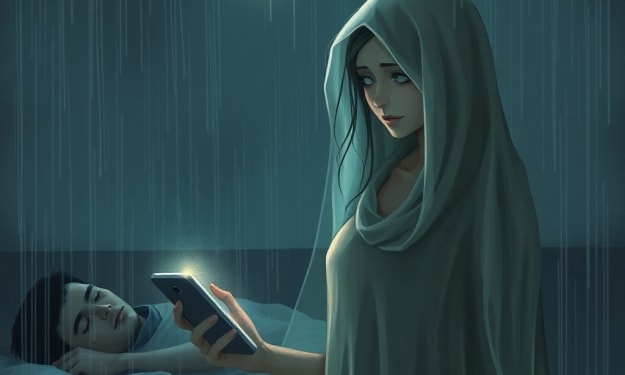
The main protagonist Lucy Snowe is a passive character who rarely acts out on her emotions such as her desires as a form of self-discipline. This self-discipline, or rather sexual repression, she practices results in Lucy becoming an observer to the world around her. However, by giving herself such high moral expectations based on her faith (Catholic) and nationality (British), she is unable to completely rid of her desires whether she likes it or not resulting in a fetish of watching others. Thus, Lucy Snowe denies herself worldly pleasures and in doing so fails but also gains pleasure from that denial which makes herself become a voyeur. To clarify, the term voyeurism in this instance is used as a means to broadly describe the pleasure of simply looking at other people’s experiences rather than the explicit sexual pleasure of watching individuals involved in sexual acts. However, it is also important to note how some of the examples provided could have sexually intimate undertones and how that defines Lucy’s sexuality.
Voyeurism is introduced relatively early on in the novel when Paulina (a distant relative of Lucy’s godmother) and her relationship with Graham (the son of Lucy’s godmother) is introduced. Within the first six chapters, the reader learns more about Paulina Mary Home because of how invested Lucy is with her and Dr. John Graham Bretton. For instance, in chapter three titled, The Playmates, She goes in depth into the kind of intimacy Paulina and Dr. John has. Lucy states, “Polly, being near him, kneeling on a little cushion or the carpet, a conversation would begin in murmurs, not inaudible, though subdued. I caught a snatch of their tenor now and then; and, in truth, come influence better and finer than that of every day, seemed to soothe Graham at such times into no ungentle mood” (Brontë 32). She then proceeds to quote the conversation the two are having with one another as if she was a fly on a wall, intruding on their privacy. It is quite clear that Paulina and Graham are in the midst of a personal discussion but Lucy just has to know for her own amusement and pleasure.
Not only does Lucy forcibly make herself involved in others’ affairs, she brings in the reader to join in so as to validate her fetish in voyeurism and to hold them accountable for her own self-projections. This is especially true of how she talks about Dr. John since she does have romantic feelings for him through most of the novel but are ultimately unrequited. Therefore, anytime Lucy speaks of Dr. John directly to the reader she is no different than when Paulina or Ginevra Fanshawe (Paulina’s first cousin and Lucy’s pupil) talk about their feelings for men to her. For example in chapter nineteen, titled The Cleopatra, Lucy describes his behavior stating, “...the reader is requested to note a seeming contradiction in the two views which have been given of Graham Bretton — the public and private — the out-door and the in-door view” (Brontë 221). Though she denies herself from freely talking about her affections for him, she still enjoys watching and talking to the reader about him so she can have that same pleasure and fulfill her fetish. She is no different than her younger counterparts, and more perverse but she would never admit to that.
For Lucy, being a voyeur is a crucial part of her identity because it encourages her to believe she is alone even when she is not. Ironically it is her way of making herself feel included yet also remain distant so as to navigate herself in various social environments. For instance in chapter thirty-eight titled, Cloud, Lucy disguises herself as she sneaks into the Rue Fossette (the boarding school she teaches at) where she is able to blend into a crowd with Madam Beck (the woman who employed Lucy as a teacher) and her acquaintances. As Lucy observes the crowd, per usual, she states, “I rather liked to find myself the silent, unknown, consequently unaccosted neighbour of the short petticoat and the sabot; and only the distant gazer at the silk robe, the velvet mantle, and the plumed chapeau. Amidst so much life and joy, too, it suited me to be alone — quite alone” (Brontë 502). It is important to note how though Lucy enjoys voyeuristic tendencies, she herself is extremely uncomfortable when she is being watched by others. This is why she prefers to be what she considers independent and has a great deal of power-play involved as only she can be an observer to herself. Anyone else that challenges Lucy’s position of being unseen is therefore teasing her and inviting themselves into her fantasies, such as her colleague, Monsieur Paul Emanuel.
Though Lucy represses her desires, she ‘slips’ and gives into her feelings with him which results in a dramatic character change that is quite the opposite of how she is determined to present herself as. He acts as a catalyst for Lucy’s passion since he is the only one that is able to truly see who she really is. Since Lucy insists on being the only observer, it causes her a great amount of distress as seen in chapter twenty-eight titled, The Watchguard. She states, “‘Well done, Lucy Snowe!’ cried I to myself; ‘you have come in for a pretty lecture — brought on yourself a “rude savon,” and all through your wicked fondness for worldly vanities! Who would have thought it?” (Brontë 370). For Lucy, her voyeurism is kept contained since it is only her and the reader who, at first, are allowed to be involved in her scandalous desires of intimacy. However, once those fantasies start coming to life, Lucy, the reader, and Monsieur Paul Eamanuel are now part of a ménage à trois, in which he invites himself in. Now she struggles to adjust her fetish to actively include the man she loves.
Lucy also uses her voyeurism fetish as a way to cope whenever she is in an uncomfortable or stressful situation. Instead of confronting new and strange experiences she delves into her fetish as a way of escaping into a fantasy that is right before her eyes. In chapter fourteen, titled The Fête, for example, Lucy performs in a play produced by Monsieur Paul Emanuel, where she experiences discomfort, ironically, from being watched. However she notices something about Ginevra while they are both on stage, “...it presently became evident she was acting at some one; and I followed her eye, her smile, her gesture, and ere long discovered that she had at least singled out a handsome and distinguished aim for her shafts; full in the path of those arrows — taller than other spectators, and therefore more sure to receive them” (Brontë 155). Once Lucy is able to watch others even when she is the one being watched, she becomes much more comfortable in her role as a male suitor for Ginevra’s character of the play. In fact, Lucy uses what she sees as a way to project into her performance as if it were foreplay describing it as “...to be lifted in a trance to the seventh heaven” (Brontë 156). It is clear that she has experienced something orgasmic from her performance thanks to what she saw between Ginevra and Dr. John in which she fully acknowledges that pleasure.
In contrast, it is when Lucy is completely alone that she is miserable because there is no one for her to watch. The denial of her fetish causes her emotional distress since voyeurism is her only means to take pleasure in herself and her environment. In chapter fifteen titled, The Long Vacation, Lucy falls into a depressive state stating, “...a sorrowful indifference to existence often pressed on me — a despairing resignation to reach betimes the end of all things earthly...The hopes which are dear to youth, which bear it up and lead it on, I knew not and dared not know” (Brontë 173). Now that Madam Beck and Monsieur Paul Emanuel are no longer around for her to watch, she does not know how to experience any gratification because of the codependence of her fetish. She even refuses to find any alternatives and instead drives herself further into her own depravations, hence why voyeurism is a fetish for Lucy rather than just a kink. She needs to experience watching someone in order to gain any sort of pleasure.
To summarize, Charlotte Brontë uses her gothic novel Villette to explore what manifests from a repressed sexuality, which for Lucy Snowe is a fetish in voyeurism. Rather than actively partaking in intimacy with those she cares for, Lucy Snowe prefers to passively intrude on the privacy of other couples and their relationships. It is because of this voyeurism that Lucy finds herself constantly in a power struggle with either the men she is attracted to, or even potential romantic rivals. Despite her longing to be above one-sided affections and other sensual pleasures, she inherently becomes a perverse woman who still struggles to come to terms with her own voyeuristic fetish and hunger for intimacy.
Now it did take a literature class complete with class discussions and a professor leading these discussions at Northern Kentucky University for me to see the subtle horniness of Lucy Snowe and other characters of the novel. Classic Western Literature is a kind of storytelling that takes time and patience for modern audiences but not everyone wants to put that effort in and for completely valid reasons. However, to completely dismiss this larger category of literature means missing out on some pretty scandalous and entertaining stories.
All citations of Villette are from a 2004 Penguin Books edition with an Introduction written by Hellen M. Cooper.
About the Creator
Carley Courts
she/her & they/them
25 from Cincinnati, OH
I've been writing ever since I was a kid. My favorite genres to read are horror, sci-fi, speculative fiction, and fantasy. I love writing just about any genre though!
Keep reading
More stories from Carley Courts and writers in Fiction and other communities.
Still Single
Still Single The screen showed a young man smiling at the camera with perfectly white teeth. His clean shaven face coupled with his strong jawline made his sparkling smile stand out even more. But what stood out the most were his soft golden brown eyes that seemed to gently whisper, “That’s right, I’m the one you’re looking for,” to any woman who came across his profile.
By Carley Courts5 years ago in Humans
Miss Persephone's Manual to a Seemingly Ordinary Life
Miss Persephone was found at the dining table, her blue eyes swollen, her tears arriving and retreating like the tides of the ocean. Earlier that day, her family had visited her in the retirement home where she had lived for eight years. It was her eightieth birthday.
By Imola Tóth2 days ago in Fiction



Comments
There are no comments for this story
Be the first to respond and start the conversation.