
Mrs Lydia Osgood’s “Practical Advice for my Daughter”, Chapter 2, How to grow a Spring Garden.
For Instructions Included

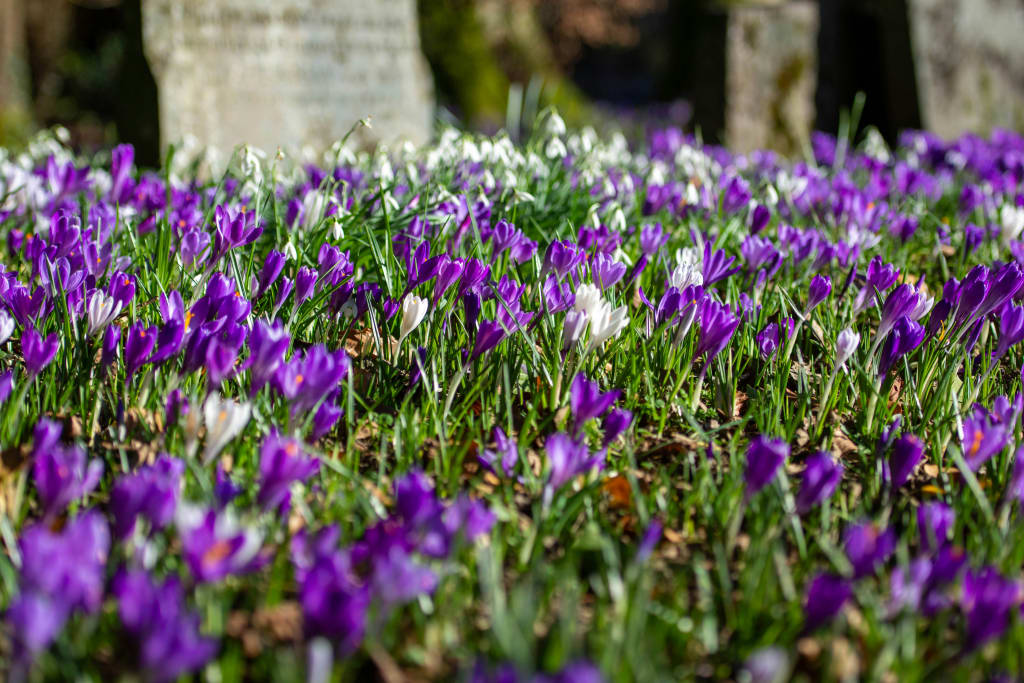
There are times in one’s life when one feels frightfully unhappy and all seems rather dreary. Forewarned is forearmed however, and one must lay the ground for recovering one’s joie de vivre as soon as such a circumstance might be anticipated. Bleak midwinter is such an occasion, and after dark months, nothing is more pleasing to a soul than watching the nodding heads of narcissi on a bright spring day. A spring garden heralds the renewal of light and the coming of summer’s abundance, whatever has been lost to the winter.
Many people mistakenly believe that one requires a large estate or at the very least a substantial plot in order to grow a spring garden. Nothing could be further from the truth. In this chapter I will provide clear step-by-step instruction to enable you, should you be so inclined (and it is my hope that you will be) to create your own joyful tableau of spring colour to lift the spirits after the darkest of times. As in chapter 9, “Fruitcakes for Weddings, Christmas, and Other Occasions”, time is a virtue here, and preparation is key. You will want to start thinking about your spring garden no later than early autumn, preferably before things start to visibly wither, and steps 1 to 3 will need to be completed well before the winter solstice for best results.
Step 1: Planning
There are certain things in life which take us by surprise, but the majority of what befalls us can be predicted and planned for. This includes death, taxes, and the seasons, which are inevitable and unavoidable. The light will fade, things that had seemed quite vigorous in summer will die back, and you will have to contend with a certain bleakness. As much as we might wish it to be otherwise, there is no use in pretending it is not so. Rather, it is preferable to make the best of things, and to set oneself up for better things to come. I would refer you again to Chapter 1, “Dealing with Grief, Disappointment, and Other Upsets”.
After horses, working on a garden is the most rewarding work you are likely to do. Believe me, the pleasure of planting and nurturing a thing of beauty and watching it flourish cannot be underestimated. A garden is also a salve for a wounded spirit, and it is worth remembering that gardening gives your hands something to do in times of trouble. However, preparation is vital. It is imperative, for a spring garden, that you do not wait until the depths of the winter to pass to turn your face to the returning sun. There is nothing to be gained by sitting about waiting for the worst of it to be over before beginning the work of one’s own happiness, quite the contrary, this could be considered rather negligent.
The first step to planting any garden is to set your mind to achieving it. It is not unusual for people to say to me that they would love a beautiful garden, but that they are simply not a gardener, and to this I say poppycock, and so must you. Almost everyone has the capacity to create a garden if they can summon the will to do so, and I do deplore a tendency to languish in the mud for lack of effort. That said, many novice gardeners become discouraged within their first season due to over ambition and inadequate planning. While enthusiasm is commendable, as in Chapter 6, “Careers”, and Chapter 7, “Starting a Family”, it is important to pause and consider the realities of your circumstance. Here I recommend you ask yourself the following questions (you may write your answers on a piece of paper or in the margin if you so wish):
1. What is the purpose of my spring garden?
The answer may seem obvious at first, however your motivation does bear some interrogation. The best gardens are invariably planted for the pleasure of the planter. When one plants a garden for one’s own enjoyment it is very often the case that others will delight in it also, though it is my recommendation that the elicitation of compliments, or even envy, is never the primary aim of your endeavours.
2. What space do I have available for my spring garden?
You must choose a position that receives at least some sun during each day. Just as one must be wary both of a chap who weeps all the time and one who is eternally blithe, your soil should be neither waterlogged nor perennially dry if you can manage it. Balance is preferable, but tend towards dry if you must. You do not require a large flowerbed, it is possible to plant bulbs into flowerpots, or even a window box. Some bulbs may even thrive indoors, and ground can often be improved, for example, by the trimming of shade plants. Think flexibly and use what you have, but with reference to your answer to questions one and three.
3. What resources am I willing to commit?
You are likely to have some responsibilities you will need to consider, such as the care of animals, a lonely elderly father, or perhaps children one day. This does not mean that spring beauty is out of your reach, but it would be appropriate to plan for a display commensurate with your capacities in any given year. A small, well positioned display can even be more impactful than extensive but ill-conceived planting, so do not allow yourself to be discouraged by your limitations, every gardener has some. There is beauty in each flower, and a single golden daffodil is as worthy of attention as a host. A host, after all, is formed of many individuals.
4. What do I like?
Whilst your neighbour, your husband or your father may rave about tulips, if your preference is for hyacinths, then it is hyacinths that you should plant.
Step 2: Preparation
Planning is of little value without action. This can feel particularly challenging when preparing for a spring garden as things must be set in motion at a time when one is liable to be distracted by other things of more immediate concern. However, as in Chapter 4, “Hosting a Reception”, no-one will thank you for dropping the platter because you forgot to feed yourself both before and during the event.
Preparation falls into two camps; preparation of the garden, and preparation of the self. We shall first address the garden.
Ideally, one would ensure that weeds were removed, the maintenance jobs of late summer and early autumn are completed, and that the soil is loosened and turned. Bulbs, however, are surprisingly resilient. Nature is ever keen to endure, and it is possible to produce a pleasing display without the necessity of perfect ground, which is seldom achievable in reality. One must neither await nor expect perfection in a garden any more than in a horse, or for that matter, one another.
Similarly, if you are able to purchase your bulbs from a reputable source, your garden may be more reliable. However, do not turn your nose up at bulbs offered by your fellow gardener. Usually these are of good quality and extremely serviceable, and many of my own favourite plants have been sourced in this manner. Planting bulbs of indeterminate type is always a gamble, but can provide unexpected joy, and at their worst may prove to be ordinary. Do discard any bulbs, however acquired, which feel spongy, hollow, or unexpectedly insubstantial. These are a waste of your time.
When it comes to the self, however gloomy the weather, one must avoid moping. It is easy when downcast to put off a task which may require us to stretch ourselves, but nothing is to be gained by this, and everything stands to be lost. By deciding and committing to a schedule for planting you may circumnavigate the bounty of excuses we are wont to discover when the job appears optional and our enthusiasm is impaired.
It is important, also, to warm up before commencing. Gardening is hard on the knees, hips, back, shoulders and wrists, but by warming up, and pacing ourselves according to our capacities, we find we are capable of more than we think. Sometimes things hurt more than we expected, and this is generally perfectly normal, but if it persists, it may be worth seeing someone. Anticipate the need for rest, which can be difficult to do, and ensure that hot water, tea, and biscuits are easily available so that you may remain hydrated and fuelled for your endeavours. When one is surrounded by autumnal death and decay, one can become inadvertently beguiled into neglecting one’s own vigour and weakening accordingly. While the dying of one living thing may sadden you, it is absolutely no excuse to allow yourself to wither in sympathy.
Step 3: Planting
In many ways, this is the most straightforward part of the procedure. Despite this, many inexperienced gardeners find planting the most intimidating step. Do not be cowed by your own doubts, execution of the action is usually achievable when taken one step at a time. Chapter 3, “Event Coordination; Funerals, Christenings and Weddings” offers further advice here. Planting requires you to get your hands dirty, but take time to notice the richness of the soil. All life is here. You will have at your fingertips decay and regeneration both. Your focus, in planting a garden, must be to turn to the latter, however it can temper the unpleasantness of the falling leaves to celebrate their part in enriching the soil in which you plant.
By this stage, you will have prepared your site as best you can, whether lawn, flowerbed, or pot. My own preference is straight into the ground such that naturalisation becomes a possibility, but if you prefer a pot, which can after all be moved around to suit, then that is what you should have. You will also have decided upon which bulbs you want to plant and gathered those in readiness. Planting is now simple. Prepare a hole to an appropriate depth - generally 2 to 3 times the height of the bulb. Insert the bulb in the hole with the point facing Heaven and fill over with soil. There is a proliferation of guidance regarding the spacing of planting, however this can be taken with a pinch of salt. Allow each bulb space to breathe and a route to the light and all will be well.
Step 4: Vigilance
It is a misconception that once planted, a garden will fend for itself. Whilst you can do nothing about the weather, you must guard against animals (squirrels for example) who may unabashedly lay claim to your hard work, destroying it in the process. These animals may look appealing, and you may feel a degree of sympathy for them, but this does not mean that they should be allowed to ride roughshod over your endeavours and tarnish your joy. You may wish to consider netting your spring garden until shoots are well-established. There is nothing to be ashamed about in protecting your interests. Good planning and preparation can and have come to nothing when basic maintenance is disregarded, and checking for weeds, displaced bulbs or other damage should be a regular job.
Step 5: Patience
Instant gratification is alluring to us all, but I can attest that true gratification and pride in one’s creation comes with patience. You must not expect your work to pay dividends overnight. One must endure the cold and dark, it will come and it will pass and it will come and pass again. There is joy, however, once you notice the days start to get longer again, in a daily inspection of your garden. The thrill of seeing the first shoot poking through frozen earth should be relished. Life returns! Please do not be afraid of this thrill, it is right that you feel it. Allowing it will neither betray your recollections of summers gone nor invite mishap to the coming spring. Do not allow your memories of the winter passed or the anticipation of the next winter to come to overshadow your pleasure in the spring, or you shall take no pleasure in anything.
Step 6: Notice
Many a gardener has fallen foul of a failure to actually recognise the beauty of their own garden. What a terrible waste of all that life! This can happen for two reasons, and you should guard against both.
First, a refusal to acknowledge the natural order of things. Do not make this mistake. Some people cling to summer despite the roses dying, and some become so swaddled in winter blankets that they don’t hear the return of the Woodlark. Yes, it is just as dark in the days after winter solstice as it was in the days before, but one day at a time, the days grow brighter, and one must not forget to look about oneself and recognise change for what it is. Inevitable, inexorable, and neither entirely good nor entirely bad.
Secondly, the expectation of perfection. Only a fool waits for perfection in a garden. As one snowdrop reaches its peak, another will be already wilting, and the tulips yet to show their shoots. This is by design of course. It is easy to romanticise a moment of perfection, but it is a poor strategy for sustainable thriving in a garden. Everything must take its turn, and you must learn to recognise the beauty of your imperfect garden. Keep in mind also that others may critique the imperfections, but this is usually motivated by a desire to be helpful coupled with a poor understanding of the circumstances of your particular garden. Remember that these same people are far less likely to verbalise their admiration and enjoyment of the garden, but I assure you that it is the case that admiration and enjoyment are in fact the predominant feelings elicited.
And there you have it. It is my belief that the planning, preparation and planting of a spring garden, however small, should be a priority even as the events of autumn and winter make such considerations feel untimely, and I hope very much that you are able to turn your mind to the possibility of spring, however unlikely that feels, over the closing months of the year and through the bleakest of winters. Remember that while dark nights, sadness and cold encourage passivity, happiness is attained through engagement, intention, and a willingness to observe the beauty of a bloom even while the rain still falls.
About the Creator
Keep reading
More stories from Hannah Moore and writers in Fiction and other communities.
The First Person. Winner in The Forgotten Room Challenge.
She enters the room. The door, she knows, has been here - unpainted wooden panels, plain brass knob, no keyhole - between her bedroom and the bathroom every morning and every evening of every day, and yet she cannot remember if she has ever been inside.
By Hannah Moore2 months ago in Fiction


Comments (3)
This is filled with quiet British grit and wit, Hannah. I laughed out loud at the title of Chapter 9 and grinned widely at several others. I look with feverish anticipation to the day that all of Mrs Lydia Osgood’s wise instructions and proverbs are published, most especially chapter 9! Good luck on the challenge!
Excellent! I loved the exact outline and steps along with commentary throughout - the weather, people judging, expecting perfection or instant gratification. Well done, Hannah! Great entry!! You must be a gardener based on the content. Hard on hips and knees…
The garden of the mind grows the alchemy of healing for the heart in the year of the fire horse. Hugs to you.