
Mrs. Hinkle’s Barn
When I was growing up in a suburb north of Detroit, Mrs. Hinkle and her housemate lived next door to us. My definition of “old” has changed since then, but even by my present-day standards I am pretty sure they were very old.
Mrs. Hinkle’s housemate, a woman whose name I do not recall, I see in my mind’s eye only as a shadowy presence behind the front door.
A shadowy presence, yes, but not a spectral presence--there was nothing eerie about Mrs. Hinkle or her housemate. By the same token, neither the 19th Century two-storey brick house they lived in nor the big disused barn in the back of the yard seemed haunted, to me or to the rest of the gang of children who lived on our lane, although we were a dramatic and imaginative lot. There was nothing forbidding about the barn, with its faded red paint and its mossy roof, except that our parents forbade us to play in it, or even to set foot inside.
Mrs. Hinkle’s yard was unusual, a relict from a bygone age when people still got around by horse and buggy and everyone kept a milk cow, even in town. Not that Mrs. Hinkle kept a horse or a cow, but, had she decided to do so, they wouldn’t have looked out of place.
When my father was young, our town had been a village with its own identity and pretensions to industry, but now Detroit was encroaching with speed and deliberation, its highways and mile roads like blood vessels--and indeed they were called major arteries--connecting the town more and more closely with the Motor City.
We lived in an old brick house too, but our lawn was mowed in keeping with the suburban standard of the day. Mrs. Hinkle’s yard was, to a child, vast and wild, intoxicating and tenderly comforting at the same time.
Step off the gravel drive of Mill Pond Lane, walk past the overgrown rose bushes and into the apple orchard in Mrs. Hinkle’s yard. There are only a few gnarled old apple trees, fragrant with blossom in spring, fragrant with green apples in summer, full of wormy fruit in fall, and fragrant again with rotten apples in November.
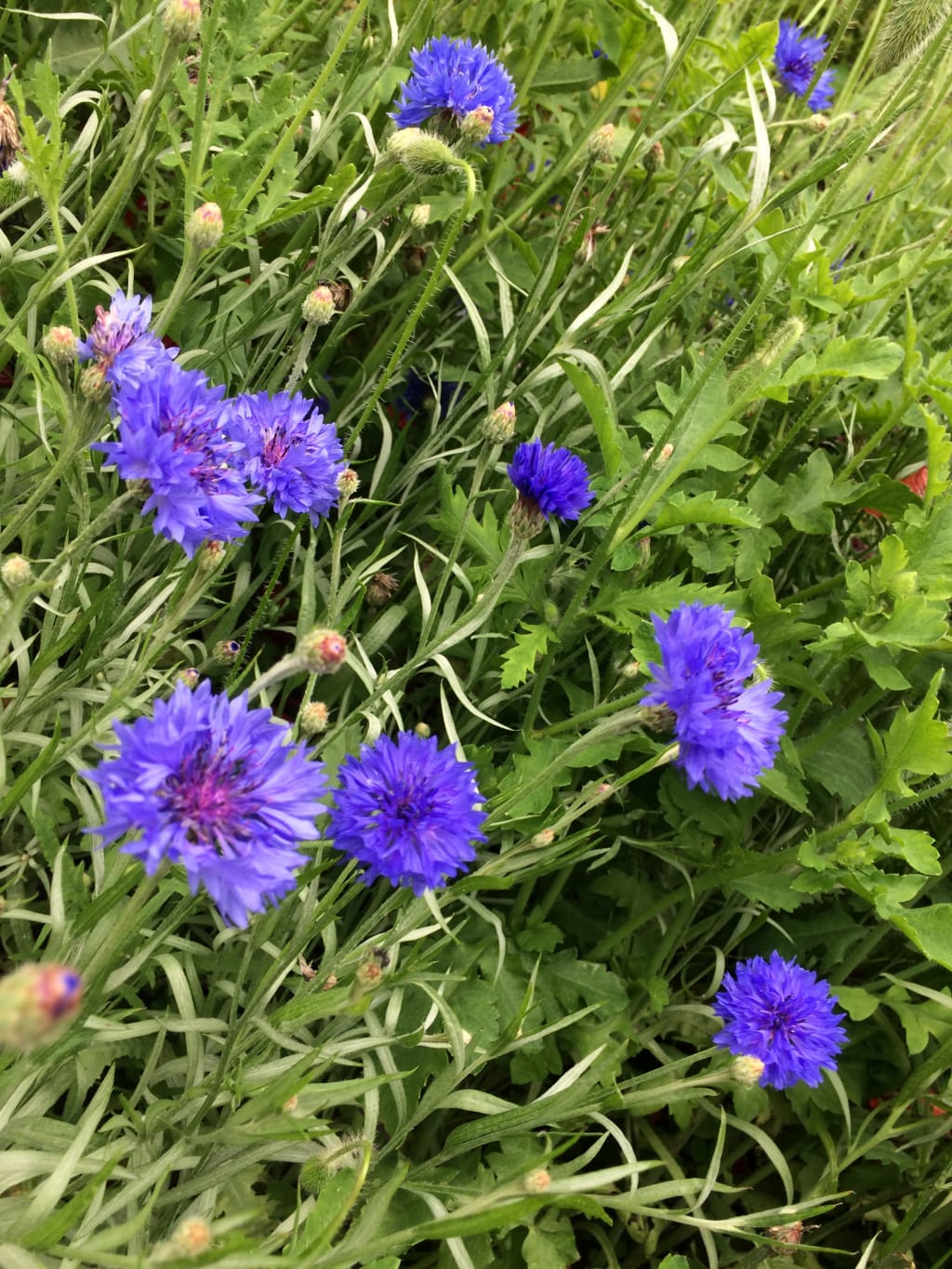
In apple blossom time, morel mushrooms grew in the unkempt grass under the apple trees. We brought them home to my mother. Walking--or running, as we preferred-- past the old red barn and behind the house, we arrived at the field where tall grass, red raspberry bushes and bachelor button flowers grew in profusion under the summer sun. Mrs. Hinkle let us pick all we wanted. When I wanted to get away from it all--and children as well as adults need to do this from time to time--I could lie in the deep, sweet-smelling grass and watch the bugs climbing the stalks and the clouds changing shape overhead. If we ran through the field and down the hill, we would end up at the bank of the old mill pond, which was lined with weeping willow trees. It was a wonderful playground for children.
One day I was sitting in one of Mrs. Hinkle’s apple trees missing my friend and erstwhile companion Mikey, a neighbor boy a year or so younger than I was. My mother had just told me that Mikey’s mother thought we played together too much; she wanted him to play baseball with the other boys instead.
Mikey used to follow me around and listen to my stories. I would show him raindrop-size footprints in the sand by the mill pond and tell him they were made by elves. I had Mikey believing in fairies; I had myself believing in fairies. When Mikey and I grew up we were going to get married and have a farm with every kind of barnyard animal.
It was confusing. Why couldn’t Mikey and I be friends? Our parents were friends, so my mother probably knew the real reason, but she wouldn’t explain. Grown-ups were confusing generally, and it was no use trying to understand them, I decided.
Because I went to bed early, I didn’t know what went on at night. It was a mystery. My parents’ martini parties were not in the least mysterious, however, as long as I was awake. The ladies wore bright lipstick and smoked cigarettes. Their bangle bracelets jangled when they put their cigarettes to their lips; they threw their heads back when they exhaled. They were glamorous creatures, not the same as when they were vacuuming or making tuna casserole during the day.
At martini parties they shrieked with laughter, so that even after my older sister Barbara and I were in bed they kept us awake. The men’s voices were a low rumble, and there was music playing, always jazz. We had no idea what our mother, or mothers in general, got up to after we finally got off to sleep. They had a separate and discrete nighttime life of which we knew nothing. They were basically nocturnal creatures, never becoming their true selves until after dark, when we were sent to bed. As for the fathers, they went to work in the morning and were gone until dinnertime. Grown-ups. There was no use trying to understand any of them.
As a child I wanted to be good, but by the age of nine or ten I knew that being good was very difficult. I wasn’t interested in the pedestrian, unthinking obedience that parents and teachers demand of children, but in a conscience-driven, even heroic, goodness.
My family was Episcopalian, but I wished I could be Roman Catholic, like my friend Maureen. The playground at her school had a statue of Mary on a tall pedestal, which I scaled one day in order to hug the Holy Virgin and seek her blessing. Immediately, a custodian came running out of the building waving his arms and yelling at me to get down. Catholic children would know better.
As I sat perched in the apple tree, pondering all of these matters and coming up with no useful conclusions, my grandmother Rose came striding out of our house, clear-eyed and purposeful, calling for Nancy.
“Nan-ceee! Where is the baby?”
When Rose was a girl, her little brother Fraser drowned in the Brazos River in Waco, Texas, and she would never forget it.
My mother came out onto our porch, pale and distraught, shielding her eyes with her hand.
“Where is Nancy?” she called to us. “Have you seen Nancy?”
I just stood and stared, struck dumb. The thing is, the last time I had seen Nancy was an hour or so earlier, when she was standing in her playpen, a little curly-headed prisoner, and I decided to set her free. I pulled the wooden bars on one side down to the floor, as I had done on other occasions, and Nancy clambered over them. Rather than assuming responsibility for her welfare after that point, I ran out the front door, followed by Duck, our Chesapeake Bay retriever, and climbed a tree, forgetting all about my little sister.
So, while I didn’t mention it to anyone, then or ever, I knew that it was my fault Nancy was missing. A three-year-old, as I well understood, is vulnerable in the extreme, being inexperienced, curious, afraid of nothing, and mobile. I felt physically sick with dread and guilt.
Generally, the grown-ups didn’t go wandering around Mrs. Hinkle’s yard the way children did. If a grown-up did that, it would be trespassing, and it would look very strange. My mother had to ask us to find her morels; she had to wait for us to bring her bowls of raspberries from Mrs. Hinkle’s hill. She couldn’t go and get them herself. But on this occasion she ran through Mrs. Hinkle’s yard like a young girl, calling, through the field and down the hill to the bank of the mill pond. Both she and her mother, Rose, clearly feared the worst.
I jumped down. Duck had been patiently waiting for me at the foot of the tree. I didn’t know where to look. This wasn’t the first time Nancy had run off on her own. Once Rose found her asleep in the clothes hamper. Once she was asleep behind the living room sofa.
Another time, the previous spring, my older brother Dan, Barbara, Nancy and I were having a picnic with our mother by a stream. The day was sunny but chilly. The grass was studded with dandelions; it was still early enough in the season that the dandelions were welcome. Baby Nancy was wearing her little pink wool coat. I remember looking up from my tuna fish sandwich and seeing something pink in the water. I tried to scream but couldn’t. The current was carrying Nancy downstream. And then Dan was in the water, holding onto the back of Nancy’s coat and pulling her out.
I know this is what people always say, but it all happened so fast.
Now Duck was barking with excitement, and I was telling her, find Nancy! Find Nancy! I ran all around our house, Duck yapping at my side, and back to the lane. Because the barn had always been off limits, I generally ignored it, but I could see that it looked different. The sliding barn door, usually closed, was open, just a crack. It was dark inside. Duck and I ran over at the same moment, so I never knew whether she was acting like Lassie or just following me.
Dust motes danced in the light slanting into the barn through spaces between the boards of the wall. There was no hay in sight, no farm implements, just boxes of what looked like discarded household belongings stacked by the door. Baby Nancy was sitting in a ray of sunlight on the dirt floor, holding a petunia she got from somewhere and thinking her own thoughts. Duck jumped around, barked, and licked her face. Nancy laughed.
So that is how I became the hero of that particular day, although I knew I didn’t deserve it. As I said, I didn’t mention to anyone, then or ever, that I had let the baby out of her playpen and then gone off and left her.
My Grandma Rose used to say that Mrs. Hinkle was pretty. I couldn’t see it. Her eyes were blue, a noticeable blue, her face was round, her cheeks were pink, her hair was white. Pleasant. But pretty? Sophia Loren was pretty. Marilyn Monroe was pretty. My mother was pretty. Mrs. Hinkle was just old Mrs. Hinkle. But she was nice.
The two old ladies died long ago. The red brick house and the old barn were demolished and a housing development was built on Mrs. Hinkle’s property. I haven’t forgotten her. And now that I’m older I know that Mrs. Hinkle was a girl once too, a pretty one, and maybe a mother, and that she and her housemate, whoever she was, lived their own lives and enriched the lives of all of the neighborhood children, even if we scarcely gave them a thought. But at their age, you know, they understood about that.
“How did Nancy get into the barn?” I asked my sister Barbara, not long ago. “I never could figure that out.”
“Oh,” she said, “that was Dan’s secret fort. Didn’t you know that? He must not have closed the door all the way.”
“But we never went in there!” I said. “We weren’t supposed to!”
“You never went in there?” Barbara started laughing.” All the kids went in Mrs. Hinkle’s barn!”
Some things I will never understand.
About the Creator
Keep reading
More stories from Martha Allen and writers in Fiction and other communities.
Clean Earth
Clean Earth This morning Sophie, half asleep, roused as usual by the yowling of Keith the cat, enters the kitchen of her apartment. It’s just another morning until she startles, feeling stings, little pinpricks, on her feet and up her ankles. She looks down.
By Martha Allen5 years ago in Earth
Wild Card Weekend Recap: What Happens Now?
I think I figured out why I love Wild Card Weekend so much. It's because it's the first playoff anything of the calendar year. The NFL season starts in the fall, and once upon a time, the champion was crowned either on or slightly before New Year's. The evolution of the NFL schedule has resulted in the playoffs starting just into the New Year, and currently, the final week of the season falls on the first weekend of the New Year, with Wild Card Weekend coming a week after that. So yes, chronologically, the NFL's Wild Card Weekend serves as the first playoff anything of the calendar year.
By Clyde E. Dawkins4 days ago in Unbalanced



Comments
There are no comments for this story
Be the first to respond and start the conversation.