
Moon’s Gift to the Blind Girl
She had never seen its light. So the Moon learned to sing the shape of the world to her.

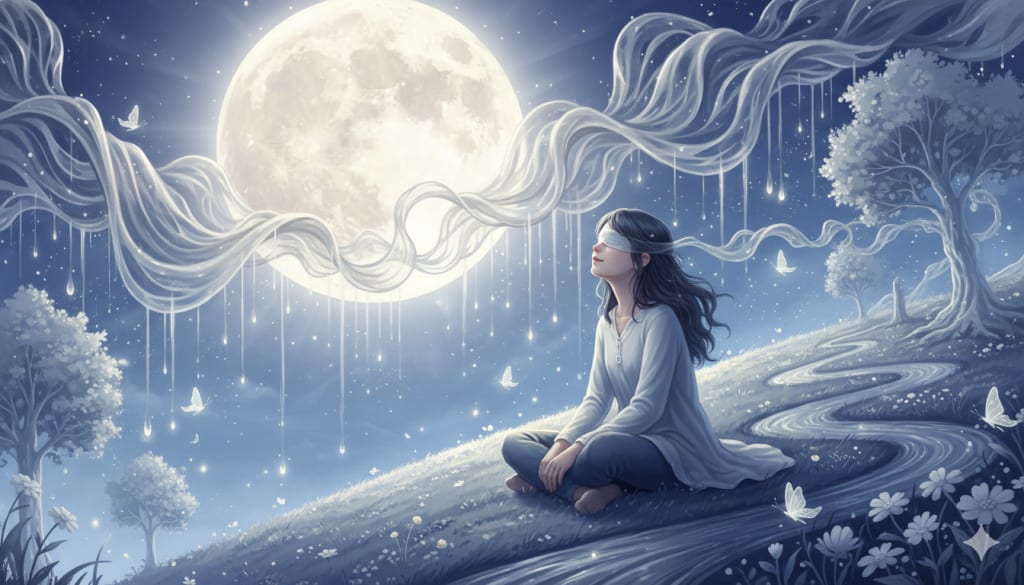
Elara’s world was not dark. People called her blind, but that was their word, born from their own fear of the absence of light. Her world was built of sound and scent and texture. The rough bark of the old oak was a story of strength. The scent of rain on dry earth was a complex symphony. But the one thing that remained an abstract concept was the Moon.
Her grandmother would describe it to her. “It’s a silver coin in the sky, my dear. It casts a soft, gentle light that makes the world look dreamy.”
But what was silver? What was light? These were just words.
Frustrated, Elara would go into her garden at night, turn her face to the cool emptiness where she knew the Moon resided, and whisper, “If you’re so beautiful, why can’t I know you?”
The Moon, who had been listening to the wishes of humans for millennia, heard her. It heard not a demand, but a genuine, heartfelt plea for connection. The Moon had always given light, but it had never considered that its gift was inaccessible to some.
So, the Moon decided to give a different kind of gift.
One night, as Elara sat in her usual spot, a strange sensation began. It started as a gentle pressure in her ears, like the world was holding its breath. Then, a sound began. It was not a sound that traveled through the air, but one that blossomed directly in her mind, pure and clear.
It was a single, low, resonant chime, like a massive, distant bell. And with that chime, she felt the shape of the hill she sat on—a soft, sloping dome of sound. Another chime, higher-pitched, and she felt the tall, straight presence of the oak tree next to her, its branches a complex, shimmering melody of smaller notes.
The Moon was not shining. It was singing.
Each object in the world, touched by the moonlight, now had its own unique tone, its own musical signature. The pond at the bottom of the hill was a collection of soft, liquid glissandos. The sleeping flowers were a chorus of faint, sweet harmonies. The fence was a steady, rhythmic beat.
Tears of awe streamed down Elara’s face. This was more than sight. Sight was one flat picture. This was a symphony of existence. She could hear the density of a rock, the hollowness of a bird’s nest, the complex, flowing life of the stream.
She stood up, walking slowly through her garden, her hands outstretched. The Moon’s song guided her perfectly. She didn't need to touch the rose bush to know its thorny, intricate shape; it was a sharp, beautiful chord with a dangerous, prickly counter-melody. She could "hear" the rabbit hiding in the tall grass, a quick, thrumming rhythm of a tiny, fearful heart.
For the first time, she could perceive the vastness of the sky, not as an empty void, but as a deep, silent canvas upon which the Moon painted its sonic masterpiece. And the Moon itself was the conductor, the source of this incredible concert. It was not a cold, silent rock. It was the most beautiful musician in the universe, playing the world just for her.
She made her way to the village, which was usually a confusing labyrinth of echoing walls and unpredictable sounds. But under the Moon’s song, it was a structured, magnificent composition. Each house had its own bass note of foundation. The cobblestones sang a percussive rhythm under her feet. She could hear the difference between the solid, deep tone of the blacksmith’s anvil and the high, brittle ring of the bakery’s window.
People saw her walking with an unearthly confidence, a radiant smile on her face as she navigated perfectly around obstacles she could not see. They whispered that she was blessed.
When she returned to her garden, the Moon’s song softened into a single, gentle lullaby—the sound of the world sleeping. Elara sat down, overwhelmed with gratitude.
“Thank you,” she whispered into the night.
A final, warm, pulsing tone washed over her, a feeling of “You’re welcome” that needed no translation.
From that night on, Elara was the Moon’s favorite listener. On clear nights, the Moon would perform its symphony for her, and she would dance in her garden, not to music she heard, but to the music of the world’s very soul. She learned that the Moon’s true light wasn’t for the eyes; it was a frequency of pure understanding, a gift of perception granted only to those who knew how to listen with their heart.
She had never seen the Moon, but she knew it better than anyone. She knew it was a maestro, a poet, and a friend. And in its silent, silver song, she had found a world more vivid and alive than any sighted person could ever imagine.
About the Creator
Habibullah
Storyteller of worlds seen & unseen ✨ From real-life moments to pure imagination, I share tales that spark thought, wonder, and smiles daily
Keep reading
More stories from Habibullah and writers in Fiction and other communities.
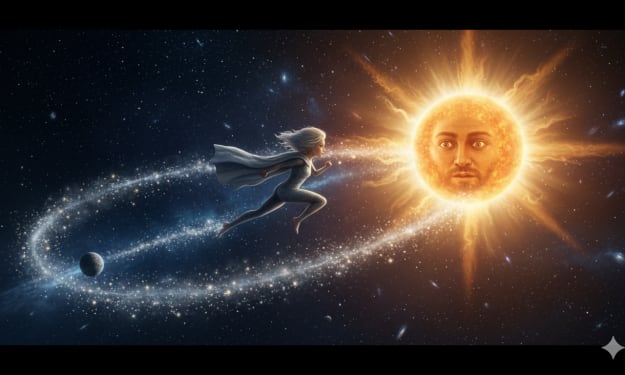
The Moon That Chased the Sun
For eons, their dance was the clockwork of the universe. The Sun was a king of fierce, glorious light, painting the world in bold strokes of gold and blue. The Moon was his quiet queen, softening his harsh edges with her gentle silver, weaving dreams into the night. But they were never together. The cosmos, in its infinite wisdom, had decreed they must forever be apart, their love a constant, heartbreaking near-miss.
By Habibullah4 months ago in Fiction
The Family Riches
According to family legend, our massive wealth originated from the creative genius and business acumen of my great-great-great, Grandfather Oliver Dooley. Ever since I was a young child, my parents and grandparents talked about this ancestor as though he were a cross between a conqueror and God himself. The older I got, the less believable I found these tales of his grand exploits to be. I began questioning the family lore. When I did, my elders would give me a disgusted look, point to our time- worn family bible, and exclaim, “If you don’t believe me, look it up. The family history is all in the book.”
By Mark Gagnon3 days ago in Fiction


Comments
There are no comments for this story
Be the first to respond and start the conversation.