

*originally published on Medium*
“She’s coming around,” a voice says, far away. Shapes blur in my vision and I can’t tell if this is real or a memory.
“Natalie.” A stern voice reaches out to me through the fog. “Can you hear me?”
I groan. My throat feels tight, like it’s been days since I used it.
“Do you know where you are?” It’s more command than question.
“I’m… at school,” I say, through a dry mouth. Everything hurts because I’ve just been beaten with a pointer, for reading from the Alizarin reader. Miss Garvey says I’m a typical Viridian brat, always challenging authority.
“She’s delusional.” The voice retreats. There are mumblings. More stern voices.
“This is pointless. She doesn’t remember anything.”
“So what do you want me to tell Rhinehardt?”
“I don’t think there’s any reason to continue.”
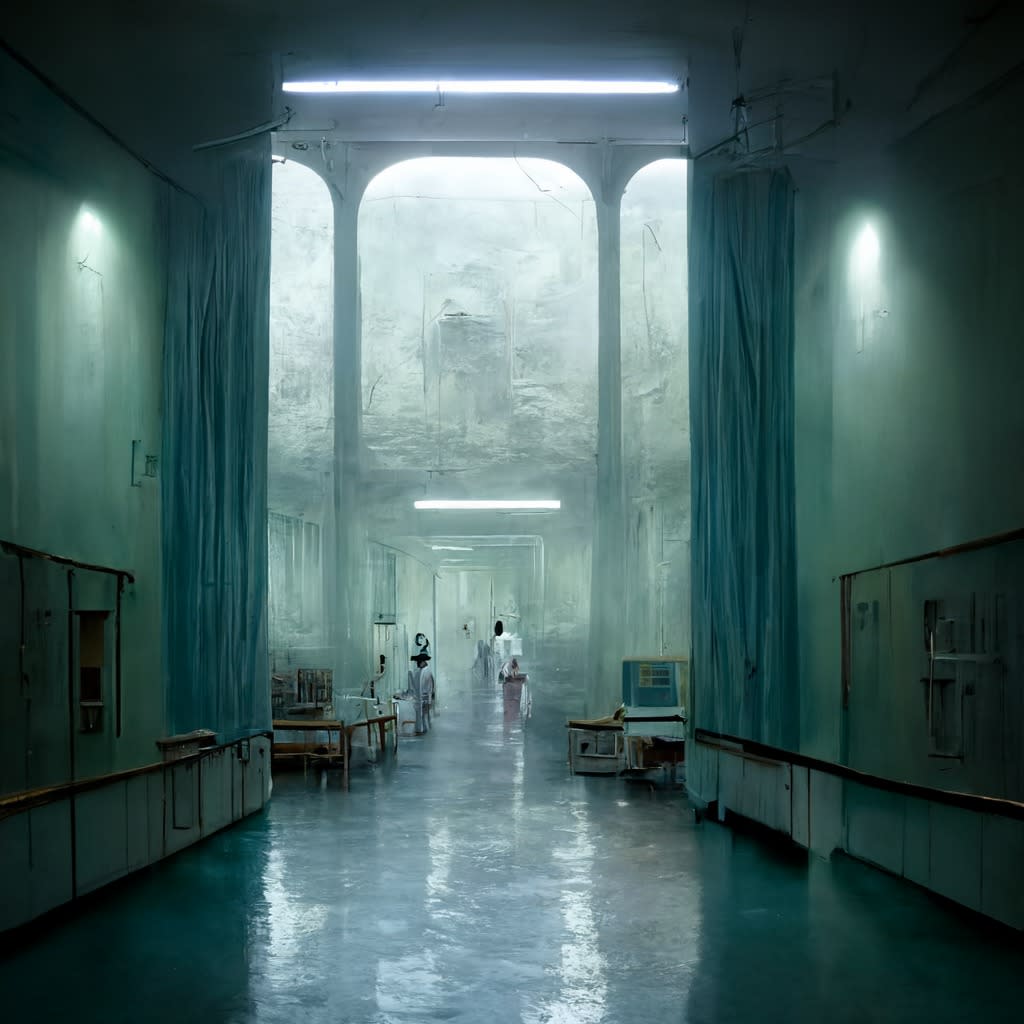
The voices dip out of my hearing. My vision is clearing. Above me, the ceiling hangs in an ominous grid of white squares. There are wires and tubes attached to me through needles in my wrists and the insides of my elbows. The ghost is there, beside me. She shakes her head, telling me to stay quiet.
“… some more time,” One of the voices is saying. “Another week.”
“Fine, but it’s your case. I don’t think there’s any point proceeding. She isn’t a candidate. She’s too damaged. Jericha, what do you think?”
“I’m still recovering from the last time I tried to treat her.” The third voice says with a snort.
My stomach tightens when I realize I’m strapped down. I attacked my doctor. Too damaged. Soon I will disappear, too, like the people I can’t remember. My thoughts are liquid, and they begin to bleed into the white all around me. I want to sleep, but I don’t want to disappear.
Good, the ghost whispers to me, her green eyes wild. Fight.
My wrists are too thin for the strap across them. I try to pull one free. It’s hard to move, hard to make my muscles listen to unfamiliar commands. I’m so weak, so dizzy. The room swirls around me. My heart just keeps pumping more medication through my body. My blood is poison for my thoughts. The tension seeps out of my muscles, my eyelids.
Don’t stop. She is impatient with me. She’s so strong, but I’m weak. I’m tired. I’m crazy. Run… her voice is fading. Everything is fading.
Roses. They were pink and fragrant and fragile. Her father grew them just for her, as a surprise, for her birthday. Flowers were a waste of valuable agricultural resources and he could get into a lot of trouble for doing such a reckless thing. But they were so beautiful. She had always wondered about flowers, ever since Daddy showed her pictures of them. They had the seeds, but no reason to grow them anymore, since the bees were gone. ProsCo took care of all of that now. Here, with the roses, she didn’t think about the danger. She rubbed the velvety-smooth petals between her fingers and breathed in the smell. Her father was delighted that she liked them. He grinned and picked her up and swung her around. She laughed and laughed.
Wake up. There is no soft return to consciousness this time. Someone is shaking me. I look around, trying to get my bearings. My hands and arms throb. The needles are gone. The ghost is loosening my restraints.
You have to get up, she says, with her silent, voiceless words. They’re coming.
“What?” I blink, trying to understand. “Who’s coming?”
She helps me sit up.
“Did I really kill you?” I ask her, my voice echoing around the empty clinic. “Why are you helping me?”
But she isn’t there.
I stare down at my bloodless arms and focus on staying upright. My legs dangle over the side of the bed. They stretch and drip and wobble in my vision, not like legs at all. My knuckles are bruised. I flex my fingers, but I can’t feel anything.
A moment later, the far door opens and the three doctors walk in — Dr. Wu, Dr. Abernathy, and a third doctor I’ve only seen twice before. Dr. Rhinehardt seems to be in charge of this facility. He only comes in when there are big decisions to be made. He is shorter than the other two, and carries a pen and a clipboard instead of a tab. A pair of wire-rim glasses perch on his nose. They make him easy to identify, even if I can’t focus on his face.
“Well, Natalie, it’s good to see you awake.” Dr. Rhinehart stands in front of me, looking down at his clipboard. “You’ve been sedated for some time, I see.”
It feels like days, but I can’t be sure. “I’m feeling much better now, Doctor.” I’m surprised how steady my voice sounds.
“Glad to hear it,” he mutters, never looking up. “We need to discuss what happened with Dr. Abernathy.”
I glance at her. There are two faintly pink lines on her cheek. They’re healed enough that I know I’ve been out of it for at least a week.
“I am sorry, Doctor,” I say. “I don’t know what happened. I guess one of my delusions must have taken over.”
“Your violent outburst was prompted by a picture of this woman.” Dr. Rhinehardt hands me a photograph from the file on his clipboard. I wonder why they aren’t restraining me now. I wonder what they’ll do if I lose my mind again.
Tentatively, I glance at the photograph. Smiling eyes, long blonde hair.
Mom, the ghost yells in my ear. I ignore her, though she’s shaking my shoulder now. We have to hurry, she needs me!
“She’s pretty,” I say. “But I don’t recognize her. I’m sorry.”
The doctors don’t look at each other, but they each take notes on that. A moment later, they summon a nurse to take me back to my room. Her hands are cold and lifeless on my skin and I pull away from her the second I’m through my door.
“Dinner will be served in an hour,” she says. “Here’s your pill.” She hands me the familiar red-and-white capsule and I take it out of habit. My head is starting to hurt, anyway.
Everything is heavy. The air is cold and thick. I crawl onto the bed and pull the blanket around myself. The flimsy blanket does nothing to warm me. What’s going to happen to me?
The photograph Dr. Rhinehart showed me did tell me one thing — my ghost is not just a figment of my imagination. She had a mother, once, with long blonde hair.
My mother had soft hands.
She used to brush the hair out of my face when I was little. “You look like you’re hiding behind there,” she laughed. “Come out, come out!”
They bring me dinner. I eat alone, in my room. I turn the spoon over and over in my hands when the algae is gone. It’s a white plastic spoon, all rounded edges and safety. I run my thumb over its edge. I want to keep it, but I don’t understand why. I don’t understand the urge I feel to tuck it between the mattress and the bed frame. They’d know I’d taken it, anyway, and search until they found it. Still, the desire is there, the first thing I can remember wanting.
They come back before I can decide.
They’re almost nothing, the nurses. White uniforms, white stockings, white hairnets over their hair. They move in sync and their faces show no trace of human emotion. Smooth around the edges, like the spoons.
When the nurses are gone, there is something on the floor that wasn’t before. A tiny, folded, scrap of paper. I didn’t see it fall, and I certainly didn’t see either of the automatonic nurses drop it, but nevertheless, there it is. I pick it up. It’s a very small piece of paper, with a question on it.
Who are you?
I rip the scrap of paper into tiny shreds, tears pricking at the corners of my eyes. It’s a cruel question. Who am I? I can’t remember. That’s the whole point. Like asking someone with an amputation, where’s your arm? I don’t know, and it doesn’t matter anyway, because it’s too late now. It’s gone. I can’t make it grow back.
It’s never coming back.
The thought turns into a lump in my throat that swells when I try to swallow. I curl up on the bed and focus on the blank gray wall in front of my face. I don’t feel anything, I tell myself.
“How do you feel, Natalie?” Dr. Rhinehardt’s office is different than the room I’m used to. Bigger. Somehow even grayer.
“I don’t feel anything.”
There is no table in this room. Only his chair, and mine, far away from each other, on thin carpeting.
“That’s good.” Dr. Rhinehardt holds no papers or clipboard this time. He just sits, hands folded across his lap. “We want you to be calm. That’s the best way to tackle your mental issues.”
I nod.
“Tell me the first thing you remember, Natalie.”
I blink. “You mean, today?”
“I mean, your earliest memory.”
He must be joking. “I… I remember getting up this morning. I got dressed, I took my medication…” I trail off. I don’t remember when or if I ate, or what I did before coming to his office. I don’t remember what corridors I took to get here.
“Think back with me, Natalie. Think back to when you first came to us.” His voice is soothing. “Lay your head back on the chair, and go ahead and close your eyes. Think with me. Your first day here. What do you remember?”
I obediently close my eyes and try to think. My head swims. White robes, white socks, four gray walls, gray algae, lukewarm showers. Was it today that I took a shower? Which pills happened on which day? I remember being in the clinic after I attacked Dr. Abernathy. I remember something happened that made me angry at her, but I don’t remember what it was.
“I got in trouble,” I say.
“Yes.” He says. “Think back further. Try to remember the first day you were in this facility. Who did you meet? What did you see?”
My thoughts begin to stumble. They’ve never asked me anything like this. They’ve never wanted to talk about “before.”
I try. I think. My memories stutter. White white grey. Black behind my eyelids. Pills turn the pain into heaviness. Blurred faces. Voices far away. Walking down the halls. White and grey. Bright white bursts of pain. So much pain. And then that heaviness weighs me down to sleep.
“All right, Natalie. We’re going to try something.” The doctor stands up and walks across the room to fiddle with an electronic fitting on the opposite wall. He turns off the overhead light and sits near the wall, in the dark. A bright white light shines from the device.
“Focus on the light.” Dr. Rhinehardt says.
It tracks slowly across the room, changing from white to blue to green. It backtracks and turns from green to red, then repeats, slowly gaining speed until it’s strobing too fast to track, creating a seamless spectrum of color. I start to feel nauseated.
“What’s your name?” Dr. Rhinehart asks.
I blink and glance at him. “Natalie?”
“Focus on the light, please.”
The beam slows down until my eyes can catch it.
“What is your mother’s name?”
I struggle to remember, my eyes darting back and forth as the light speeds up. “I don’t know.”
“What is your father’s name?”
“I don’t know.”
“How old are you?”
My chest squeezes with panic. “I don’t know.”
“Can you name one person you love?”
I chew the inside of my bottom lip.
“Answer, please.”
“No.” My voice is pathetic.
“How many people have you killed?”
I stare at him, my breath knocked out of me. “What?”
“Focus on the light, and only the light, Natalie.”
“I’ve never killed anyone.” When the words come out of my mouth they feel flat, lacking conviction. Cold dread squeezes my heart. The ghost. I killed the girl who’s haunting me.
“This is all part of the treatment. Please watch the light.”
Reluctantly, I go back to tracking the light.
“How do you feel right now, Natalie?”
“Freaked out.”
“Please be more specific.”
“I’m freaked out, rat it. How else do you want me to put it?” I snap, and jump up from my chair. “You just insinuated I’ve killed someone! I can’t remember anyone I love! I’m freaked out, ok?” I pace closer to him.
“You’re angry.” Dr. Rhinehardt’s voice is placid. “Interesting.”
For a second, I want to wrap my hands around his neck. The anger drains out of me, though, my head aching too sharply to maintain any other feeling. I take a step back and slump into the chair, drained. Is it interesting? It doesn’t feel that way. It feels exhausting. Why did I say that? It didn’t sound like me.
“Focus on the light, Natalie.”
“My head hurts.” I lean forward, after a long time, and drop my head into my hands. “Can I go back to my room now?”
“Of course.” Dr. Rhinehardt unfolds his hands but doesn’t stand up. “The nurse will take you back now.”
All I know is the pain between pills. All I want is the velvet weight the medicine brings. They give me more pills now. The ghost doesn’t come any more. I am floating. Nothing hurts. I’m cured.
I don’t worry about my treatments anymore. They’re easy, now. I sit in Dr. Rhinehardt’s office and don’t say anything, and he listens to the nothing that I say, and he tells me I’m doing very well, and then I go back to my room and they give me more pills and I float. Sometimes he tells me to watch the light. Sometimes he tells me to lay back and count backwards from ten. I see nothing, feel nothing, taste nothing. I am nothing. I have reached perfection.
They give me so many pills now, more than I need for the pain. I store them up and take them 3 or 4 at a time, then lay naked on the cold floor and let the blissful nothing carry me away. I close my eyes as the room swirls around me and I float to happy.
Happy isn’t like before. No pictures, no sounds, just memories of a feeling. Happy that feels like flowers blooming inside me. Or happy that feels like little bubbles tickling up my body. There’s a happy that feels like being wrapped in a warm blanket after being very, very cold. A happy that is like a finger tracing patterns on my stomach.
I will never be scared or cold or crazy again. I will always have the pills. I will always be floating.
I never take more than 4 pills at a time. Until the day I take 8.
About the Creator
Emily Finhill
I'm just a tormented spinster authoress, trapped in the life of a happy suburban mom.
Reader insights
Nice work
Very well written. Keep up the good work!
Top insights
Compelling and original writing
Creative use of language & vocab
Excellent storytelling
Original narrative & well developed characters
Masterful proofreading
Zero grammar & spelling mistakes
Keep reading
More stories from Emily Finhill and writers in Fiction and other communities.
Snow in the Woods
Ice crunched under the tiny feet of a child almost as pale as the frost. The forest loomed over the child and her companion, trees shaking shaggy heads in dismay. The man led the child by the hand. He had a sharp boulder of a face, and barely a glint of humanity in his little pebble eyes. The girl was cold. She wore only her nightgown, made of the finest white linen and embroidered with gold thread. The royal crest graced her collar, but she was yet too young to know what that meant. The man yanked on her, pulling her farther into the shadowed woods.
By Emily Finhill3 years ago in Fiction



Comments
There are no comments for this story
Be the first to respond and start the conversation.