
Meltdown: Chapter One
Content Warning: this book contains themes of mental illness, trauma, loss/grief, suicidal thoughts, sexual assault, ableism, and xenophobia. It contains violence, gaslighting, bodily disfigurement, torture, and death. Not intended for audiences under 13.


*Originally published on Medium*
I remember how it all began. With anger, hunger, and hate. Even when I couldn’t remember my own name, I remembered the anger, sparked by a playground tyrant with cold eyes. Fanned by the words they wrote on our house, and the things they called my father. Anger that roared so hot, it began to feel good, burning away every other feeling. I fed the hate to the anger and the anger grew stronger, consuming everything, creating a safe barrier of ash around me.
It was my own house that burned, though.
I remember the flames. My father carrying me out through thick acrid smoke. The beams cracking, and the thud of our bodies. I remember how I scrambled, alone, through hot coals that burned the soles of my feet as I ran into the waiting arms of my mother. My heartbeat punched bruises in my ears as she screamed for my father. She screamed on and on, forever. I think she might still be wailing, just outside the range of hearing.
I remember how it all ended.
I was running, like always, and I didn’t see them coming. I remember the thud of colliding with something impenetrably hard, and then falling. I remember the empty space rushing past me, blowing my hair around me, whipping me all the way down.
I don’t remember the middle.
It isn’t true to say these things happened to me. Sometimes I forget, because the memories seem so clear. I can feel her heart beating against her throat. I can feel her heat, her anger, her determination. But I am not that girl. I don’t know how she got so angry, or how her house caught fire, or why she ended up in that dark underground place.
The first time I saw her, I was exhausted. I was hurting. The doctors asked hard questions that day, and I didn’t know the answers, and everyone was disappointed. All I wanted was to sleep.
Instead, I felt a cold gust of air. I looked up, and she was standing over me.
“You killed me,” she breathed, her face vague and angry. Dark gold hair curls in a wild cloud around her. Then she leaned over me and began to whisper.
Sometimes, she tells me secrets. Sometimes, she tells me lies. I know they are lies, because my doctors tell me so. They tell me I’m delusional, I had a psychotic break, the wires and the pills are for my own good.
I don’t know why I have these thoughts. I don’t know why I hear her, telling me I killed her, telling me nonsense— grab that spoon from the tray and hide it, she says. Throw the tray at that nurse and grab her keycard while she’s distracted.
I ignore her. Dr. Abernathy says we have to ignore the voices. She says the only difference between the crazy and the troubled is how we behave. I don’t want to be crazy. The crazy patients have to go to the other side of the facility, to the place where they do the tests.
I don’t want to be crazy. I just want to be left alone. I don’t know how the ghost found me here, beneath the ground. I don’t think I’m supposed to know that we’re underground. The doctors don’t talk about anything outside of this place. I think they want us to believe this is the whole world. But I know there is a city above us, a city inside a glass bubble that sits on a destroyed world, waiting to pop. I remember, from the ghost’s memories.
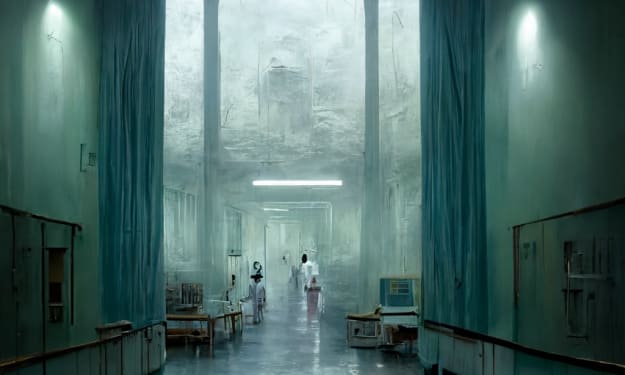
“Natalie,” Dr. Wu says gently. I blink. I don’t know how I got here. I am sitting at a table in a small room that is all gray and white, all linear and angular and cold.
“Can you tell me what this says?” He prompts me.
I try to make my eyes focus on the table. It’s covered in loose, messy, handwriting. It’s just one word, over and over.
“It says, ‘run,’” I say.
“Why did you feel the need to write that?” He asks, without any trace of concern, or even curiosity.
“Me?” I look down at my hands. I am holding a pen and the heel of my hand is smudged with ink. “I…” I trail off, staring into Dr. Wu’s wide, blank face. I have trouble tracking the details of his features. “I don’t remember.”
“That’s alright.” Dr. Wu pats my hand.
I pull my hand away.
“Why did you pull away, Natalie?” Dr. Wu taps notes on his tab, not looking at me.
I try to think. “I don’t know,” I reply, honestly. “I’m tired.”
“We’ll try again tomorrow.” Dr. Wu stands up and pushes the button that makes the nurse come.
He holds his hand out, palm up. I look at it blankly, trying to remember. Am I supposed to shake it?
“The pen,” he says, all patience.
“Oh.” I have already forgotten I am holding it. I drop it back into his hand, careful not to touch him.
The nurse wheels me back to my room. My head is pounding, red and black crowding in at the corners of my eyes. She gives me the pill that makes the pain go soft and abstract, and I lie down on the narrow bed.
I want to go home. The ghost girl whispers in my head.
“I don’t know what that means,” I whisper back.
Then I’ll show you.
I fall asleep, and it feels like losing control.
“Yo!” Theo hollered. “Pick it up, Tas! This ain’t your day off!”
She wiped the sweat out of her eyes with one grimy sleeve and flipped two fingers at him. “Isn’t it about time for you to go do your nails or something, spuzzhead?”
A broken cup whizzed through the air by her left ear.
“Hey!” She scowled. “You really want to start this with me? I kicked your ratted behind last time, remember?”
“Just get a move on,” Theo said, white teeth flashing against dark skin. All humor, no bite. That was probably why she’d beaten him. “I’d like to get home this century.”
Muttering a few words which would have severely disappointed her mother, she dug her shovel back into the pile and shoved it deeper with her foot. The stench of rotten food, mildew, and decay filled the pit, laced with the occasional wafts of gangrene. The muscles of her shoulders burned as she hauled another shovelful of trash into the wheelbarrow. Above them, orange lights flickered and dimmed before buzzing brighter, barely penetrating the shadows in the pit.
She grimaced as a particularly foul odor wafted up from somewhere near marker 9. She had a bad feeling about that smell. Sure enough, her shovel uncovered something brown and oozing.
“We got a leg, Theo!” She yelled over her shoulder. She grimaced down at the severed limb.
Theo trotted over, dragging his big bucket, his blue plastic suit rustling.
“Oh, rat, that’s one sweet load of nasty.” Theo rubbed his gloved hands together.
“Take it. I don’t want to catch whatever it’s got.” She started shoveling again.
Whistling, Theo picked the leg up and dropped it into his bucket, where it landed with a thwack against whatever other parts he’d picked up so far.
“It will be spuzz soon enough,” he said.
I wake up with the smell of garbage and rotting flesh still in my nostrils. I roll over and vomit onto the floor beside the bed. My whole body is cold and clammy, sick with the smell and exhausted by the physical labor. Almost like I was really there. The thin gray blanket does little to warm me in the freezing room. I press the button to call a nurse to clean up my mess.
The nurse shows up with a mop and bucket and no expression on what passes for her face. I can’t make out a single feature. Does she have blue eyes? Brown? I stop trying to decide as my stomach twists and lurches.
She makes a note on her handheld computer and cleans up my mess without saying a word. I lie back when she leaves, fighting sleep but needing rest. I don’t want to give the ghost another chance to show me her life.
Why would you ever want to go back to that? If I killed you, I did you a favor.
My dreams are flashes of a life I don’t recognize. Steam pouring up through grates on a dark street, catching pink and orange light in eerie clouds. Rats scattering in a cracked and molding tunnel. A girl laughing with an open mouth, teeth flashing, dark hair falling across her face as neon signs flash overhead. A glowing screen that can make you feel things, things you feel just for fun. A pair of hands — my hands — covered in blood and ash, shaking. Lights flashing in a darkened room, bodies packed tight, writhing like one creature in rhythm with music so loud it’s more sensation than sound. Strong arms wrapping around me and holding me against his chest, warm and familiar and —
I startle awake. Not me, I remind myself. Her. Not me.
When the nightmares come, I’m glad that I’m not her. I’m glad that I’m safe here, away from the muck and the stench and the hunger. But the laughter she shared with friends, the warmth of her mother’s embrace, the heat in the hands of a boy… those things are foreign to me, unknown in my underground sanctuary. I am alone here. We are all alone together, walking down the halls in sync, taking turns in group, eating in evenly spaced quiet.
I get out of bed and dress myself in a set of white pajamas identical to the one I’ve just taken off. I drop the old ones into the laundry chute in the wall. The doctors and nurses wear shoes and coats and pants and sometimes neck ties. I am not given shoes or a coat or pants or a necktie. We in the white pajamas walk barefoot to the room where they feed us our daily allotment of gray algae.
Some of the patients work in the algae gardens, tending long troughs of water under carefully tuned lights. I think I’d like to be allowed to work, tending algae or washing clothes or serving at the counter. They don’t want me to work, though. Not yet. I am not “stable.”
We all sit at the same table, although the room is large enough for each of us to have our own table and several between. I don’t know why the room is so large when there are only thirteen of us. Sometimes I think there used to be more, but I can’t remember. It doesn’t seem like there have ever been enough of us to fill this room.
If I think hard, so hard it makes my head ache and my vision shiver with my pulse, I remember a girl. She was tall, much taller than me, and she had black hair and soft brown eyes. She sat next to me. I think she held my hand once while I cried. But she’s been gone for hours, for weeks, forever.
We eat with our heads down, burying ourselves in our own fractured minds to escape the slimy chill of the algae sliding down our throats. It tastes like nothing. Like mucus. Like swallowing words you weren’t brave enough to say. There is so much nothing in it that sometimes phantom tastes bubble on the back of my throat, and I remember sweet and spicy and sour. The ghost brings memories of taste, but also of crushing hunger. Is it better, I wonder, to have too little of something amazing, or more than you could ever want of nothingness?
“How are you feeling today, Natalie?” Dr. Abernathy asks. She sits with one leg draped over the other and taps her fingernails against her thigh. They are red. She’s the only doctor with red fingernails. I’m still having trouble with faces.
“I feel fine.” My hands are folded on the table in front of me and I don’t remember coming from the dining hall to her office.
“Today, I want you to try a word-association experiment with me.” Dr. Abernathy picks up a stack of cards from the small table at her elbow. “I’m going to show you an image, and I want you to say the first word that comes to your mind. Do you think you can do that for me, Natalie?”
“Yes.” I clasp my hands on my lap under the table.
“Alright.” Dr. Abernathy holds up the first card. It has a picture of the pills they give me to help my head.
“Medicine?” I say. This feels like a trick.
“Very good.” Dr. Abernathy nods and holds up a picture of a bed.
“Sleep,” I say.
“Good.”
Next is a bag, an ordinary-looking messenger bag. A school bag.
“Bomb,” I say. I blink. That’s not right.
“Hmm.” Dr. Abernathy makes a note. “Let’s continue.” She holds up a card with a woman’s face on it.
I lunge across the table, screaming.
About the Creator
Emily Finhill
I'm just a tormented spinster authoress, trapped in the life of a happy suburban mom.
Reader insights
Outstanding
Excellent work. Looking forward to reading more!
Top insights
Compelling and original writing
Creative use of language & vocab
Excellent storytelling
Original narrative & well developed characters
Keep reading
More stories from Emily Finhill and writers in Fiction and other communities.



Comments (1)
Great writing! Keep it up!