
Marco De Franchi, "Il giorno rubato"
A paranormal thriller

The Fantastico italiano series, directed by Luigi De Pascalis for the Lepre editions, deals with the fantastic “with roots in our culture”. “Il giorno rubato” by Marco De Franchi enters fully into this category. The plot tells of the massive eruption of the supernatural into daily life and does so based on the heritage of traditions of the city from which the author comes, namely Rome.
The main character, Valerio Malerba, is a writer who produces bestsellers like Roberto Giacobbo, where he investigates paranormal phenomena with rational clarity and scientific skepticism. But the irrational, the imponderable, the unexpected falls into his life, upsetting it, unhinging all awareness, all previous beliefs, overturning the knowledge and reality of the world as it appears. It all starts from a day that does not exist, March 13, 2007, a day stolen, disappeared into thin air, a day in which nothing seems to have happened, a day of which the entire community has lost memory. This will be the starting point that will put Malerba in contact with more than disturbing presences that have very little of normality, until the final, explosive discovery, it is appropriate to say.
In his research, Malerba will cross and discover an underground city, mysterious and unknown to most, reviving ancient pagan beliefs such as the cult of Mithras, and that of Mater Matuta, which is not, as one might think, the beneficient adoration of the Great Mother, but an even more remote rite, made up of male and evil entities, venerated by populations settled on the Lazio hills before the advent of Rome.
“We can say that the Great Mother was the first human expression of those terrible and incomprehensible divinities, their childish watering down. An attempt to give a name to the incomprehensible. The real womb from which we are born is that of the Great Ancients: a bad womb, or at best indifferent. A stepmother to sacrifice and be sacrificed, but in vain.“
The same stepmother Nature of Leopardi, on closer inspection: indifferent telluric energies, just slightly curious and yet, in the end, capable even of being amazed at the evil that we men are able to do, where they have neither moral nor immoral intentions towards us, just as we would not have them towards a handful of ants.
If there is a flaw in the novel (but it is also a peculiar characteristic) it is that of having wanted to “set everityng right”, perhaps overcharging, mixing dissimilar things, from zombies to Erasers — which remind us a little Rowling’s Dementors — to the political fantasy ending, but the mechanism is still very well thought out and compelling.
“In this Zero Plan I believe that some ‘energies’ are moving. I don’t know their nature or origin, and I can’t define them differently. But they do exist, it is a fact, and by now you will have had ample proof. Perhaps in ancient times they were worshiped as deities and as the world has approached the modern era they have changed their name and shape, while remaining the same: demons, ghosts, antimatter, particles of God, Biggs boson, call them whatever you want.“
The author, like all of us after all — but even more for the job he does — does not understand the world around him, which is increasingly the scene of violence, madness, a wicked design. Family tragedies, crimes, attacks follow one another, overlap, multiply more and more, dragging civil society towards the abyss, towards the center of the maelstrom.
To counter them there is the character of Malerba, the result of a “serene” creative mind, uncontaminated by the role it plays, drawn with a calm language, in a moderation that is not banality but, on the contrary, the result of balance, elegance, cleanliness and measure.
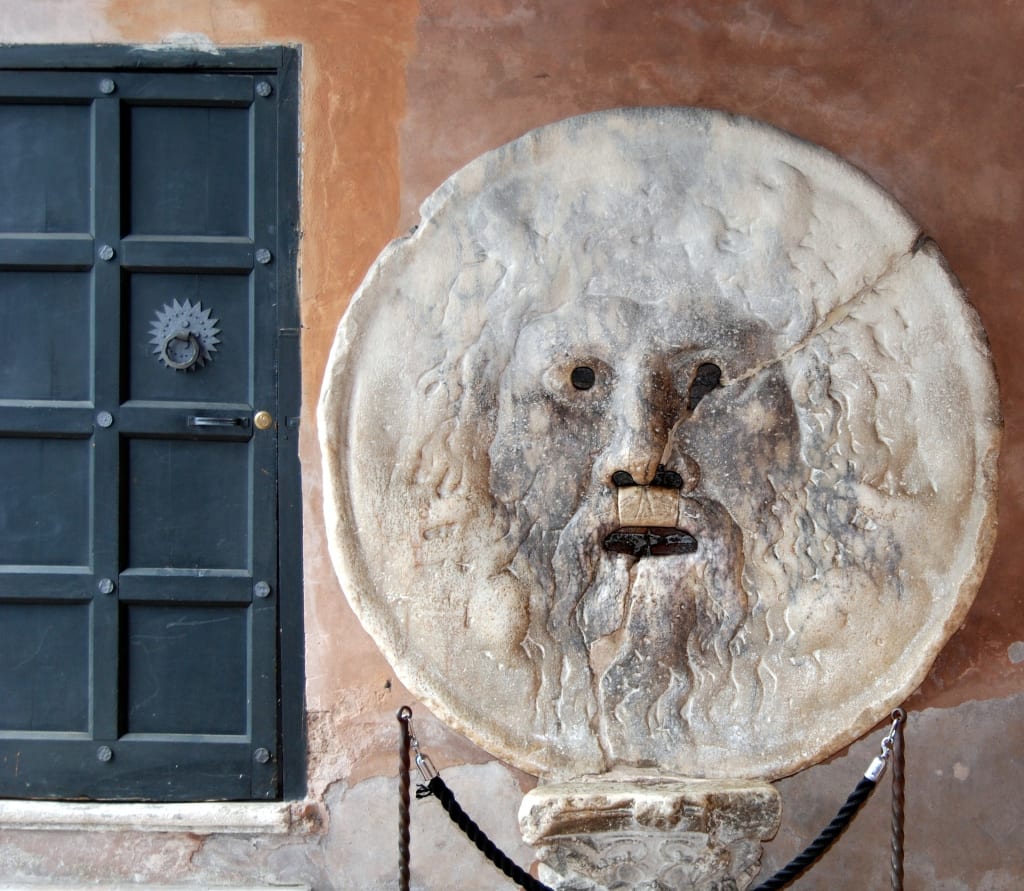
The most intriguing part of the story, I reiterate, is not so much the vicissitudes of Malerba, a little repetitive, but rather the representation of a nocturnal, threatening Rome. We move through temples, squares, half-empty and echoing streets, from the site of the ancient Forum Boarium, to the Bocca della Verità, to the underground mithraeum, to the alleys where hallucinations of small dusty bookshops materialize and appear and disappear. Letting ourselves be lulled by free associations, via Margutta comes to mind from the legendary drama “The Sign of Command”, (1971) directed by Daniele D’Anza.
The plot lets itself be devoured and this is, and will always remain, a value for me. What does the pleasure of reading consist of if not in the desire to turn the page, to know what is happening, in the secret enjoyment at the thought of picking up the book again at the point where we left it? It is what prompted us to read as children and it is what we should never lose, in spite of all the intellectualisms in the world.
To conclude, let’s say that bringing up Dan Brown’s “Angels and Demons” or Stephen King may seem obvious and for some it may not even be a compliment, but it is comforting that we are no longer forced to “fish abroad” and, finally, we also begin to produce good genre fiction, written with evident passion and without sloppiness.
About the Creator
Patrizia Poli
Patrizia Poli was born in Livorno in 1961. Writer of fiction and blogger, she published seven novels.
Keep reading
More stories from Patrizia Poli and writers in Fiction and other communities.
Miss Persephone's Manual to a Seemingly Ordinary Life
Miss Persephone was found at the dining table, her blue eyes swollen, her tears arriving and retreating like the tides of the ocean. Earlier that day, her family had visited her in the retirement home where she had lived for eight years. It was her eightieth birthday.
By Imola Tóth2 days ago in Fiction


Comments
There are no comments for this story
Be the first to respond and start the conversation.