
Man Is Never Happy in Any State
"Under the mountain of troubles, seeking joy."


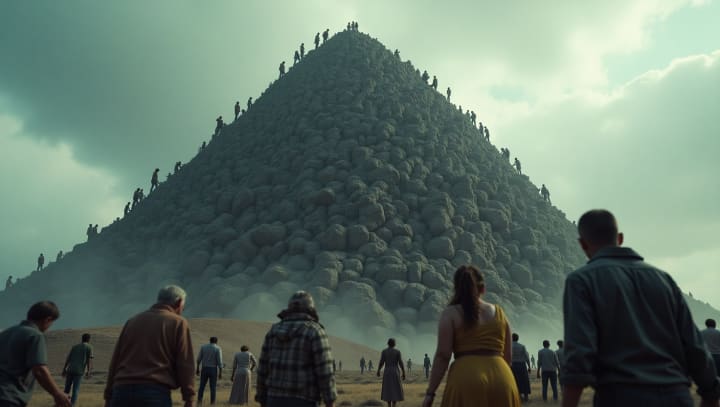
I dreamt that a proclamation had been issued from the court of the Celestial King. Its message was this: all the people of the world should bring forth their sorrows, griefs, and tribulations and pile them in one place. For this purpose, a field had been designated — a field more vast than even the realm of imagination. People began arriving.
I stood in the center, enjoying the spectacle. I watched as one after another came and threw their burdens from their shoulders, yet each burden seemed greater than the last. Eventually, the mountain of misery rose higher than the clouds themselves.
Among them was a withered, trembling man — so thin he seemed made of air. He moved with agility and cleverness through the crowd. In his hand was a mirror that exaggerated whatever was reflected in it. He wore a loose, flowing robe stitched with gold-threaded images of giants and genies, its hem bound to the hem of Doomsday. As the robe fluttered in the wind, countless strange and eerie faces emerged. His eyes were wild, yet carried a sadness. His name was Delusion.
He would tie each person’s burden, load it, and carry it to the designated place.
When I saw my fellow human beings groaning under their loads, and beheld the towering mountain of misery, I felt a deep unease and indescribable pity. Yet among this scene, a few people stood out, offering me some strange comfort.
One man, wrapped in an old brocade robe, brought a large bundle. When he tossed it onto the heap, it was revealed to be the affliction of poverty. Another came running, drenched in sweat and panting under the weight of his burden — he threw it down, and it turned out to be the misery of a terrible wife.
Then came a vast crowd beyond counting — lovers, it turned out. On their heads were bundles made of sighs, within which lay the arrows of longing and the spears of sorrow. Though they moaned in agony under their burdens as if their hearts might burst, strangely, when they reached the mountain, not one could bring himself to let go. They simply shook their heads and walked on, still carrying their pain.
I saw many old women shedding their wrinkles, young men discarding dark complexions, thick lips, or teeth so foul they induced shame. Yet what shocked me most was that the mountain grew tallest from physical defects.
I saw a man happily carrying an enormous burden on his back. As he drew near, I realized he was a hunchback — he had come to cast off his deformity, for he considered it the greatest of all misfortunes.
Among the heap were all kinds of illnesses and ailments — some real, some imagined by confused minds. One particular burden contained the entire sum of all diseases that afflict youth — and many handsome young men brought them as the price of their reckless habits.
But what surprised me most — in this vast mountain, there was not a single trace of foolishness or moral corruption.
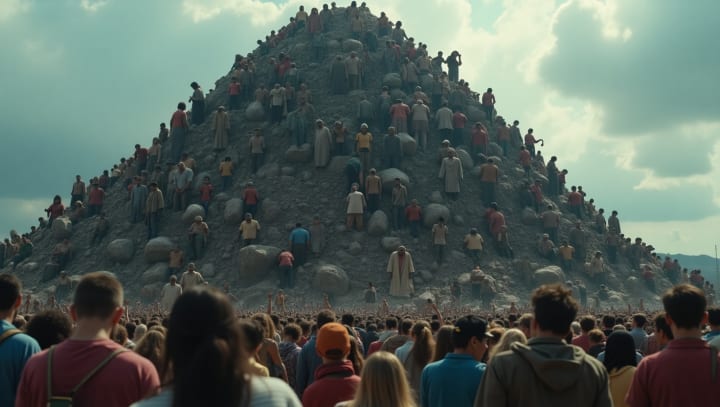
Watching this spectacle, I thought: if someone truly seeks relief from their emotional weaknesses, physical limitations, or intellectual flaws, no better opportunity could exist. I wished I could hurry and toss mine away too.
Just then, I saw a hedonist approaching with the burden of his sins. He flung it away — but when I looked closely, I saw that what he had discarded was not his sins, but his sense of foresight. Then came a group of scoundrels. I thought they might rid themselves of their poor judgment — but instead, they threw away their modesty and shame.
Once everyone had laid down their burdens, Mr. Delusion, still hard at work, saw me standing aside. Assuming I was free of sorrow, he turned toward me. Seeing him approach, I panicked. He swiftly held up his mirror, and I saw my face — tiny, insignificant. In contrast, my body appeared grotesquely large and out of proportion. I was so alarmed that I tore off my own face like a mask and threw it away.
To my strange fortune, I found another discarded face — it was massive, and just its nose was the size of my entire original face.
We studied these piles of burdens with keen curiosity. At that moment, a decree arrived from the court of the heavens: everyone was now free to exchange their burdens and choose whichever one they preferred, then return home.

Delusion once again got busy — swiftly tying up bundles and distributing them.
Each person began reclaiming a burden. The pushing and scrambling that followed defied description. Let me share a few of the things I saw.
An old man, noble and dignified, had been suffering from gallstones and wished for an heir. He exchanged his pain for a handsome young boy. But the boy was disobedient and unruly — so much so that his real father had abandoned him. The moment he arrived, he grabbed the old man’s beard and began attacking him. Just then, the boy’s real father appeared nearby, now doubled over with the same gallstone pain. The old man pleaded with him, “Please, give me back my old pain and take your son! My first affliction was a thousand times better.” But the rules no longer allowed another exchange.
A poor slave had cast off the chains of bondage and taken on vertigo instead. But after walking just a few steps, he collapsed, clutching his head in agony.
Many people regretted their trades. Some sick people had taken on poverty and now despised it. One man who once couldn’t eat now suffered from insatiable hunger. Another had given up anxiety and now writhed in liver pain.
Women, too, suffered. One had exchanged white hair for a boil on her foot and now limped in pain. Another gave up her hourglass waist — but now walked with a huge belly. Someone took beauty but received disgrace and scandal with it.
In every case, it seemed the new flaw felt worse than the old one. I realized then: our sorrows are measured according to our own capacity — or perhaps we simply grow used to them over time.
I felt terrible for the old man who had transformed into a handsome youth, only to develop kidney stones and again lose the ability to walk properly. Even more pitiable was a young man whose beauty had vanished — now hunchbacked, his shoulders drooping, hairline receding, walking with a cane. The women who once adored him now passed by in disgust. He shrank before their eyes.
Since I’ve shared others’ exchanges, I must share mine as well.
That man with the massive face had taken my tiny one — and looked utterly grotesque. I looked at him and burst out laughing, realizing he had grown ashamed. But I had no reason to be proud either.
When I tried to wipe the sweat of shame from my forehead, I couldn’t reach it — my new face was so enormous that my hand landed far from where I aimed. My nose was so large that when I passed my hand over my face, it repeatedly collided with it.
Beside me were two other men worthy of laughter. One had previously limped due to fat legs. He had traded with a man whose legs were so thin, they barely existed. The first now looked like he was walking on two cats, floating through air. The second, with his enormous legs, traced wide circles as he walked. I joked, “Walk ten straight steps, and I’ll buy you a bag of candy!”
Eventually, the entire heap was divided among the men and women. But their condition was pitiable — burdened and exhausted, they ran in disarray.
The entire field resounded with cries, laments, and moans of regret.
Finally, the Celestial King took pity on humankind’s pitiful state. A new command was issued: everyone may now discard their current burdens and reclaim the ones they had originally brought.
Overjoyed, people cast off their new burdens and took back their original ones.
Another decree followed: Delusion, who had led them all astray, must be banished. In his place descended an angel from the heavens — a serene and dignified being named Patience and Endurance.

He looked to the heavens with hope in divine mercy and sat beside the mountain of misery. At once, the mountain began to shrink — eventually reduced to a third of its size.
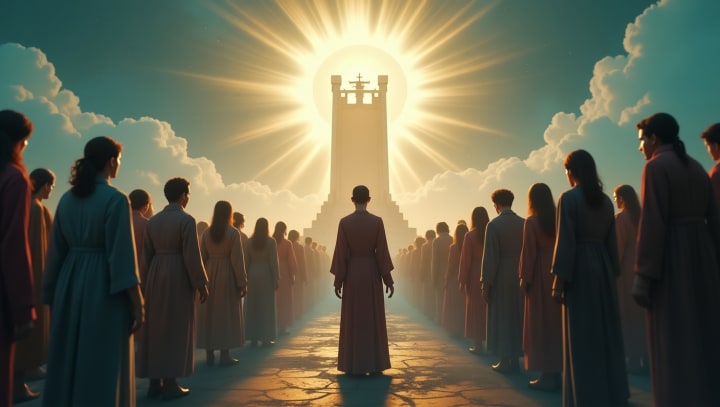
He calmly handed each person their rightful burden, counseling them not to panic, but to carry it with dignity. Each person took it and returned home, content.
Everyone expressed their gratitude, saying, “Thanks to your grace, we didn’t have to sort through that endless heap to find our own suffering.”
About the Creator
Usama
Striving to make every word count. Join me in a journey of inspiration, growth, and shared experiences. Ready to ignite the change we seek.
If You Love Me, You'll Do It
I met Jason when I was five years old. I could say that I loved him from the moment I saw him. He was so handsome to me and I felt in awe by his presence. When they introduced him as the new kid in school, I wanted to be his friend right away. I remember it like it was yesterday. I remember his smile and how he didn't seem shy. He appeared confident and ready to learn. I waved at him and said "hello," before anyone else could even say a word. He sat next to me, and I asked him if he wanted to be friends. He looked so happy as he said, "Yes!"
By Sidney Smith (Sid Smith)7 days ago in Fiction



Comments
There are no comments for this story
Be the first to respond and start the conversation.