
Make Me
A schoolgirl crush you might say, if the object weren’t currently wanted for the kidnapping/maybe murder of your former (first and only ever) best friend.

I’ll be the first to admit my friendship with Madison Hammond was born of necessity, welded together as we were in the vestibule outside the guidance counselor’s office on the first day of fifth grade. The lunch bell rang and still Davy Moore was in the office, having pulled the fire alarm during morning announcements. The secretary came out and told us we should go ahead and eat our lunches as we waited. I, recommended for counseling on the credentials of having to repeat the fifth grade due to an excess of absences the previous year; Madison requiring guidance after moving from a private school upstate on the wake of her parents’ scandalous divorce: her father, a prominent politician had been caught paying a negligibly female call-girl with government funds.
Madison was shy, sweet, lost. I was bored, empty, restless. That first day in the school office, Madison was so nervous her mandarin orange gelatin kept wobbling off her spoon. I passed my free-lunch spork to her and became instantly enchanted by the brief pulse of a smile as it flitted across her face, a smile like in a movie when someone opens a normal closet door to reveal a fantasy world, a universe of otherworldly brightness that is not immediately conceivable. Her smile was something I’d revisit later and puzzle out.
When Madison went missing seven years later, our senior year, I was interviewed for the News at Nine special, the fact of which enraged the horde of ponytail flipping aspiring Instagram models who had replaced me as Madison’s peers once our paths diverged in high school in the wake of her breathtaking bloom. But none of that posse had required the extended support of Dr. Grayson, the guidance counselor whose disappearance aligned exactly with Madison’s, making him the sole Person of Interest in the case. And so it was me, giving the interview. The one Dr. Grayson didn’t hypothetically abscond with.
My mom told me I didn’t have to go to school the day after my primetime interview aired but the alternative was even bleaker—the soundtrack of Mom’s pre-shift ritual battering my bedroom door: the hen-house mania of the home shopping network peppered with the “sniff-snort-cough” triumvirate of Mom sampling Lonny- the-dishwasher’s weekly orange bottle special. I chose school as the lesser evil: I’ll be graduating in the spring but Mom will be snorting pills and setting the bar for personal fulfillment on birthstone jewelry and Precious Moments figurines forever.
I didn’t care at all that everyone at school was talking about me. For me, the most painful part was the blunt shut door of the guidance counselor’s office, the name plaque already removed. I traced the blanched rectangle left in its place, once the wooden underbelly of the name emblazoned on my heart: Dr. Grayson.
A schoolgirl crush you might say, if the object weren’t currently wanted for the kidnapping/maybe murder of your former (first and only ever) best friend.
I wish I’d known Madison was going to become an after-school special. I would have studied her even harder. I wish I’d known he’d choose her over me. I would have made that impossible.
Our middle school alliance was built in the elaborate forts we erected for movie marathons in her den, dipping logs of Pillsbury cookie dough in bowls full of rainbow sprinkles and eating them raw, then rolling around on the carpet pretending to be deathly ill. I once fell asleep face down on a sprinkle that left a bruised pock like an apostrophe on my cheek for days.
I’d never had a best friend. I found it fascinating but ultimately un-penetrating, a rind around my heart that could not be stripped gently. We watched Heathers and learned croquet in the village green, wearing Madison’s old plaid school uniform skirts two sizes too small. We watched The Craft and tried Light as a Feather, Stiff as a Board on her pale pink Pottery Barn Teen rug. We passed a crossword puzzle and bags of sour gummy worms back and forth at recess. I saved all the pink and blue for her and she tipped the crystals from the bottom of the bag onto my outstretched tongue, where it burned sweet like sugar acid snow.
I escaped to her house whenever possible. The loft above the Hungarian pastry shop where she lived with her mother was just a block west of the row house my mother paid rent on just frequently enough to evade eviction. At my house, passing trains made the windows chatter in their frames like skeleton teeth. At Madison’s loft, the windows clinked like crystal champagne toasts. At my house, Mom kept a neck brace by the door to put on every time someone knocked, in case it was an insurance investigator. At the Hammond’s house, there was a bowl of bananas and Nutrigrain bars by the door so that Madison would remember to grab a healthy snack every time she left the house.
---
I told “award winning investigative journalist” Martha Masterson some of this in the interview. She smelled like the pages of the Cosmopolitan magazines we used to steal from Mrs. Hammond’s bedside table. The way she perched on the upholstered studio chair gave the impression that she was trying to minimize her contact with the fabric.
Something about me bothered Masterson, I could tell. As she watched me speak, tiny lines stole across her forehead. Registering them, she’d shake her head, clearing her face like an Etch A Sketch. She called for touch-ups a lot.
At the close of the interview she flipped her notecards face-down on her pencil skirted lap and pasted compassion on her eagle-eyed face. She said, as if it had just occurred to her
“If you could say something to Dr. Grayson right now, wherever he is, what would you say?”
I was aware of the expectant dilation of the main camera lens, the blinking red light stretching the seconds into eternity. I swiveled to face it directly, swallowing away a curious lump rising in my throat. “Dr. Grayson,” I said, licking his name from my lips. “Why not me? Why didn’t you just take me?”
---
He gave us journals, that first day. Each Monday we’d deposit them in the folder outside his office, to be returned to us on our weekly Wednesday check-ins. God, I loved him. I wanted to live in his file cabinets, breathing his aftershave, stroked by his wide and worldly thumbs. I sensed in him a world of black and white, right and wrong. I wanted him to diagnose the state of my existence, make solid the dotted lines of my future state. We joked about it, Madison and I, but for the first time I was diligent, the transcription of the details of my pathetic adolescent existence giving way over time to a catalogue of my young adult transgressions.
Madison and I grew apart our freshman year of high school. She joined the volleyball team, sprouted C-cups, and amassed a posse of Neutrogena commercial cling-ons. She tried to include me at first but I found the side-eyed sarcasm of her new horde too grating, and sank back to the lockered scenery of teenage obsolescence. I’d found a new escape by that time, scouring the boardwalk video arcades for muscled arms to rein me in, define me to myself. My friendship with Madison was reduced to a faint and pleasant memory, the birthday cards she slipped into my locker each year, spilling glittered confetti on the floor for her horde to roll their eyes at. She was prom queen and I was scenery.
I was in the midst of my own awakening, though, the sudden feeling that something’s going to happen. I’d discovered the force of teenaged male desire, the release that came from maneuvering myself into a position of surrender, claiming pleasure as if unbidden, useless even to resist. I wanted my own desire to be sublimated, arbitrary even, an afterthought, a sidenote, an inconsequential truth. Only then could I regard myself with the disinterest necessary to get an objective view. I was like the invisible man, taking shape only under wandering hands, hungry eyes. For better or worse I’d found that I could inhabit myself most fully when subjugated. I wrote the details of each backseat, back alley, backyard romp in my journal, craving Dr. Grayson’s concern or better yet, complicity.
“Some people have to shut out their monsters completely,” he told me once, my journal cradled in his wise, blunt hands. “Others are strong enough to tame them to use at will.”
I knew then that I was Other, and I sensed that he was too.
---
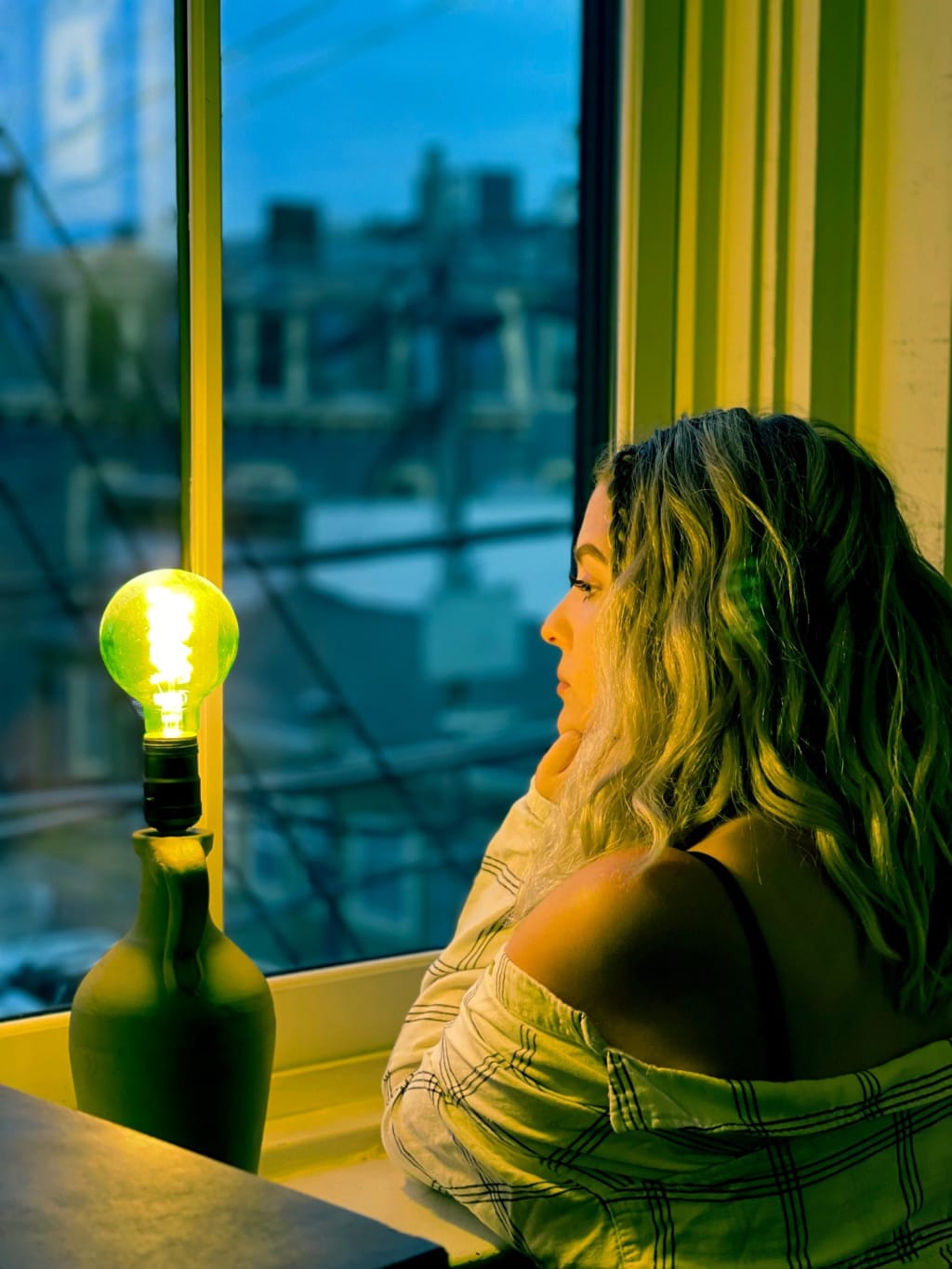
Madison’s mother took less kindly to her social ascension, grounding her often—for missing homework, missed curfew. But Madison found a workaround. She had a lamp in the window of her bedroom that she fitted with a color changing bulb: red for when her mother was home and awake, green for when her mother was out or asleep. When the light was green friends knew it was safe to climb the fire escape and they’d slip together out into the night. If I stood at my window and craned my neck just so, I could see her window to the west, and know if she was free. When she disappeared, her mother left her room just as it was, the green light burning on, at the edge of my view.
---
When I returned home after my first day at school after the interview aired, the phone was already ringing in the empty house, the caller ID flashing Private.
I knew in the moment before he spoke who it was, because through the phone I felt the whole world go quiet and still.
“Crystabelle,” he said. He said my name the way he always did, the way I loved, like he was telling an invisible audience the name of a prized specimen.
“Dr. Grayson.”
“I always told you you could come to me with any questions. I never thought you’d use News at Nine as your medium, but here we are.”
“I never thought you’d vanish off the face of the earth with Madison Hammond.”
“There was no way for me to prepare you for that eventuality without jeopardizing my research.”
“They found the underground room you built for her under your shed.”
“I suppose they did.”
“Where is she now?”
“Things didn’t go…as expected.”
“Why did you choose her?”
“Look outside your bedroom window. I’ll wait.”
I dropped the phone and ran. Amidst the day lilies beneath my bedroom window there was a manila envelope, in the envelope, Xeroxed copies of the pages of my eighth grade journal.
In the halls, she leaves a wake of boys with swiveling necks and cartoon eyes. Her skin sits just right on her bones. Her features so perfect they verge on confection. In the fall she likes to wear long cardigans, gesturing with her hands in the pockets so that when she gets emotional she looks like an exotic flightless bird testing the limits of its wings. I like the feel of her chin on my shoulder, pointy as a kitten’s. What is it like, to be a person who has always been loved? Some people treat you like an audience, some like a co-star. The spotlight of her attention animates me, makes me almost real, like when someone is such a good dancer they make you look good too, if you can just make yourself nimble enough to follow her lead. People want to be around her like people want to be around the coast in warm weather. Her company like a beach, a vacation, sought after, painting revelers with a healthy glow they can carry with them for a while, looking in the mirror and saying, I was there and it was good. I was good.
About the Creator
Caroline Fremont
I live in Ohio with my family. I got my MFA in Creative Writing from the University of North Carolina Wilmington. I miss the ocean. I hate small talk, large crowds, and unexpected loud noises. I'm fascinated by things that scare me.
Keep reading
More stories from Caroline Fremont and writers in Fiction and other communities.
Once for Me and Once for Chuckie
Now that Chuckie and me are five we’re allowed to go to Grove Park by ourselves because it’s so close our mom can see us if she stands on our porch. And guess what? The park is right by the train tracks! If a train comes while we’re on the swings, we jump off and run across the field and climb the fence to pump our arms at the engineer. Sometimes he waves or even blows the whistle!
By Caroline Fremont4 years ago in Fiction


Comments
There are no comments for this story
Be the first to respond and start the conversation.