
Lurking Behind the Stars
Millions of years ago, a scientist wondered what they might find if they managed to block out the sun
For many who live on the planet Earth, one of the most mysterious and magnificent wonders of life is the sky; limitless, always changing, and filled with so many things that so many of us will never see.
At night, when the Earth turns away from the light of the sun, many stars become visible that were invisible during the day. And, if you go someplace where there are no lights, whether natural or artificial, illuminating the night, countless more stars come into view.
But have you ever wondered what we might be able to see if the light of the sun was gone altogether? If, perhaps, our sun is so bright that there are even more things in space we’re unable to see, even in the dark of night? If we could somehow take the sun’s light away, just for a moment or two, is it possible that we could see things from the Earth that we never would have known were there? After all, the sun isn’t the only light in the sky; the stars make their own light.
Well, it just so happens that, millions of years ago, there was a scientist who wanted to find out for themself. This scientist didn’t actually live on the planet Earth, but on another planet nearby, who’s technological advances had surpassed even what we on Earth have achieved in the modern day.
Though it took them many years, the scientist managed to engineer a legion of satellites and send them out to a series of points surrounding the sun. From there, the satellites would emit waves of energy to one another to form a force field around the sun. As the scientist had calculated, if held for no more than 90 seconds, the force field would be able to block out the light of the sun without doing any serious damage to the solar system.
Then came the night that the experiment would take place.
The scientist stood in their observatory, awaiting the moment that their satellites would encapsulate the sun, and they would have only moments to study the surrounding celestial bodies without the obscuring glare of its rays.
One moment, the sun was a burning beacon of light in the vast black sky, and the next, it disappeared.
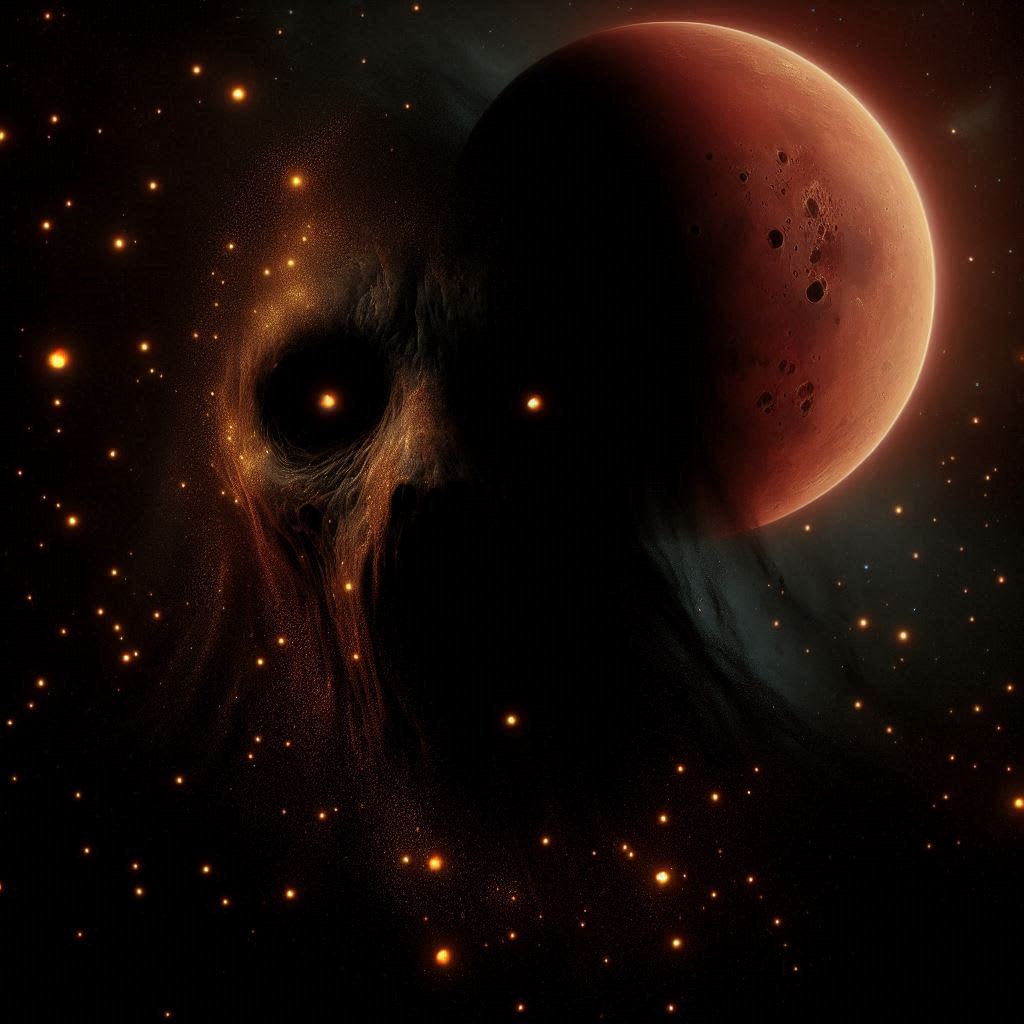
At first, the scientist was in awe as countless previously-unseen stars came into view, but then their gaze was caught by a large unfamiliar shape. It was a reddish sphere, dimly lit by the surrounding starlight; possibly an asteroid, or even a small dead planet.
Then, suddenly, the scientist noticed another shadowy mass emerging from behind the sphere, and it didn’t appear to be any kind of rock. It had an irregular shape and, in some places, was speckled with yellow spots that seemed to have their own glow. To the scientist’s amazement, they began to make out the features of a face.
The mass appeared to be looking around, as if it was cautiously venturing out from its hiding spot behind the red rock, and then it looked out directly toward the scientist. Surely it couldn’t see them from so far away, the scientist thought. Unlike the scientist, this figure wasn’t operating an observatory, and yet it continued to stare directly toward them.
Then, to their shock, the figure’s face began to change. Its eyes narrowed as its mouth widened, twisting into a demonic smile. The figure seemed to be rapidly growing, and panic set in as the scientist realized that it was advancing on the observatory.
Frantically, the scientist scrambled to signal the satellites to disable the force field, releasing the light of the sun.
As the sun reappeared in the vast black sky, the stars disappeared again, along with the dead planet and the evil figure. As time passed by without incident, the scientist was reassured that the figure had returned to its hiding place.
They didn’t dare block out the sun again to find out for sure.



Comments