


Peter Gower stood on the deck of the Freyja and watched Mary Wollstone step out of a bright red, convertible motor car. She was even more beautiful than the day she rejected his last marriage proposal. He was no expert on the affairs of the heart. But after six failed attempts to win Mary’s hand, it dawned on this slow thinker that his future may not include a union with his heart’s desire.
Despite being heir to the Earl of Granville, Gower was a victim of the post-war social order. American heiresses once bought English titles. But social guidelines had changed. Women voted. American daughters - especially those who could afford it - embraced their emancipation. They demanded radical new arrangements such as marrying for love.
As Peter contemplated Mary, a black Rolls Royce whispered up. A chauffeur helped Lord Arthur Quiller and his wife, Lady Charlotte, dismount. Quiller was a brusque man radiating irritation. His clothes were crisp and faultlessly tailored. But their immaculate perfection evidenced a man not born to the purple.
He was an industrialist who had clawed his way from penury in Yorkshire coal country to the apex of the commercial aristocracy. Already wealthy, The Great War had made him fabulously wealthy. And at 70 he could buy whatever he wanted. And what he wanted was a peerage, a country manor, a house in town, old masters and a young wife.
A taxi deposited Peter’s Eton chum Fergus Soames and his wife Bootsie. They were an attractive couple who lived a scandalously Bohemian life among London’s literati. A second cab brought Thomas, Lord Arthur’s valet/bodyguard, an ex-Tommy more likely to settling debates with fists than rhetoric and Emma Lazarus, Lord Arthur’s secretary. She was a handsome woman who disguised her sex appeal with a pair of efficient glasses and hair dragged back into a Teutonic bun.
“What ho! Peter. Has the old bugger arrived.”
Peter turned to see another of his old schoolmates approaching him. David Rockingham, a cigarette holder clenched between his teeth, waved a champagne flute at the new arrival. David was Lord Arthur’s stepson. His mother Constance, now dead, had been Lord Arthur’s first wife. David’s father Percy had also shuffled off this mortal coil after a gambling jag, impressive in its exuberance, had gifted the family fortune to a variety of bookies.
The yacht was an exotic vessel some 280 feet long, outfitted in the current Art Deco rage. An attentive staff showed Lord Arthur and Lady Charlotte to their staterooms in the aft of the ship. Fergus and Bootsie Soames were taken to another suite amidships. Peter and David bunked together in bachelor quarters. While Lord Arthur’s valet and secretary had modest births in the pinched bow of the vessel.
After settling in, the party reconvened on the sun deck to witness the departure. Longshoremen released the mooring lines. A tug pulled the Freyja’s bow toward a gap in the breakwater. The whisper-quiet engines revved. And the passengers watched Cannes recede.
“I say, the chappie who designed this barge must have stayed awake during class, what?” Peter announced to no one in particular.
“With the checks I had to write, he had better bloody well have.” Lord Arthur rejoined. It was hard to tell if he was miffed or showing off.
“It is quite darling.” Mary drawled in that accent American heiresses learn at expensive schools.
“What kind of engines has she got?” Fergus asked with polite interest. He was a philosopher not an engineer. But his mother had raised him to be polite. And he had the sense that industrialists like that sort of question.
He was right.
“Two V-16 Hispano-Suizas, Mr. Rockingham,” crowed Lord Arthur. “Each rated 4,000 horsepower. I was going to use Napiers - buy British, fly the flag. But, by gum, those Frogs make some fine marine engines.”
“Quite right,” agreed Fergus, hoping that was the end of that conversation.
It wasn't.
“It’s those bloody unions,” Lord Arthur continued. “No respect for the risks I’ve taken. Just want everything handed to them for free. Mark my words, we’ll be no better off than the Russians if we don’t stand firm.”
Fergus regretted his politeness. He wasn't sure what unions had to do with engine quality. But he had obviously launched the factory owner down a well-worn path of grievance.
Luckily, a young woman passed among them with a tray. Lady Charlotte, used to her husband’s doggedness in pursuing his resentments, stanched the flow.
“Arthur, there are those prawn pastries you love.”
Fergus grasped the opportunity to dam Arthur’s verbal river.
“Nothing better than a jolly old crustacean. I tell the lads at Boodle’s that all the time. And I think I can safely say the majority are with me. Democracy, what!”
Lord Arthur peered at him wondering if Fergus was pulling his leg. But at least he had stopped talking about industrial relations.
Fergus seized his opportunity. While Arthur was distracted by the comestibles, he fled to the company of his school chums on the other side of the deck.
“I say, that was a close run thing,” he announced to Peter and David. “The man does know how to get the most out of a subject.”
His listeners, themselves both victims of an Arthurian broadside against greedy workers, nodded in sympathy.
“I was opposite him at one of Lady Hanley’s dinners,” David said. “I was trying to make a favorable impression on Vivian Stokely. He was lecturing the congregation about the shortcomings of Churchill and the War Munitions Department.”
The gong rang and all descended to the aft deck set for lunch. After the meal, the party dispersed. Lord Arthur took his secretary to a stateroom he used as an office. Lady Charlotte retired to her suite. Bootsie, Fergus and Mary changed into bathing suits and lay out on the sundeck. Peter and David chatted under an umbrella by the transom.
“I say, any luck with Mary?” David asked Peter.
“No,” replied Peter. “Although I felt her last rejection lacked the firmness of the others.”
“There are some cracks in the ice, then? The walls are buckling. As it were?”
“Damned hard to tell, to be honest. I’m not what examiners call a good judge of a woman’s willingness for matrimony.”
“The reason I ask, old boy.” There was a resolution in David’s voice, that caused Peter to turn to his friend.
“The reason I ask is that …. ” David hesitated. Peter sensed a weight on his mind.
“The reason I ask,” David hazarded for the third time, “is that Mary has been looking at me.”
“Has she now? Well, that’s not against the law, is it?” Peter retreated to his usual levity. But underneath his placidity, his heart beat with awful anticipation.
“Not the criminal law,” David said in partial agreement. “But it may have put a dent in a higher code.”
“What on earth do you mean David?”
“Well Peter, I must confess that I looked back at her.”
Peter sat back to contemplate this treachery.
“You looked back at her,” he asked for confirmation.
“Yes.”
David tried to get his mind around this new state of affairs. A lengthening silence was broken when David spoke again.
“I have asked around, you know.”
“Have you now?”
“I have.”
Another silence descended as both men pondered this development. Peter then decided that some clarity might move the conversation along.
“Asked around about what?”
“Well, to be blunt and put my cards on the table, I asked the committee under what circumstances it might be according to Hoyle for a chap to ask a question another chap had been asking. In plain English is there a time where the other chap should stop asking the question to give the first chap an open field to ask the question?”
“What was the verdict?” Asked Peter.
“There was no consensus as to the precise measure. Some thought that four stabs at it were probably the most the other chap should be allowed. Other reactionary thinkers believed that tradition demanded five. But there was unanimity that six was the absolute maximum a fellow could expect.”
So there it was - as plain as day - David had thrown his hat into the ring. Peter would have competition for Mary’s hand.
“I suppose this calls for a drink,” he said to acknowledge the existence of this rivalry.
“I suppose it does,” replied David to confirm the contest.
The rest of the day passed as days on luxury yachts puttering around the Mediterranean do. The workers worked. Idlers idled. And plutocrats and their secretaries made love in stateroom offices while their wives napped through the insult.
They dressed for dinner. The men in white jackets. The ladies in gowns that flaunted new tans. It was a convivial affair. Lord Arthur, basking in the afterglow of his afternoon’s labor with Emma, let others talk as he nodded along.
The night reached the wee hours and all retired. Peter lay staring at the ceiling illuminated by the light of a full moon reflecting off the placid sea as the boat motored on sedately. He fancied himself a man of action and a strategist. He was no student of Sun Tzu’s Art of War, but he knew enough to know that defeating the enemy is best achieved through stealth rather than a frontal assault.
The next day they baked in the August sun, played deck games, and lunched on the offerings of Arthur’s Maxim-trained chef. As the sun descended, they dressed for dinner. Thomas attended to his master’s sartorial needs. And Peter took the opportunity of the valet’s absence to visit the manservant’s modest cabin. It did not take him long to discover the Webley revolver in the bottom drawer of the dresser.
Tonight the company, rendered soporific by the sun, retired early. By eleven only Peter, David and Mary remained up. They were enjoying a nightcap with Mary displaying her modern sensibilities by acting as bartender.
They caught each other up on the latest gossip. Peter said little. David was an authority on the sins of the London scene. And Mary spoke of the scandalous generation of flappers riding around unchaperoned in Duesenbergs with brilliantined young men.
Peter looked impassively at the vivacious woman. It seemed to him, as he calculated the geometry, that although Mary’ chair was equidistant to her two companions, its occupant sat in such a manner as to be closer to his rival than himself.
He had been raised in the chivalric tradition. He was acutely aware that propriety demanded he cede the field. But love had blinded him to millennia of honor. Atavistic echoes of untamed ancestral Anglo-Saxon blood impelled him to take action. And he cleaved to the philosophy that ‘all’s fair in love and war.’
Eventually, Mary decanted herself from her chair. Her companions bid her a good night. They watched her leave - a vision of femininity blazed by the moon illuminating her sequined white dress.
“We should follow her lead, old man,” David said to Peter.
“Let us have one more. There is something I wish to say, dear boy.”
David agreed to the agenda. And Peter made their nightcaps.
“I have been contemplating your thinking on questions and whatnot,” Peter said, looking over the rail at some distant invisibility. “I think the committee may have a point. However, I believe that custom allows for the first chap to keep asking the question while the other chap is given free-range to start asking the question.”
Never one to hurry important matters, David took his turn to contemplate this refinement of the issue. The clock ticked. Peter wondered if David might have fallen asleep, But he did not check as it is bad form to stare at a man wrestling with an Aristotlean problem.
David broke the silence
“I believe you are correct, Peter.”
The use of his Christian name confirmed to Peter that David had spared no ounce of his gray matter and had considered the proposal with an intellectual honesty usually reserved for children.
David explained his reasoning.
“We live in a modern age. Whether we care for it or not, women now have permission to decide their destiny. Mary can weigh her options in the full knowledge of what those options are.”
In his heart, as wounded as that organ was, Peter gave David his due. He may have wished to remain the sole competitor for Mary’s hand. David may have wished to see his rival quit the pursuit. But King Solomon had split the baby. The two men saluted each other with their brandy and sodas. And drank them down.
They rose to go to bed. Peter, who was feeling groggy, politely insisted that David go first. Following behind his childhood chum, Peter took the pistol out of his pocket. During the clatter of the day, it had not occurred to him that a gunshot on a soundless night would assuredly raise the crew. It would be impossible to disguise the crime and its author.
Peter may not be bright, but he had a certain feral resourcefulness. He adjusted his plan on the fly. Grasping the Webley by its barrel, he raised it up to club David into unconsciousness. That deed done, he would chuck the body over the side confident that, even if the corpse were found, the wound would be attributed to a drunk stumbling into a hard object and falling overboard.
But as he raised the weapon his vision blurred. He collapsed with a thud to the deck. David turned to see the cause of the noise. He knelt beside the supine man and Peter heard him ask,
“Are you all right, old boy?”
Peter could not answer. His throat was paralyzed. His tongue frozen.
“No, he is not all right.”
Peter watched as David twisted around to see the source of this pronouncement. Mary’s face slid into his narrowing field of vision.
“What are you talking about?” a clearly confused David demanded.
“Peter is not all right because I put GBL in his brandy.”
“Put what… “
“It’s an anesthetic, David.”
“Why?”
“I do not care to wait. You, Peter and your rules are wasting my time. I want you. But you insist on your public school code. It’s the 1920s David. Not the 19th century.”
“Shouldn’t we call for help?”
“Oh do stop being so clueless David. Peter was trying to kill you. That’s a gun, not a cocktail stirrer.”
“Give me a hand,” she added. “We have to get him over the side.”
David acquiesced to the determination of this thoroughly modern woman. He took Peter's shoulders as Mary grabbed his feet. And with an instinctively coordinated heave ho, they tossed Peter off the boat.
The last thought on Peter’s mind, as the warm Mediterranean embraced him, was the realization that now he had seen her as a woman in full, he had never loved Mary more.
About the Creator
Pitt Griffin
Once upon a midnight dreary, while I pondered, weak and weary, it occurred to me I should write things down. It allows you to live wherever you want - at least for awhile.
Keep reading
More stories from Pitt Griffin and writers in Fiction and other communities.
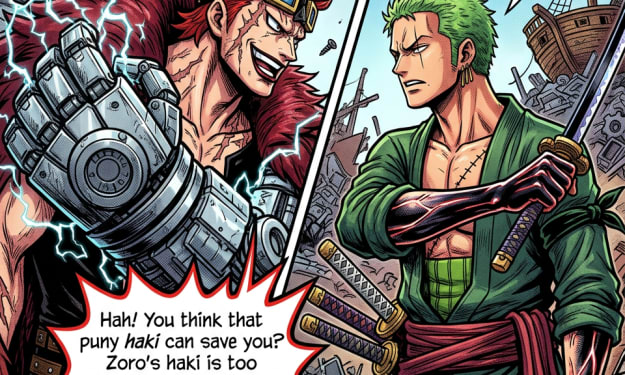
Captain Kid vs Roronoa Zoro
Eustass Captain Kid is a Supreme King of proven strength. He departed his forsaken homeland after enacting a vengeful massacre. Roronoa Zoro is also a conqueror. He's gambled his life numerous times as if he enjoys tempting fate. Between these two powerful pirates however, there's One who reigns supreme over the other.
By Twilights Cavern5 days ago in Fiction



Comments
There are no comments for this story
Be the first to respond and start the conversation.