
Long After Night Has Fallen
a love story

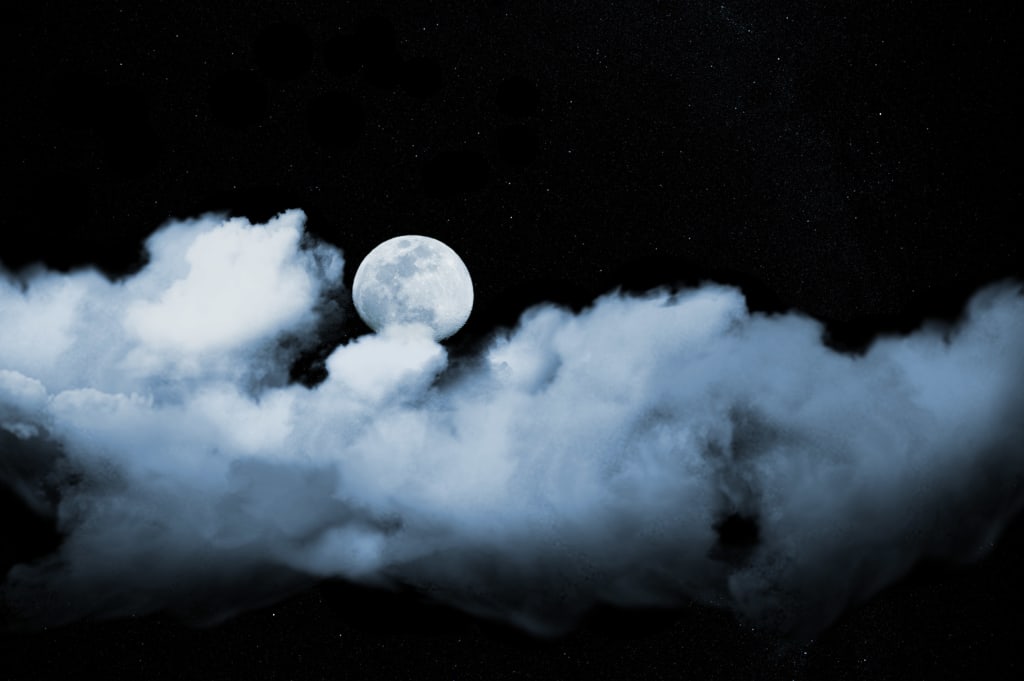
Long after night has fallen, the girl watches the light of the moon swirl and sway its pearlescent waltz about the room, its movements snakelike and vaguely forlorn, its gradations of pale color thrown by fierce gusts of desert wind blowing with abandon through the thin gray walls. Some bleak white copy of an aurora borealis undulating on her dirt floor like something in its death throes. Where the light doesn’t fall, the shadows are deep and alive, their edges aflame with shimmering moonlight but the deepest corners black and untouchable as dreamless sleep. In the makeshift and broken roof above her head she can hear a flurry of wasps moving about in their furious and unceasing revolutions; they have built a nest somewhere up there, and she knows that they will persist long after she is gone. They have already persisted after so, so many. She thinks of dying, and of taking it into her own hands.
Instead, into her own hands she eases the warm silver of the locket that hangs from her neck, the worn cleft of the locket soft against the tip of her thumb, her cracked gray fingernail pressing down hard into the space exactly equidistant from both sides of the heart. If she squeezes the locket hard enough, perhaps it will absorb her, spirit her away to some better place. Sometimes, engaged in the cataclysmic act of reflection, she can even remember that better world, a world that, though it led to this one, was peopled and bright and filled with clean contenting solaces beyond accounting.
She looks at her reflection in the locket, stares into a face distorted by moonlight and by the unburnished face of the metal but much more so by starvation, by filth, by an almighty and unspeakable drear in the very pit of her soul. Once she might have known her own reflection, might have seen in her own flushed cheeks and coal-black curls and large, brown, thoughtful eyes some close approximation of her very self looking back at her. All there in that reflection but personality, but knowledge, but history. But no longer. Now when she looks in the locket and considers her own wasted face, the heavy-lidded eyes regarding her from deep inside the sockets of a countenance varnished with sweat and grime, there is no suggestion at all in all that devastation that there might even be a thing like personality or knowledge or history. The facsimile is therefore as close as it has ever been to representing her. But she no longer recognizes the reflection. It is as if some sickness has overtaken her, turned her into someone else. The work of some malefic parasite. It is a horror of horrors, to feel oneself slipping away, but somehow it is even worse to see it.
She lets the locket fall from her hand, lets it roll right off the very fingertips and clang against her bony chest with something that feels to her like finality. What had she been expecting to see there in the first place; what is she looking for? There is nothing to find but oneself in a wasted world so long after the end of time.
She sits up slowly, looking with brokenness at the shake of her emaciated arms pushing her body upright, at the way her thin legs struggle dumbly to cross themselves. The looseness of the tattered, rank rags of her clothes upon her body. When at last she is sitting up in her bed with her back rested against the wall, she can look about and try to center herself in the tactile ordinariness of this one-room shack. The thin blue mat on which she sleeps, the assortment of stinking rags atop it, into which she burrows each night like some hopelessly beleaguered mouse. A meager pile of scavenged food, cans mostly, half of which will probably be too far gone when she opens it, reduced by the ravages of time to thick black slurry, to odorful viscera. A giant barrel of nearly rancid water. A stack of books, manuals, old papers that she has long since read and read again. Odd tools stacked arbitrarily by one wall. An empty pistol by her bed. A fat spider in a quivering web above her bed. The barely upright metal walls filled with holes and with large patches of brown-and-orange rust betokening the decay of each and every thing on this Earth. A small square hole in the bottom of one metal sheet that she comes and goes through, which she comes and goes through far less than she once did. Moonlight eddying in the room. The cry of the wind. The day’s ferocious heat left to simmer in the space like persistent embers breathing amongst the remnants of a fire. These paltry dystopic images tossed about haphazardly, like the lesser playthings of a forgetful god.
There is nothing to see here, either—nothing to ground her. She is coming undone. With a great effort she closes her eyes and considers instead the darkness, its smooth edges, its unfathomable depths. A desperate growl sends sparks of pain through her stomach and she closes her eyes tighter still, squeezing the lids shut until the sockets pulse and staggering white heat sears through her temples. It feels like she is falling, tumbling head over heels into that endless blackness without name or form. There is something pleasant about it, welcoming in its emotionless simplicity, like some instinctual dance through a cool void without time or memory. If she could be rid of any one thing, it would be memory. If she could only sink a little deeper.
But life clings to her like a desert cocklebur, and who ever knows what obstinance it yet has in store?
Something makes her open her eyes. At first she thinks it is another breathtaking roar of pain from her stomach, but the sounds of it are higher-pitched, outside of herself. Weakly, she tilts back her head and looks up to the high metal ceiling, the corrugated and rusting sheets swimming in the moonlight flooding in through the holes and cracks. She sees the wasps moving around up there, a vast army of them spiraling about each other, like the galactic swirl of stars moving in the sky above the roof. One lone wasp has abandoned the nest and is darting with intrepid directness towards the water on the other side of the room. It is the source of the noise. She watches it stream down through the shafts of white light, and a sudden, ferocious sadness fills her heart.
“No, go back,” she wants to say. “Please, go back. Don’t be alone. Value this time you have with your family. Always, someday, it will be too late. Keeping that end at bay is the only thing we are meant to do.”
But she does not say this. She is too weak, and the words do not present themselves in such a rational order in her mind. The words and ideas are jumbled, flashes of insight and memory and painful images falling about her with the randomness of snowflakes. And it is, after all, just a wasp.
Still, it saddens her. A deep mourning fills her. She leans forward, more and more, as if to reach out to stop the wasp’s descent. The locket around her neck tilts forward, too, until it is dangling just below her face, and again she catches her reflection in it, again she sees her ruined self staring up at her like a supplicant.
But now she sees things differently. Perhaps it is only a trick of the light, the angle of her gaze. Maybe it is the indomitability of the human spirit, gently forcing her hand. Or it is one final act of madness heralding the brink of death. Whatever the case, looking into the little silver heart around her neck, she now sees a hard masculinity to her features, a pronouncement of the jawline and an angularity to the nose and a grimy beardlike darkening around her cheeks and neck. And, to her amazement, she is instantly comforted, filled with a stubborn kind of hope that radiates warmth to the very ends of her limbs, to the crown of her bent-over head. The face she sees reminds her of her first love’s face, her only love’s face, that gentle boy on the cusp of manhood, that sweet, sweet boy who had forced the locket into her hands when the world had started to die, who had whispered into her ear, while she rocked to and fro with that all-consuming and apocalyptical initial fear that everyone the world over had shared, “I wish I could have given you more.” The boy not knowing that he had already given her everything.
She puts the locket into the palm of her hand and brings it closer to her face, smiling a wan but certain smile, remembering her parents’ reticence, their shifty eyes and sighing gruffness at the idea that she thought herself old enough for a boyfriend. Maybe they had been right, or maybe they hadn’t been. What matters now is that, thinking of them, the reflection of herself in the locket resolves itself now into her father’s face—his hard chin, his cheekbones, the large brown eyes he had passed onto her. And then her mother replaces him, smiling because the girl smiles, the woman’s cheeks dimpling ever so slightly, her full pink lips parting just a little with the force of the smile.
They are there, they are all there. She can see grandparents, well-meaning schoolteachers, friends from long ago giving her the mischievous grins that only friends know how to offer. People she didn’t know she remembered, neighbors and store clerks and waiters and people she had passed on the sidewalk without a word. They are not just memories, and, she realizes, they are not even just people. In the fluidity of her own image, in the way it phases across the surface of the locket like the windblown moonlight dancing in her room, she recognizes the embodiment of all souls within one soul, she sees with startling clarity the interconnectedness and immortality of human life. Other people live on absolutely because she is still here, because they had affected her and shaped her and were her. And beneath all of this is the single most important truth, the key to the grand scheme of the universe, the certainty of her survival writ large and indomitably and with tremendous, unalterable beauty. She knows it as she listens to the wind whine against the walls, as she watches the wasp descend into the water, as she settles down into sleep.
We live for, and will be saved by, our love for others. Time after time after time.
It is the only thing that will survive an apocalypse. It is probably enough.
…
Long after night has fallen, long after the girl and even the wasps are gone from this world, the structure in which she lived stands yet awhile longer, awash night after night in churning moonlight, a monument to the inexplicable, a great metaphor that has survived its tenor. Indeed, it seems like the middle of the universe, something around which all else swirls, the only thing within sight, shivering a little in the desert winds—like a spider shaking with secret and titanic knowledge at the very center of a web without end.
About the Creator
Keep reading
More stories from writers in Fiction and other communities.
Miss Persephone's Manual to a Seemingly Ordinary Life
Miss Persephone was found at the dining table, her blue eyes swollen, her tears arriving and retreating like the tides of the ocean. Earlier that day, her family had visited her in the retirement home where she had lived for eight years. It was her eightieth birthday.
By Imola Tótha day ago in Fiction
Cora & Tina's Bottom Line
Straight from the healthy corporate advertising pitch three-hour, triweekly class, Cora and Tina found a grassy patch neighboring, their cool down swimming pool providing tranquil moments, essential during the studious agenda period.
By Marc OBrienabout 4 hours ago in Fiction
A Dart at Dusk
Seconds ago, the sullen sun set on the two of us… my exuberant furry companion and me. A fresh breeze embraces us, delivering welcome relief from the day’s oppressive heat. His typical stumbling and staggering along — apace with a sloth — has turned into trip-trapping, high-stepping, almost skipping along.
By Angie the Archivist 📚🪶3 days ago in Petlife


Comments
There are no comments for this story
Be the first to respond and start the conversation.