
Life Lessons from Panchatantra Stories
Learn from stork, crow and monkey


Most of us grew up reading Aesop’s fables, but you may or may not have heard of the Panchatantra, a collection of ancient Indian stories. I learned the five tantras of the Panchatantra are: Mitra-bheda (The Loss of Friends), Mitra-lābha (The Gaining of Friends), Kākolūkīyam (War and Peace), Labdhapraṇāśam (Loss of Gains), and Aparīkṣitakārakam (Ill-considered Actions).
These stories use animals as characters because the human mind connects more easily with tales than raw facts. If the same information is presented as plain facts, the mind may find it taxing due to cognitive load. But when narrated as stories, with birds and animals as characters, it sticks in memory.
The Panchatantra was written with a deep understanding of human psychology. What social media now explains using terms like narcissism, gaslighting, and manipulation was already captured in these ancient tales. It’s very sad, that most people today overlook these treasures, make poor judgments, invite doom and suffer.
Today, I’d like to briefly share three Panchatantra stories, along with my paintings. These are tales I’ve been telling my kids regularly. They carry powerful life lessons. So, let's get started.
1. The Fox and the Stork
So, once a cunning fox invited a stork to his house for food. He served the meal on a flat bowls. The fox slurped his food with his tongue. The stork, with his long, narrow beak, could not pick up the food and went home hungry. The fox enjoyed the stork's misery.
A few days later, the stork invited the fox in return. He served the food in tall, narrow pots. This time, the fox could not reach inside, while the stork ate comfortably.
Moral: If you hurt somebody, be prepared to face the consequences. Consider the situations of others. Be empathetic.
2. The Clever Crow
On a hot summer day, a thirsty crow was flying in search of water. It saw a pot in a garden and came down to drink, but the water level was too low.
The crow had an idea. It picked up some pebbles from the garden and dropped them into the pot. The water level rose, and the crow drank happily.
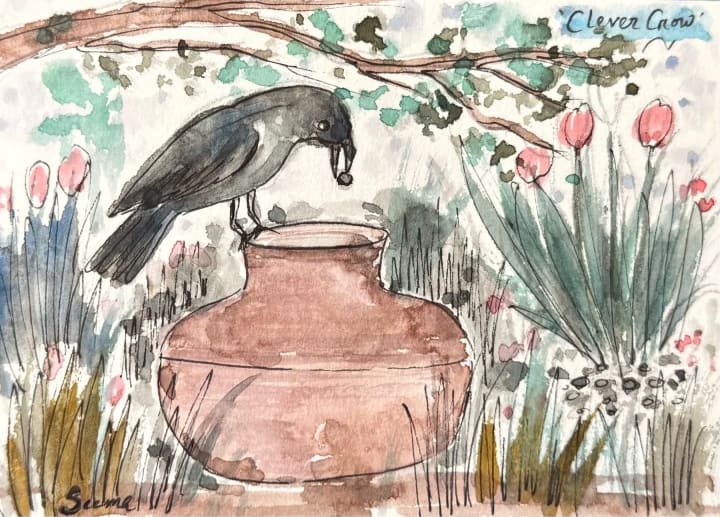
Moral: If you are intelligent and have problem-solving skills, you can save yourself, even in tough situations.
3. The Monkey and the Crocodile
By a swampy river stood a large jamun (Java plum) tree, and a monkey lived on it. A crocodile often came to the riverbank to sunbathe, and the kind monkey would share jamuns with him.
One day, the crocodile took some fruits to his wife. She enjoyed them so much, she asked him to bring the monkey, so they could feast on his liver. The crocodile resisted but eventually gave in.
The monkey, happy to be invited, hopped onto the crocodile’s back. Halfway across the river, the crocodile admitted the real plan, that he was taking the monkey to be eaten.
The monkey panicked but stayed calm. Using quick wit, he said: “Oh! You should’ve told me earlier. My liver is on the treetop. I don’t carry it around!”
The crocodile turned back. As soon as they reached the bank, the monkey jumped onto the treetop, saved himself, and chided the crocodile for his treachery.

Moral: Not everyone who seems friendly has good intentions. Your presence of mind can save yourself from perilous situations.
I hope you loved the stories. Share your view. Which one resonated the most with you?
About the Creator
Seema Patel
I am Seema. I contribute to PubMed, Blogger, Medium, LinkedIn, Substack, Amazon KDP, Vocal Media.
I write on nature, health, parenting, creativity, gardening, social issues.
My art shop: https://artsforhealinggifts.etsy.com
Keep reading
More stories from Seema Patel and writers in Fiction and other communities.


Comments (2)
Just like Aesop's Fables. Your paintings are really great and go along with stories they share and tell.
How beautiful are these stories. Your children are so lucky to have a talented mummy like you 🏆🏆🏆