
Life cycles
Survival in a valley gripped by deep ice
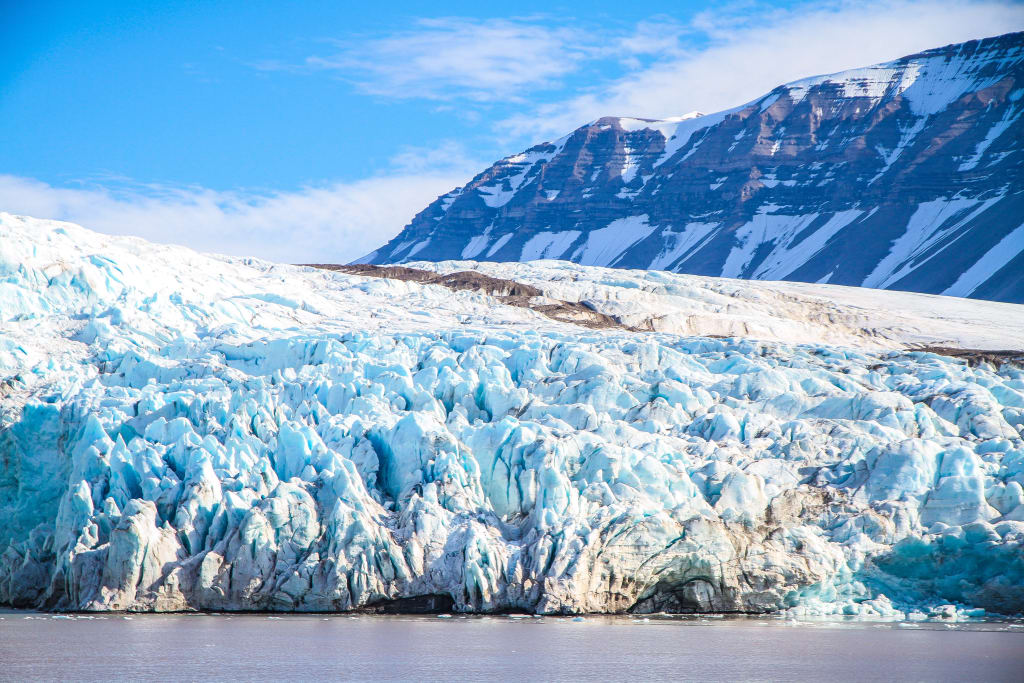
The girl sheltered with thirteen others – the smallest overwinter party she’d ever been part of. Even so, by the time the glaciers began to loosen their vice-like grip on the valley, only eleven remained. An older man had died from cold – slipping quietly from lethargy into stiffness over a single darkness.
The other death had been an infant. Its mother’s milk had dried up in the first few weeks of winter. The party had taken turns holding the tiny swaddled child, chewing nuts and spitting the paste into its puckered, screaming mouth. It was no use. The child was too small for anything but milk, and they had none to give. While it was dying they did not sing or share stories at darktime meal but just sat as the thin wailing cry grew fainter and fainter. It took four days.
Spring seemed like an impossibility when the girl’s breath created ice crystals on her hood and snow formed drifts as high as pine trees. An unsettling silence deepened across the valley and death seemed everywhere. Like all overwinter parties, the group fought back by reasserting the strength of their own life. While trapped in the shelter they made tools, span wool, pounded grain, sang – and copulated.
The girl spent most of the winter with a curly-haired youth with bark-coloured skin and bright, mischievous eyes. She’d known him since they’d both spent a summer gathering with his group when they were both children. In the years since, he had grown tall and lithe with clever, nimble fingers that he used to make delicate toys from slivers of salvaged material.
She spent her days and darktime meals close by him, and shared his bed during the long darks. The group rose and worked together, ate as a group and went to sleep at the same time, but even within this rhythm the girl fitted around his movements as tight as a hand in a glove.
-
When the spring finally came, it was accompanied by roars and crashing of ice, as well as the growing thrum of water, everywhere. The girl heard the otherworldly creaks and ear-splitting groans of the iceshelf above them shifting in the strengthening sun. The thick glaciers that hung above the valley walls and capped every horizon never retreated, but their form shifted as the days lengthened. Avalanches were frequent on spring afternoons: sometimes distant and so deep that the girl felt rather than heard the tons of ice barrelling downwards, sometimes terrifyingly close.
As the thaw grew into a cascade, the overwintering party began to leave their shelter – at first only to gather firewood and remove waste, but, as the ice retreated, they packed up precious belongings and dispersed into their separate groups. Some went to the summer camps which offered protection from the wolves and the ferocious cave lions that descended from the heights of the mountains, but were fly-rotten and miasmic.
The girl travelled instead with the curly-haired boy, meandering down the valley as green life sprang up around them. As they walked the boy would gaze west-ward at the icefield which was slung between the two high peaks at the mouth of the valley. The icefield was a mile-high labyrinth of shifting, creaking ice, tumbled with bright-blue seracs and criss-crossed with rivulets of meltwater. From the valley floor, these temporary waterways looked tiny, easy to overcome with a single leap. The girl knew they were deadly – huge, furious torrents running into crevasses that were aeons-old and mountain-deep.
Crossing the icefield was the only way in – or out – of the valley. In living memory, a small handful of newcomers had made it through the pass, bringing scraps and news from the world beyond. The people who made their way into the valley said it was a haven – locked in ice for seven months of the year, beset by bears and wolves, but still a haven compared to what was beyond.
Despite this, the curly-haired boy planned to attempt the crossing. His reason was simple. There were hardly any useful scraps left in the valley – ‘scraps’ being the catch-all for bits of old-world wreckage buried in the earth.
Plenty of the flexible, tasteless, transparent material that the ancient ones had so loved washed up in the ice-melt each year. It couldn’t be eaten or used to grow things or for eating, couldn’t be shaped or melted down or made useful in any way.
The most valuable scraps were metal. Over generations the valley people had raked every mile of the valley floor to find it, and all the limited supply had been used to create tools: cutting edges, fastenings - and weapons. But there was a whisper that in the world beyond the valley there were stockpiles and stores of steel. So the boy would go.
She cried, a little, when he left. She would never see him again.
-
The summer months were at an end by the time the girl felt the child move within her. By then, the warmth had already leached out of the sun’s rays, although the days were still longer than the darks. The girl spent days standing, heron-like, in the muddy shallows of a flooded meadow, jabbing at fish as they swam by her toes.
When the herd passed close to the girl as she crouched spear in hand, she saw that the young were no longer gawky and whip-like but had swapped their awkward grace for a thicker, shinier stoutness.
Just like the animals in the valley, her people – those who’d avoided the summer sickness, anyway – had become sleeker and rounder over the summer too, profiting from the glut of food. Their hair became less desiccated, and limbs were swollen with new strength and energy.
These were the ones, the girl knew, who would survive the winter ahead. She saw the people for whom the winter would be a bitter struggle – those who had fallen ill from stinging fly bites and lay sweating and senseless during the brief, bountiful summer.
The people of the valley gave freely what they had to others, knowing their survival depended on others. But some were sickly and nothing could be done. Mostly the sick ones were mothers with prematurely greyed hair and missing teeth, bodies ravaged by almost yearly-pregnancies. It happened when women would fall pregnant again while still feeding their infants.. Their bodies, racked with malnutrition, would swell and sag, puffed up and leeched upon.
The child inside her was the girl’s first. The first that had got this far along, anyway. Like all women she’d had signs before. The well-fed ones fell pregnant most quickly, but even the skinniest, sickliest women sometimes bore children. These women gave their whole selves to their children. They lost their hair, their teeth, and sometimes their lives for the children growing inside them. Their children mostly died anyway.
The girl wondered whether that would happen to her. She remembered the bark-coloured boy sweeping his fingers around the grinding-stone, catching tiny husks which she would lick from his fingers in the dark.
In other years, she had joined the hunting groups that ranged further up the valley after the herds. She was lithe and quick, and several experienced runners had indicated, early in the season, that she might join their band when the hunting began in the autumn. She doubted they would still welcome her now, in her sleeker, rounder state. By the time the hunters left in mid-summer she carried a high, swollen belly – hard with the tiny child.
As the fruit on the boughs began to darken and quicken, she estimated it would be another three moons until the child came. She still felt fit and fleet, but she knew the balance had been tipped against her. It was no longer safe to be away from the shelter.
By the time the leaves turned, she knew she’d made the right choice. Her body had become enormous. The space between her ribs and her pelvis had turned inside out, and it felt like her organs had been punched upwards into her chest. Something tiny and sour caught in her throat every time she ate. Sleep became impossible.
She thought now, for almost the first time, about her child. She wondered whether it would grow lithe and strong like the curly-haired boy. Would it struggle against the ice too? Would it feel safe and held by the enclosing mountains, or imprisoned by them? She shuddered. She might die for this child, and it would die anyway. Predation, malnourishment, sickness. Heat. Cold. Fall, cut, avalanche. Childbirth.
-
When the child came, she found that she didn’t die for it after all. She thought she would – she felt the life leaving her, as she lay panting and bleeding on the shelter floor. But the women around her were skilled, and they sewed her closed and rubbed precious salt into her while she screamed again.
The child didn’t die, either. Its skin was nut-dark like her own, but the thick hair across the child’s head was like the boy’s. She loved the child from the first hour of its life. She held him to her breast as she’d seen other women do thousands of times before, and after a few tries she felt him begin to feed, taking nourishment from her body. She felt deep and shocking love.
It was nearly winter again by the time she was strong enough to stand without pain. This winter she chose to join a large group, presided over by one of the oldest matriarchs in the valley. The child was precious not just to her but to her whole people, and they welcomed her warmly. Unlike the previous winter’s shelter, this one was set deep against the walls of the valley, big enough to house the thirty-eight people in the overwinter party. The roots of the shelter went deep into the mountain, and the girl found her place alongside another new mother in a dark corner. Together they fell into the rhythm of winter life, each woman holding both infants while the other ate, or spun, or sang.
One dark, the other mother fell asleep with both infants nestled within her cover. The girl sat quietly by. The shelter was rough-cut, and she could see in the wall the sparkling geological line that ran across the whole of the valley, just a hands-width deep. This stratum was made up of tiny particles of the same substance that appeared in their water and the earth. Plastic. The reason the people in the valley, and those beyond, could no longer farm or fish with any certainty that the food they gathered would nourish them.
Her fingers dug into this glinting layer of un-life. Detritus of another world. She wondered what it had been made for – whether it had served its purpose.
Her nails scraped against something cold and hard. Something metal. Tiny, but miraculously untouched by the grime of millennia or the contraction of the glaciers above.
She took the object to the fire to see it more clearly. It was about the size of her thumbnail and the shape of two seeds, imperfectly pressed together to form a smooth whole. A tiny crack ran around the rim, but aeons of time had sealed its opening. She held the object in her palm for a moment, and then brought it to the matriarch.
The older woman's creased face was inscrutable as she weighed the precious metal for a moment before passing it to her daughter, who examined it carefully. The girl knelt beside both women, bowing her head to indicate that it was a gift. A gift to the people of the valley from the people of the time before.
The matriarch nodded, and grasped the girl’s shoulder in thanks. Then they both turned away – the matriarch to add the object to the store of scraps, and the girl towards her sleeping child, held with love by another and kept safe during this long, dark night.
About the Creator
Keep reading
More stories from writers in Fiction and other communities.



Comments
There are no comments for this story
Be the first to respond and start the conversation.