
Letter to Glasgow
A flash fiction, translated from the Gaelic

Evening and, at the end of certain backstreets, a tendril of smoke curls into the clouds. Amongst the fumes of the cars, it isn’t often you can smell it. But still it's there, though now prohibited in the bike-shed at St. Aloysius', hanging at the mouth Kelvin Bridge and Cowcaddens, sucked in with the warm breath of the train, as it emerges from the chasm.
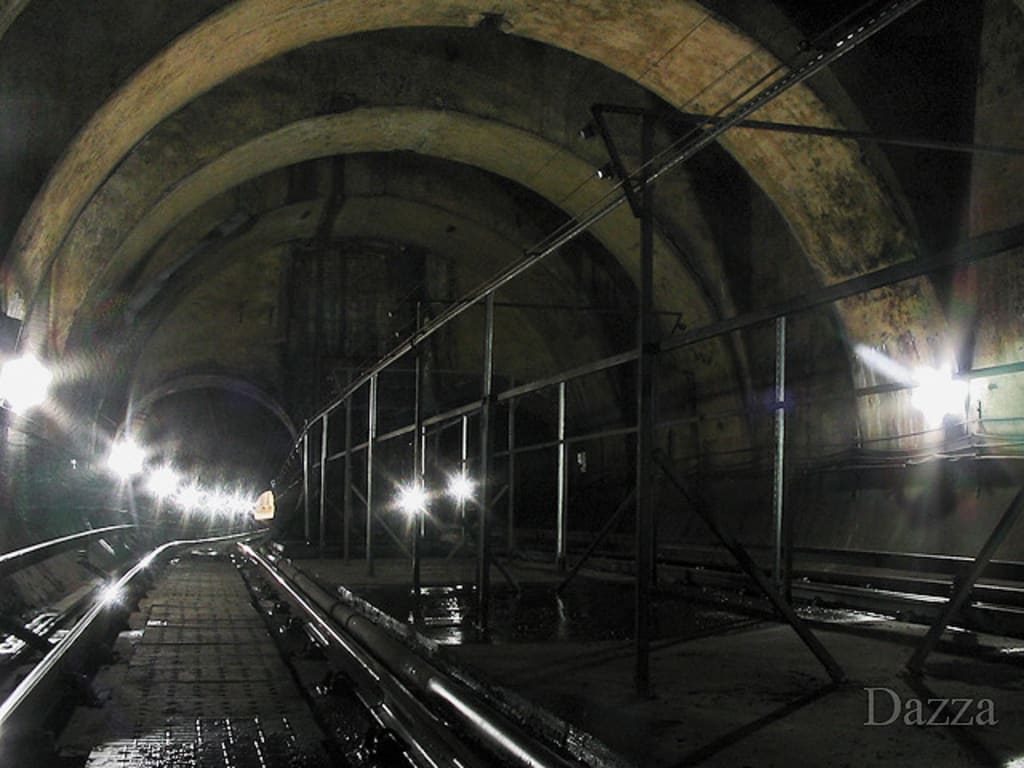
So, your history is underground. Merkland Street Station under the veil of darkness. The lightbulbs that once lit it long disconnected, fizz and flicker are no more. All that are left are the footsteps of your ghost, lying in wait for a train that never comes. They hum a melody heard on the Barras’ parquet. It has no harmony but the dirge of junction-boxes and the gurgle of the drains. They will never be taken to the ball.
Above, on land, the staccato of heels on the flagstones. Your young daughter on her way to Sauchiehall Street, enticed by a bassline. Her steps are impeded by the boom of laughter, there, by Partick Station. Lads leaving after the game. Cans of Vitamin-T in their hands. Whether their scarves are blue or green, their songs have no meaning.
Opposite her, a book lies mute in its blue and white livery. It invites her imagine a country, and leafing through she has no time to read words already heard. This is a story that echoes around the chambers of heart, writ large on every factory wall. The machines no longer shudder as the rain pelts the pavement, but speak only now of silence. This volume like all the others, foretells death. It does not hold her language, and in her palms she shuts it with a crack. To leave it open might facilitate its untold prophecy.
She’ll find freedom tonight, travelling across the city, down a rail that cuts through the lattice of the streets. Her eye is distracted by the buildings flashing past her, the swoon of the carriage and its clanking. People make you, says the sign, but who are these? Her guidebook lies open in her lap.
In it, your every surname: Buchanan, Dunlop, Glassford, Ingram, Wilson. ‘These Great Men’ she says to herself. In her bag, the chime of a phone and a response to a message sent half an hour ago. It feels like the reply is on Highland Time, bursting through the soil of your dear green place, seeking the light of the gloaming. Text and image, a friendly face and a Jamaica football shirt. Your son has made a wise choice tonight.
Somewhere beneath her, her path might intersect with his own. Your son tries to read the station’s names in a language foreign to him, though to this place it belongs. Maybe he heard its whisper one time on the lawn in Partick, before it fled on the wind. A word that filled fishwife mouths on the Saltmarket, that dissipated with the centuries, like the puff of Pàraig nan Dealbh’s camera. Your song does not know their names. Then the carriage jerks as it comes to a halt.
The night’s possibilities haul your people out, and your son follows them, towards the sunset. He will take a gentle stroll, Clydeside, to see the colours of day closing into the river. Russet in the black water. If he didn’t know better, he’d see this a streak of blood, the rust of iron sediment, spreading from where ships no longer sail out into the world. He’ll take his time, light a cigarette, in your city, built on tobacco.
About the Creator
Marcas Mac an Tuairneir
Working in Gaelic and English, Marcas has four poetry collections and a pamphlet. 'Polaris’, published by Leamington Books in 2022, was shortlisted for Scottish Poetry Book of the Year by the Saltire Society. He lives in Edinburgh.
Keep reading
More stories from Marcas Mac an Tuairneir and writers in Fiction and other communities.
Think for Me
"How do you calculate the circumference of a circle? Submit your answer when ready." [Pause] "Excellent! Every student was able to call up the answer electronically very quickly. If I, as a robot had feelings, I would express pride. You may break for lunch. Return to this cyber room in 45 minutes."
By Julie Lacksonen6 days ago in Humans


Comments
There are no comments for this story
Be the first to respond and start the conversation.