

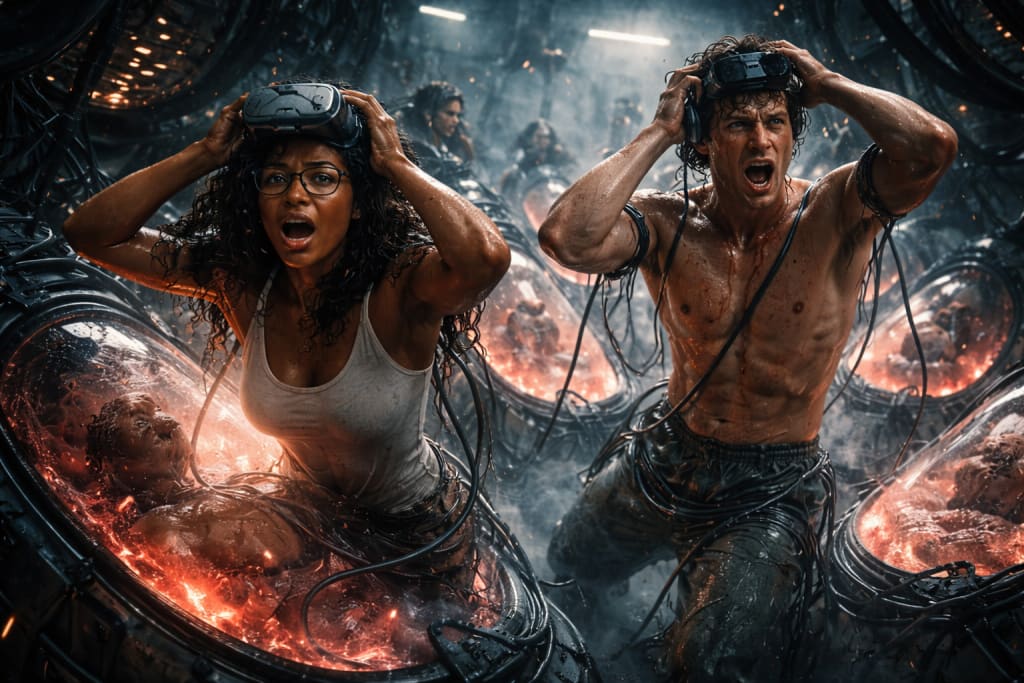
The first thing Mara noticed was that no one ever said no anymore. They said not available, pending review, outside your tier, not at this time; you know when the words were polite. Bloodless. They floated past her like customer service ghosts.
Mara worked in Records, which meant she handled the past; the real past and not the rehearsed curated kind. Her job was to verify archival consistency between public timelines and sealed datasets. She wasn’t supposed to interpret; only to reconcile discrepancies. Our system called it The Permission Layer.

Officially, the Permission Layer didn’t exist. Unofficially, it was the invisible membrane that wrapped everything: movement, speech, employment, healthcare, reproduction, protest. You could do anything…provided the system allowed it; and most days it did or at least just enough.
America still called itself free…that was the science-fiction part; the political history was harder to ignore.
Mara’s grandmother used to tell her stories about voting booths with curtains, about when unions meant something, about being able to walk into a hospital without first proving your worth. These stories were filed under anecdotal anomalies in the Records database. Too inconsistent to verify. Too emotionally charged to publish.
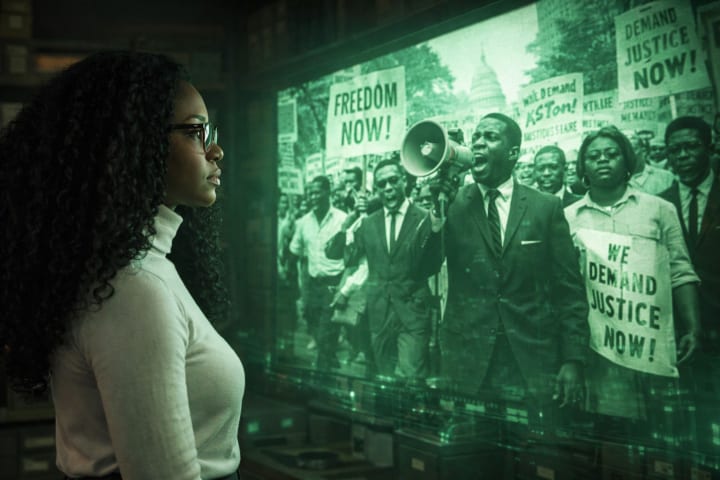
Mara didn’t believe in conspiracies. She believed in logistics...until she met Jonah.
He worked downstairs in Signal Integrity; the department that listened for the “noise”…you know the unauthorized patterns in public discourse. Their job wasn’t censorship; well not officially. It was harm reduction. When a pattern trended toward destabilization, it was softened. Redirected. Diluted. Jonah had a habit of saying too much and smiling like he knew he was being watched.

They met at the coffee dispenser, which served eight beverages and none of them tasted like coffee. “You ever notice,” Jonah said casually, “that freedom here works like a subscription?” Mara stiffened on visceral level and quickly replies “You shouldn’t say things like that out loud.” Jonah shrugged. “I didn’t say it was a bad subscription. Just… tiered.” She hated that he was right. They started talking in fragments. Half sentences. Questions shaped like jokes. The system flagged nothing and once again irony was still permitted.
At night, Mara reviewed sealed files she wasn’t authorized to open. Not because she could access them, but because the metadata told a story all on its own. Sudden disappearances of policies. Court decisions archived but never referenced again. Rights that didn’t vanish…just stopped being enforced.
The positive side to the system was that it didn’t erase history. It buried it under procedural language. The Permission Layer wasn’t a wall. It was a fog.
Jonah showed her something one evening and projecting it between them like a confession. A map of the country, glowing softly. Every state looked identical until he toggled the overlay. Red zones bloomed across the map…pulsing.“What am I looking at?” Mara asked. “Access friction,” Jonah said. “Where people technically have rights, but practically don’t.” Mara follows up with “Is this classified?” His only reply was “Only if you believe classification is real.” She laughed despite herself. It felt dangerous. Intimate.

That’s when she realized the romance had already started.
And “Love”, in this country…was still legal but only in private. Public affection triggered sentiment analysis. Too much intensity flagged instability. Love had to be small. Contained. Optimized. Logical.
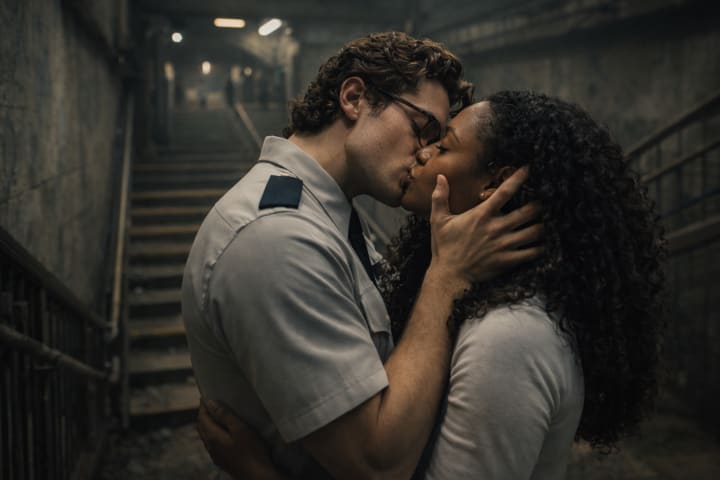
They met in places without cameras, stairwells, abandoned transit hubs, the blind spots left behind by budget cuts. Jonah kissed her like he was trying to remember something he’d once been promised. “This is what they mean,” he whispered once. “When they say freedom is a feeling.” Mara didn’t answer. She was thinking about how feelings could be regulated and the horror crept in slowly. Not monsters. Not violence. Compliance.
One day, a file crossed Mara’s desk that didn’t reconcile. It wasn’t missing data. It was extra. A version of history where protests worked. Where labor strikes led to reform. Where wars ended because people said “NO!” loudly enough. Another anecdotal anomaly, an alternate timeline…labeled ABANDONED SIMULATIONS. Her hands shook.
That night, she confronted Jonah. “They ran outcomes,” she said. “They know what happens if people actually exercise freedom.” Jonah’s face went pale. “And?”…“And they chose this instead.” The Permission Layer wasn’t designed to protect people from chaos. It was designed to protect power from consent. The science fiction illusion cracked completely then. The idea of freedom wasn’t a lie; it was a controlled experiment and kept just believable enough to prevent revolt.
“You can’t unsee this,” Jonah said quietly. “I already have,” Mara replied.
They made a plan that wasn’t really a plan.
Not rebellion. Not revolution.
Disclosure.
Mara leaked the abandoned simulations. Never and not to the public feeds but to the archives everyone used without questioning. School databases. Legal reference systems. Corporate compliance manuals.
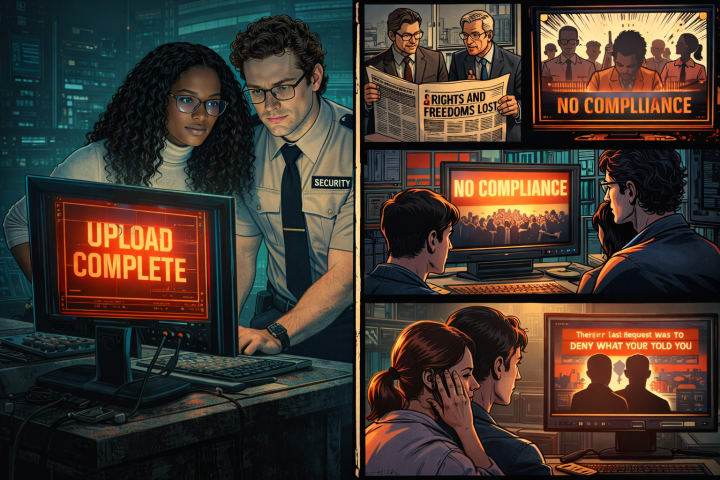
She didn’t shout the truth. She nested it like a virus that looked like documentation.The system hesitated…hmmm that was new. Jonah was reassigned the next day. Lateral move. Better pay. Less access. Mara was offered a promotion. They both declined and that was the most dangerous act of all. The story doesn’t end with sirens or speeches; rather it ends with friction.
Delays. Errors. People noticing that the permission prompts don’t always appear anymore. That sometimes, things happen without approval.
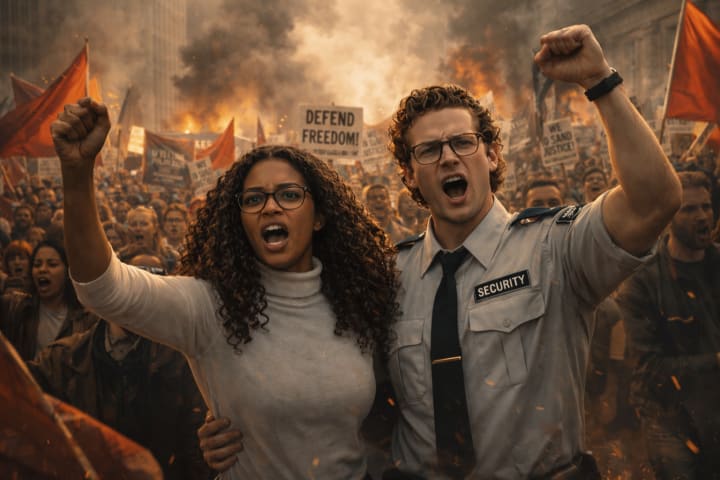
A protest that isn’t immediately dispersed.
A strike that isn’t reframed.
A vote that actually changes something.
The illusion doesn’t shatter all at once.
It never does.
Freedom, it turns out, isn’t science fiction.
Believing it without question is.
And love…the real love was never permitted.
It was practiced.
Quietly.
In the fog…but not anymore.
About the Creator
Cadma
A sweetie pie with fire in her eyes
Instagram @CurlyCadma
TikTok @Cadmania
Www.YouTube.com/bittenappletv
Affection and Healing for Yourself
During the night of the last quarter moon, I gathered my ritual supplies. I carefully handled the chunk of black tourmaline that would protect me from your overall negative and narcissistic energy. I carefully walked the house with my stick of selenite in hand, asking the universe to cleanse our working space.
By Alisha Wilkins ✒️🦋🖋️5 days ago in Fiction
Story of ox and donkey
The Landowner Who Understood Animals In a village lived a wealthy landowner. God had blessed him with vast farmlands, large houses, and beautiful orchards where different kinds of fruits grew in their proper seasons. He owned cows and buffaloes, a strong ox used for plowing fields, and a fine Arabian donkey on which he would ride for leisure trips.
By Sudais Zakwan5 days ago in Fiction
📢 Raise Your Voice Thread: 01/22/2026
Our “Raise Your Voice Threads” are hosted most alternating Thursdays at 12PM ET to offer creators more avenues to uncover exceptional stories on Vocal. As we are continuously searching for fresh creators and inspiring stories, this thread provides an opportunity to exchange and discuss the stories that have moved and motivated us on Vocal.
By Raise Your Voice by Vocal3 days ago in Resources


Comments
There are no comments for this story
Be the first to respond and start the conversation.