
Jupiter—The King of the Planets: Fascinating Facts About the Gas Giant
Discovering the Wonders of the Solar System's Giant Guardian

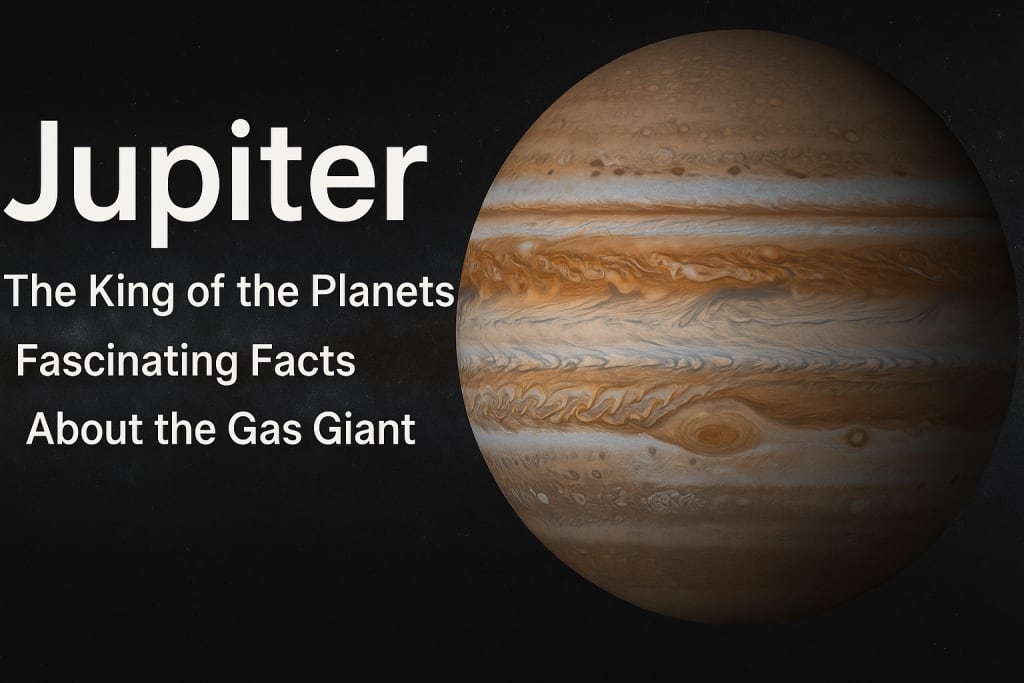
Jupiter—The King of the Planets: Fascinating Facts About the Gas Giant
When you gaze at the night sky, you might not notice it on every occasion, but Jupiter—the most massive planet in our solar system—exists up there, ruling like a genuine monarch. With its vast dimensions, swirling cloud formations, intense storms, and numerous moons, Jupiter has intrigued astronomers and stargazers for ages. In this article, we will explore the details, characteristics, and enigmas of this formidable gas giant.
1. Basic Facts About Jupiter
The largest planet in our solar system is Jupiter. It has a diameter of about 142,984 kilometers (88,846 miles)—more than 11 times wider than Earth.
Mass: It has 318 times more mass than Earth, and its gravity is more than 2.5 times stronger than Earth’s.
Distance from the Sun: Jupiter orbits the Sun at an average distance of about 778 million kilometers (484 million miles) or 5.2 astronomical units (AU).
Day and Year Length: Jupiter has the shortest day of all planets—it completes one rotation every 9 hours and 55 minutes. But a Jupiter year, or one orbit around the Sun, takes roughly 11.86 Earth years.
2. A Gas Giant With No Solid Surface
Jupiter is one of the four gas giants in our solar system, alongside Saturn, Uranus, and Neptune. It’s primarily composed of hydrogen (about 90%) and helium (about 10%), similar to the Sun.
Since it’s a gas planet, Jupiter doesn’t have a solid surface like Earth or Mars. Jupiter is a gas planet without a solid surface, in contrast to Earth and Mars. A spacecraft attempting to land there would have to descend through dense gas and be crushed by the extreme heat and pressure before it could come into contact with anything solid.
3. The Great Red Spot and Extreme Weather
One of Jupiter’s most famous features is the Great Red Spot, a massive storm that has raged for at least 350 years and possibly much longer. It’s so big that three Earths could fit inside it. The storm spins counterclockwise and reaches speeds of up to 432 km/h (268 mph).
Besides the Red Spot, Jupiter is home to bands of powerful jet streams, cyclones, and auroras that are far more intense than those on Earth. The planet’s atmosphere is a turbulent mix of ammonia crystals, water vapor, and unknown compounds, which give it its striking striped appearance.
4. A Powerful Magnetic Field
Jupiter has the strongest magnetic field among all planets in the solar system—about 20,000 times stronger than Earth's. This massive magnetosphere traps charged particles and creates dangerous radiation belts that can damage spacecraft electronics.
The magnetic field also creates spectacular auroras at Jupiter’s poles, which are even more powerful than Earth’s northern and southern lights.
5. Jupiter’s Rings
While Saturn is renowned for its beautiful rings, Jupiter also has a ring system—though it's faint and difficult to see. Jupiter’s rings are made mostly of dust particles ejected from some of its small moons due to meteoroid impacts.
These rings are divided into three parts:
Halo ring (closest to the planet)
Main ring
Gossamer rings
They were first discovered in 1979 by NASA’s Voyager 1 spacecraft.
6. Jupiter’s Massive Moon Family
Jupiter has a large and diverse system of moons. As of 2025, astronomers have discovered over 90 confirmed moons, and the number keeps growing as telescopes become more advanced.
Here are four of the most important ones, known as the Galilean moons, discovered by Galileo Galilei in 1610:
Io—the most volcanically active body in the solar system, with over 400 active volcanoes.
Europa—Believed to have a subsurface ocean beneath its icy crust, making it one of the best candidates for alien life.
Ganymede—the largest moon in the solar system, even bigger than Mercury.
Callisto—Heavily cratered and ancient, with a possible underground ocean.
These moons are practically planetary systems in themselves and have become major targets for future space missions.
7. Jupiter’s Role in the Solar System
Jupiter's enormous gravity is a major factor in the solar system's formation. By acting as a cosmic shield, it keeps many comets and asteroids from hitting Earth. According to some scientists, Jupiter has shielded Earth from frequent devastating collisions.
But, as demonstrated in 1994 when Comet Shoemaker-Levy 9 collided with Jupiter in a spectacular explosion that was visible from Earth, it can also function as a slingshot, drawing objects in and launching them across the solar system or even straight into the planet.
8. Space Missions to Jupiter
Several space missions have visited Jupiter to study its atmosphere, moons, and magnetosphere. Notable missions include:
Pioneer 10 & 11 (1970s)—First spacecraft to fly past Jupiter.
Voyager 1 & 2 (1979)—Sent back stunning images of Jupiter and its moons.
Galileo (1995–2003)—Orbited Jupiter and studied it in great detail, including dropping a probe into its atmosphere.
Juno (arrived in 2016, still active)—Focused on Jupiter’s core, magnetic field, auroras, and atmosphere using polar orbits.
JUICE (Jupiter Icy Moons Explorer)—Launched by ESA (European Space Agency) in 2023, set to arrive in the 2030s to study Europa, Ganymede, and Callisto.
NASA is also preparing the Europa Clipper mission (set to launch in 2024), which will explore Europa and search for signs of life.
9. Jupiter in Mythology and Culture
Jupiter is named after the king of the Roman gods, equivalent to the Greek god Zeus. The name is fitting, considering its massive size and dominant presence in the solar system. It has been known since ancient times and was observed by Babylonians, Greeks, Romans, and many other civilizations.
In astrology, Jupiter is considered the planet of luck, expansion, and growth.
10. Interesting Quick Facts
Jupiter gives off more heat than it receives from the Sun due to slow gravitational compression.
It’s impossible to stand on Jupiter—you’d sink into its gaseous layers.
Jupiter's core may be solid or liquid and is likely made of rock and metal, but its exact structure is still a mystery.
One of Jupiter’s moons, Ganymede, has its own magnetic field—a unique feature among moons.
If Jupiter had been about 80 times more massive, it could have become a star.
Finalization
Jupiter is more than just the largest planet in our solar system—it's a world of extreme weather, mysterious moons, and fascinating phenomena that continue to captivate scientists and stargazers alike. With ongoing missions like Juno and future explorations like Europa Clipper and JUICE, we are on the brink of discovering even more about this gas giant and its potential to teach us about the formation of our solar system—and possibly, life beyond Earth.
Whether you view it through a telescope or read about it in a science book, Jupiter stands as a magnificent reminder of the grandeur and mystery of the cosmos.
About the Creator
Mubarak Hossain Akash
Writer with a passion for storytelling, social issues, and meaningful content. Sharing words that inspire and inform.
Keep reading
More stories from Mubarak Hossain Akash and writers in Fiction and other communities.
How to Sleep in 2 Minutes
How to Fall Asleep in 2 Minutes: The Military Sleep Technique That Actually Works In our fast-moving world, sleep can seem like an indulgence. Due to stress, overthinking, or excessive screen time, countless people struggle to drift off quickly. But what if you could teach your body to fall asleep in just two minutes? Seems unlikely, doesn’t it?
By Mubarak Hossain Akash10 months ago in Fiction
Sophie's Journey
"Hello, big blue bear. I am Sophie and I am looking for myself. It seems I have lost myself. Can you help me?" "Oh, Sophie. Yes, I remember you! It has been a long time. And time is precious, for we never know how much we have left. So let us not be wasteful: do you see this old castle on the horizon?"
By Paul Finglabout 13 hours ago in Fiction



Comments
There are no comments for this story
Be the first to respond and start the conversation.