
Journey to the Unknown: Unravelling Black Hole Mysteries
Exploring Gaia BH1, LB1, Sagittarius A, and TON 618: A Cosmic Adventure

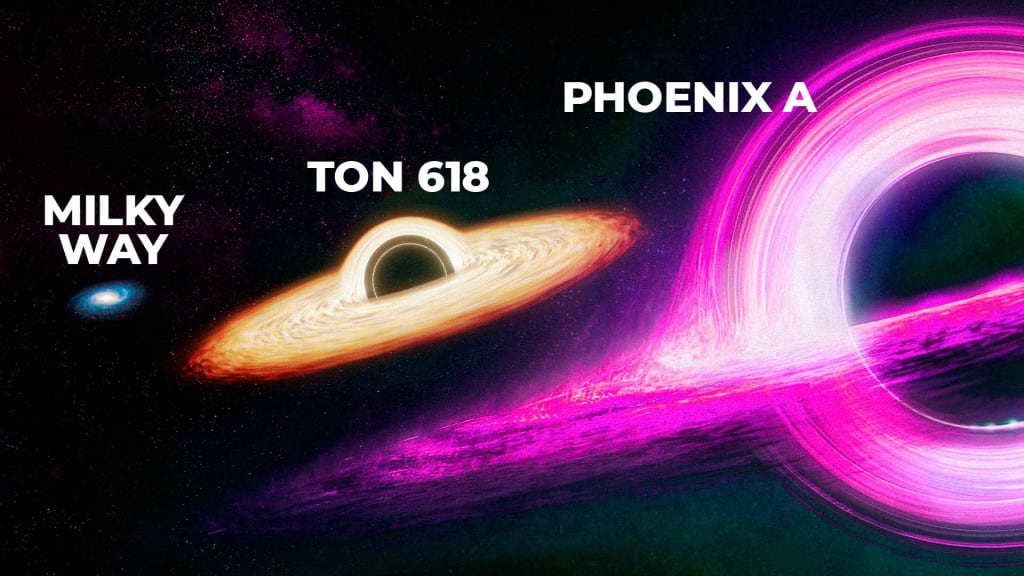
Black holes, those mysterious and awe-inspiring celestial objects, continue to fascinate scientists and stargazers alike. As we delve deeper into the mysteries of the universe, our understanding of these dark matter devouring balls of gravity has grown. In this blog, we will further explore the intriguing discoveries related to black holes, shedding light on Gaia BH1, LB1, and other monstrous black holes that challenge our current knowledge of the cosmos.
Gaia BH1: The Dormant Enigma
Black holes have traditionally been identified by their insatiable hunger, gobbling up gas and matter in their vicinity. Gaia BH1, however, defies this convention. This colossal black hole, lurking just 1600 light years away from our solar system, remains dormant, patiently waiting for cosmic matter to come its way. Its unique binary star system disguise has made it difficult to detect, as it poses as a star instead of exhibiting the usual feeding behaviour. Gaia BH1's proximity to our solar system makes it an intriguing neighbour and a subject of great interest for researchers seeking to understand the behaviour of black holes.
LB1: Unravelling the Illusion
The discovery of LB1 initially perplexed scientists, as it did not fit into the traditional categories of black holes. With a mass of 70 solar masses, LB1 was too massive to be a stellar black hole, yet too small to be classified as a supermassive black hole. The enigma led to various theories, such as the possibility of two black holes orbiting each other or the evolution of a massive star into a black hole. However, further observations and analysis unveiled the truth. LB1 was not a black hole at all but an optical illusion caused by two rare stars orbiting each other. This revelation emphasised the importance of thorough investigations and the constant refinement of our knowledge in the realm of astrophysics.
Sagittarius A: The Monstrous Heart of Our Galaxy
While Gaia BH1 and LB1 piqued our curiosity, we cannot overlook the significance of Sagittarius A*, the supermassive black hole residing at the core of our Milky Way galaxy. With a mass equal to four and a half million suns, Sagittarius A* wields immense gravitational power, influencing the motions of stars and other celestial bodies within its vicinity. While it reigns as a formidable entity within our galaxy, the universe still has even more colossal black holes scattered across the cosmos.
TON 618: A Bright Devourer in the Distant Universe
TON 618, situated a staggering 10 billion light years away from us, stands as a testament to the extremes of celestial objects. Its brilliance outshines its entire galaxy, radiating as brightly as 140 trillion suns. The sheer magnitude of TON 618 challenges our comprehension of the limits of celestial bodies and the vastness of the cosmos. Studying distant black holes like TON 618 presents significant challenges due to their immense distances, yet it also offers unique insights into the evolution and behaviour of these enigmatic entities.
The Humbling Journey of Discovery
The exploration of black holes, including Gaia BH1, LB1, Sagittarius A*, and TON 618, reminds us of the boundless nature of our universe and the humbling journey of discovery that lies ahead. Each new revelation unveils new layers of complexity, challenging our preconceived notions and encouraging us to keep questioning and seeking answers. As we gaze upon the night sky, we are filled with wonder at the countless wonders that await our discovery.
The Evolution of Knowledge
Our understanding of black holes continues to evolve, propelled by advancements in technology and relentless scientific inquiry. We must acknowledge that the universe holds many secrets, and our quest to unravel its mysteries is ongoing. While Gaia BH1 and LB1 might have initially misled scientists, they have deepened our appreciation for the complexity of the cosmos.
Conclusion
In this journey to unravel the mysteries of black holes, we have encountered both enigmatic entities like Gaia BH1 and illusory objects like LB1. Alongside these discoveries, the colossal power of Sagittarius A* and the brilliance of TON 618 have humbled us with their sheer magnitude. As we continue our exploration of the cosmos, let us remain open to the ever-changing landscape of astrophysics. With each new insight, we inch closer to comprehending the wonders of the universe and its unfathomable black holes. So, let us continue to gaze upon the stars, driven by curiosity and a sense of wonder, knowing that there are countless marvels awaiting our discovery in the vast expanse of the cosmos.
About the Creator
Rohit Singh
Software developer, part-time content creator, and tech enthusiast.
Unleashing creativity and embracing tech. Join me on this thrilling journey! 🚀
Keep reading
More stories from Rohit Singh and writers in Fiction and other communities.
Journey Back in Time: Exploring Earth's Prehistoric Permian Period
Introduction Millions of years ago, our planet looked radically different from what we know today. During the Permian period, approximately 300 million years ago, all continents were united as one supercontinent called Pangea, encircled by the vast world ocean known as Panthalassa. This era witnessed an astonishing diversity of life, and we invite you on an epic journey back in time to explore this ancient world teeming with both enchanting and terrifying creatures.
By Rohit Singh3 years ago in Fiction
Pandora’s Burden
“My brother warned me to not accept gifts from the one who commissioned you,” said Epimetheus to the woman clad in silvery raiments standing at the entrance to the temple. Her silver tiara and the silver rings on her fingers and toes glinted in the firelight cast by torches set on either side of the doorway. Lingering in the shadows, beyond the reach of the flames as she was, he could not tell what she held in her hands. At first what appeared to be a box was perhaps a funerary urn, or maybe merely an apple.
By J. Otis Haas2 days ago in Fiction


Comments
There are no comments for this story
Be the first to respond and start the conversation.