
It’s Always Snowing Somewhere — Yet 80% of the World Has Never Seen It Fall
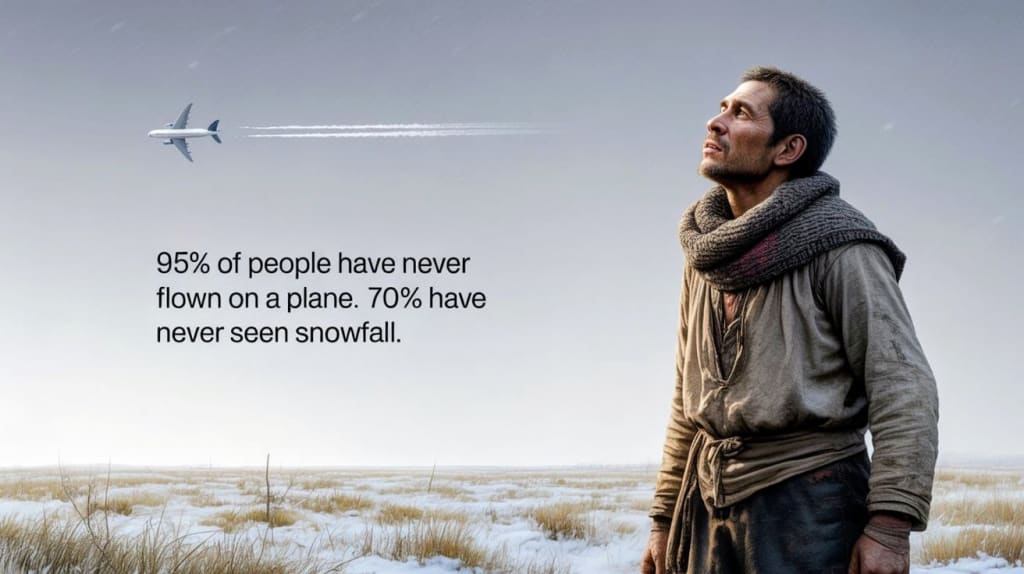
Above us, planes cross the sky every second — but 95% of people on Earth have never flown in one
If you step outside right now and look up, you might see nothing but a blank, indifferent sky.
Maybe a bird, maybe a streak of cloud, maybe the hum of distant traffic.
But what you won’t see — though it’s certainly there — are the hundreds of aircraft tracing invisible highways above your head.
At any given moment, more than 250,000 flights are active somewhere around the planet.
Every second, engines ignite, wheels leave the ground, and another silver body rises into the thin blue.
They cross continents, oceans, and time zones — some carrying business travelers, others reuniting families, some ferrying goods that sustain the quiet rhythm of our daily lives.
And yet, despite this constant motion in the heavens, an astonishing 95% of the world’s population has never been on an airplane.
Yes — for nearly eight billion people sharing this planet, flight remains a dream seen only from below.
In villages across South Asia, in the plains of Africa, and in the crowded neighborhoods of South America, people grow old watching vapor trails dissolve into the horizon.
Children point upward at the faint roar of a jet, imagining what it must feel like to be above the clouds.
To look down upon the land that holds them.
To be free, even for a few hours, from gravity’s unspoken rule.
The Sky Everyone Sees — But Few Ever Touch
The irony of our age is that flight has never been more common, nor more exclusive.
A single Boeing 777 might carry three hundred passengers — but outside that fuselage, millions remain grounded by economics, politics, or the simple geography of birth.
The global average cost of a plane ticket can exceed what entire families earn in a month.
In some regions, airports are as distant as the moon — more myth than infrastructure.
So while satellites circle, drones deliver, and billionaires talk of Mars, the majority of Earth’s people have yet to leave the ground.
And still, above them, the planes continue — silent messengers of a modernity they can only imagine.
Every second, skies are full, routes are plotted, lives are transported — but most humans remain rooted to soil, looking up at what they will never touch.
Meanwhile, in Another Corner of the Sky — It’s Snowing. Always.
At the same time those planes glide across the stratosphere, somewhere — perhaps over Greenland, or northern Canada, or the high peaks of the Himalayas — snow is falling.
It’s one of the quietest, most consistent phenomena on Earth.
Even when you’re sweating in equatorial heat, or walking beneath a desert sun, somewhere on this planet, snow is falling right now.
Meteorologists have a term for this constant cycle — the perpetual precipitation loop.
Because of Earth’s tilt and rotation, and the global circulation of air currents, it is almost impossible for an entire 24-hour period to pass without snowfall somewhere on Earth.
From Iceland’s volcanic ridges to Antarctica’s frozen wastelands, from the Andes to Siberia, frozen crystals of vapor are continuously forming, drifting, and disappearing —
millions of tiny hexagonal miracles dissolving into silence.
Yet 80% of Humanity Has Never Seen Snow Fall
It sounds impossible, almost poetic — but it’s statistically true.
The vast majority of Earth’s population has never witnessed snowfall with their own eyes.
They have seen it in films, in postcards, in Christmas decorations made of plastic flakes — but not in the flesh.
Not falling from the sky. Not melting on their skin. Not turning breath into fog and silence into sound.
Across India, Bangladesh, Indonesia, Brazil, Nigeria, Egypt, Saudi Arabia, and countless other nations,
snow is a word, not a weather.
An idea, not an experience.
In tropical regions, where temperatures rarely dip below freezing, a child can live and die without ever knowing the sound of crunching snow underfoot.
They may see it on a TV screen — a world painted white, distant, magical — and wonder if it’s real at all.
The Privilege of Cold
Snow, for those who live with it, is often an inconvenience:
a delay, a hazard, a chill that seeps through gloves and bones.
But for those who have never known it, snow carries an almost spiritual quality — a symbol of distance, privilege, and wonder.
It’s easy to forget that cold itself is a privilege — one that depends on geography, economy, and luck.
In countries that straddle the equator, winter exists only as a rumor.
Children there have never built a snowman, never thrown a snowball, never seen their breath in the air.
Some might laugh at the idea that this matters —
but it reveals something profound about how unequal the human experience of Earth truly is.
We live on the same planet, under the same sun, beneath the same sky —
and yet, the very seasons treat us differently.
The Sky Above Us Is Divided Too
The world’s inequality isn’t just about wealth or opportunity — it’s written into the weather.
While one part of humanity boards flights across oceans, another stares upward at skies filled with planes they’ll never ride.
While one city is buried in snow, another has never known what it feels like to see flakes drift through streetlights at night.
The global climate, like global privilege, is uneven.
And the same sky that shelters us all, divides us in quiet, invisible ways.
A mother in Mumbai may fan her child through another 40°C summer night,
while a fisherman in Iceland chips ice from his boat’s hull.
Both live under the same dome of atmosphere — but one has never known the other’s world.
Where Planes and Snow Meet
There’s something poetic — maybe even cosmic — in the fact that airplanes and snow share the same stage.
Both are creatures of the sky,
both born from vapor,
both symbols of motion and impermanence.
One is the creation of human ambition —
aluminum, fuel, and flight plans.
The other, a creation of nature —
silent, spontaneous, dissolving before it hits the ground.
And perhaps that’s the ultimate metaphor for our age:
Humankind has mastered the technology of flight, but not the equality of experience.
We’ve conquered the air, but not the sky.
The View from Below
For billions of people, the sky remains an unreachable frontier —
a stage for others to play upon.
They look up and see trails of vapor like brushstrokes across blue,
and they wonder where those lines begin, and where they end.
They imagine what it would feel like to rise through the clouds,
to see the world shrink beneath them,
to watch the curve of the Earth and feel — if only for a moment — infinite.
For them, snow and airplanes belong to the same category of magic:
real, but remote.
Visible, but untouchable.
And perhaps that’s what binds all humans together —
this quiet, shared awe of what exists just beyond reach.
The Earth, Seen from the Ground
We are a species that dreams of flight, yet lives with feet in the dust.
We speak of global connection, but our experiences of the world remain radically unequal.
While some gaze down from thirty thousand feet,
others gaze upward, chasing the same dream through the noise of city streets.
While some wake to snow drifting past their windows,
others dream of what that silence might sound like.
But somewhere, right now —
a plane is crossing the Pacific.
And somewhere else, a child in Norway presses a mittened hand against falling snow.
And somewhere far away, a boy in Ghana looks up at a white streak in the sky and whispers,
“One day, I’ll be there.”
He doesn’t know it,
but in that moment, both the airplane and the snow are above him.
Different altitudes.
Same sky.
Closing Reflection
Maybe that’s the quiet lesson the world keeps trying to teach us:
that no matter how far we travel or how high we fly,
we are all bound to the same planet —
a world where it’s always snowing somewhere,
and yet most of us will never feel it fall.
A world where millions of planes cross above our heads,
but most of us will never leave the ground.
And still, we look up —
because hope, like snow,
has a way of falling silently from the sky.
About the Creator
Wellova
I am [Wellova], a horror writer who finds fear in silence and shadows. My stories reveal unseen presences, whispers in the dark, and secrets buried deep—reminding readers that fear is never far, sometimes just behind a door left unopened.
Miss Persephone's Manual to a Seemingly Ordinary Life
Miss Persephone was found at the dining table, her blue eyes swollen, her tears arriving and retreating like the tides of the ocean. Earlier that day, her family had visited her in the retirement home where she had lived for eight years. It was her eightieth birthday.
By Imola Tóth4 days ago in Fiction




Comments
There are no comments for this story
Be the first to respond and start the conversation.