
Is Time Travel Theoretically Possible?
Time Travel Possibilities
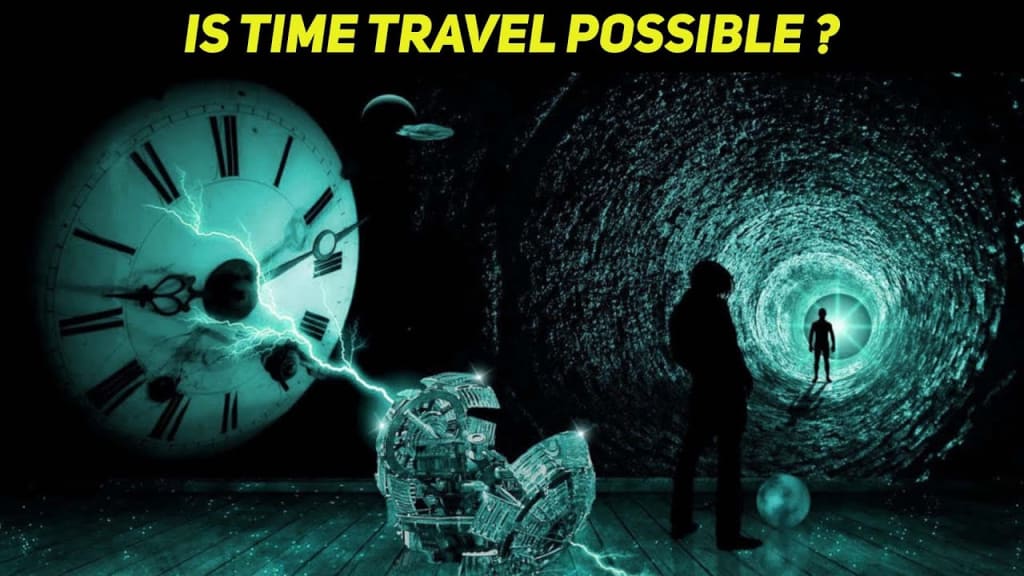
Time travel has long been a fascinating concept in science fiction, capturing the imaginations of countless individuals. While it remains speculative, the notion of time travel has garnered significant attention within the realm of theoretical physics. Although the scientific community has not yet discovered a definitive method for time travel, certain theories and possibilities have been proposed.
The concept of time travel is intricately connected to the nature of time itself. According to our current understanding, time is a dimension that flows in a forward direction, from past to future. This understanding is based on the theory of general relativity put forth by Albert Einstein, which describes the relationship between space and time.
One potential avenue for time travel is through the manipulation of spacetime, the fabric that encompasses the universe. General relativity allows for the existence of "wormholes," hypothetical tunnels that connect distant regions of spacetime. If traversable wormholes could be created and controlled, they might serve as shortcuts between different points in time as well as space. However, substantial challenges such as the stability and construction of wormholes remain unsolved.
Another concept related to time travel is the idea of "time dilation," a phenomenon predicted by Einstein's theory of special relativity. Time dilation occurs when an object or person is moving at speeds close to the speed of light. In such cases, time appears to pass more slowly for the moving object relative to a stationary observer. While this effect has been experimentally confirmed, it does not enable the kind of time travel commonly depicted in fiction.
Furthermore, certain theories within the field of quantum mechanics suggest that time travel may be possible on a microscopic scale. For instance, the "many-worlds interpretation" proposes the existence of parallel universes, where each possible outcome of an event exists in a separate reality. In this framework, one could potentially "jump" between these parallel universes, effectively traveling through time. However, these ideas are highly speculative and remain purely theoretical at present.
It is important to note that time travel, if achievable, would entail numerous paradoxes and logical conundrums. The most famous of these is the "grandfather paradox," which posits that if one were to travel back in time and kill their own grandfather before they have children, a contradiction arises: How could the time traveler exist in the first place to carry out such an act?
However, it's important to note that both of these concepts come with significant challenges and constraints. Wormholes, for instance, are purely hypothetical and require the existence of exotic matter with negative energy density to stabilize them, which we have not yet observed. Additionally, even if time travel were possible, there are several logical and physical paradoxes associated with it, such as the famous "grandfather paradox" where one could potentially go back in time and prevent their own birth.
In summary, while time travel continues to capture the human imagination, its feasibility remains uncertain and speculative within the current framework of scientific understanding. The manipulation of spacetime through concepts such as wormholes, time dilation, or quantum phenomena holds promise but faces significant challenges. Additionally, the existence of paradoxes further complicates the possibility of time travel. As our knowledge and understanding of physics advance, we may gain further insights into the nature of time and unlock the secrets of time travel, but for now, it remains an intriguing topic for scientific investigation and the realm of science fiction.
About the Creator
Minu Singh
My name is Minu Singh, and I am delighted to share my passion for writing an articles . As an avid writer, I aim to engage and captivate my readers, taking them on a journey of knowledge, inspiration, and thought-provoking perspectives.
Keep reading
More stories from Minu Singh and writers in Fiction and other communities.
Can a Robot Ever Become Your Friend?
To summarize, in a science fiction novel, the question arises whether robots would be portrayed as enemies or friends of humanity. Exploring the concept of human-robot friendship, it is important to understand the significance of friendship in our lives and its impact on our well-being. Research has shown that friendships contribute to better physical and mental health, similar to romantic relationships.
By Minu Singh3 years ago in Fiction
Miss Persephone's Manual to a Seemingly Ordinary Life
Miss Persephone was found at the dining table, her blue eyes swollen, her tears arriving and retreating like the tides of the ocean. Earlier that day, her family had visited her in the retirement home where she had lived for eight years. It was her eightieth birthday.
By Imola Tóth3 days ago in Fiction
Coming of Age
Over the last five years, life in the Bay State seemed to be in a constant state of turmoil. Tariffs on glass, lead and several other items were responded to by the colonists with boycotts. Unrest grew to a fevered pitch until, on March 5th, 1770, the Boston Massacre occurred. Three years later, a group of men dressed as Native Americans boarded a ship and tossed its cargo of tea into Boston Harbor. Their action was dubbed the Boston Tea Party. It was easy to see how a fourteen-year-old boy who lived twenty miles from the big city could be easily confused by the state of the world.
By Mark Gagnona day ago in Fiction


Comments
There are no comments for this story
Be the first to respond and start the conversation.