
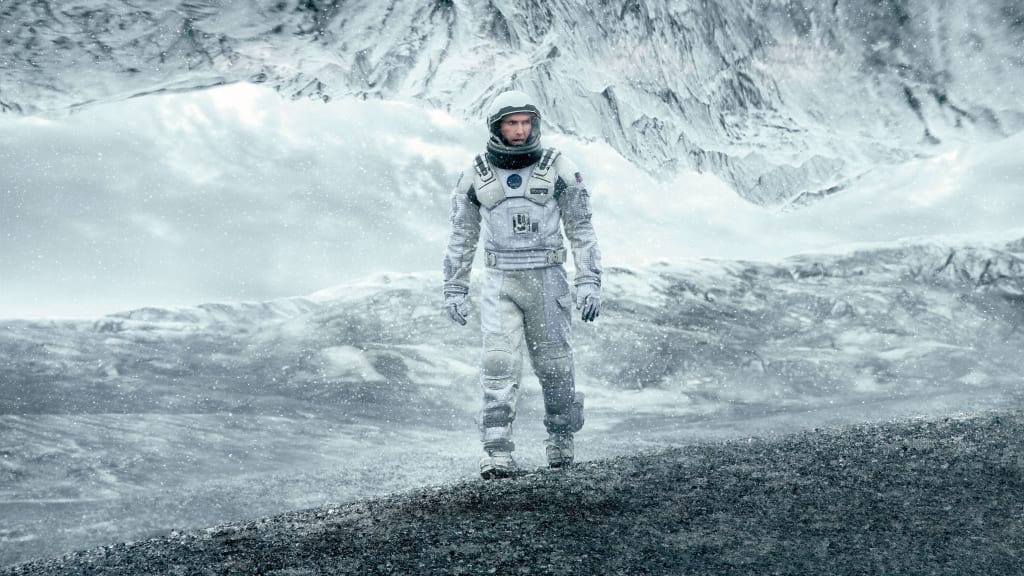
"Interstellar" is a science fiction film released in 2014, directed by Christopher Nolan. The film is set in a dystopian future where humanity is facing extinction due to environmental degradation, and a group of astronauts set out on a mission to find a new home for humanity.
The film explores several themes including the role of science and technology in saving humanity, the power of love and sacrifice, and the importance of intergenerational responsibility.
One of the key themes in the film is the role of science and technology in saving humanity. The film presents science as a tool for solving problems and discovering new worlds, but also acknowledges the limitations of science and the importance of embracing uncertainty and mystery. The film also highlights the importance of international cooperation and collaboration in scientific research, as the astronauts work with teams from different countries to complete their mission.
The film also explores the power of love and sacrifice, as the main character, Cooper, must make a difficult decision to leave his family behind in order to save humanity. This theme highlights the sacrifices that people make for the greater good and the importance of selflessness and courage in the face of adversity.
Finally, the film touches on the theme of intergenerational responsibility, as the characters must consider the impact of their actions on future generations. This theme is embodied in the character of Murph, Cooper's daughter, who is seen as the next generation of humanity and is crucial to the success of the mission.
In conclusion, "Interstellar" is a thought-provoking film that explores several important themes and questions related to science, technology, love, sacrifice, and intergenerational responsibility. The film offers a unique perspective on the future of humanity and the role that science and technology may play in saving it.
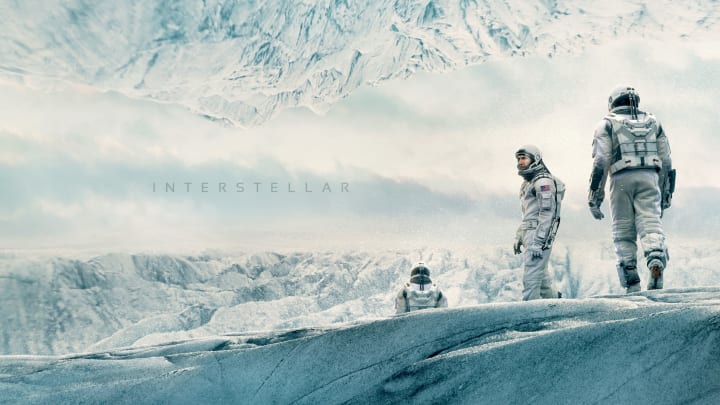
The film showcases the role of science and technology in saving humanity, while also acknowledging the limitations of these fields and the importance of embracing uncertainty and mystery. The film emphasizes international cooperation and collaboration in scientific research and highlights the sacrifices that people make for the greater good.
The main character, Cooper, must leave his family behind in order to save humanity, embodying the theme of love and sacrifice. The film also touches on the theme of intergenerational responsibility, as the characters must consider the impact of their actions on future generations. This is embodied in the character of Murph, Cooper's daughter, who represents the next generation of humanity and is crucial to the success of the mission.
In conclusion, "Interstellar" offers a unique perspective on the future of humanity and the role that science and technology may play in saving it. The film raises important questions and themes about the impact of our actions on future generations, the sacrifices we make for the greater good, and the limitations and potential of science and technology.
A black hole is a region of space where the gravitational pull is so strong that nothing, not even light, can escape it. Black holes are formed when a massive star collapses in on itself, compressing its matter into an extremely dense and small region of space known as a singularity. The boundary surrounding the singularity is called the event horizon, and this is the point of no return for anything that crosses it.
Black holes are categorized based on their mass, with the smallest being called "stellar" black holes and the largest being "supermassive" black holes. Stellar black holes can have masses ranging from several to tens of times that of our sun, while supermassive black holes can have masses equivalent to billions of suns.
The presence of a black hole can have a significant impact on its surroundings. For example, it can disrupt nearby stars and cause them to orbit in an unusual pattern, and it can also accrete matter from its surroundings, forming a disk of material that can emit X-rays.
Black holes are still a subject of much scientific study, as they pose many mysteries and challenges to our current understanding of physics and astronomy. Despite their mysterious nature, black holes play an important role in shaping the universe, and they are an important tool for studying the evolution of galaxies and the formation of stars.
In 2014, there were a number of active space stations in orbit around the Earth. The most well-known of these was the International Space Station (ISS), which is a collaborative effort between several space agencies including NASA, Roscosmos (Russia), JAXA (Japan), ESA (Europe), and CSA (Canada). The ISS was launched in 1998 and has been continuously occupied by astronauts since 2000.
In 2014, the ISS was home to a number of scientific experiments and technology demonstrations, including research in fields such as biology, physics, and material science. The station also served as a platform for testing technologies that could be used for future space missions, such as long-duration human spaceflight and deep space exploration.
Other space stations active in 2014 included China's Tiangong-1 space laboratory, which was launched in 2011, and the Russian Orbital Segment, which is part of the larger ISS program.
In addition to these operational space stations, there were also a number of private space stations in development, such as Bigelow Aerospace's planned inflatable space stations, which aimed to provide commercial space access and research opportunities for a range of customers.
About the Creator
Keep reading
More stories from ibrahim Hussain and writers in Fiction and other communities.
How, Too
Many people wonder how, too. You are not alone, and I am an expert. I will teach you how, too! First, you need to remit a small application fee and fill out an application describing the nature of your financial situation and how often payments will be made, as this will have great bearing on how well I teach you how, too.
By Harper Lewis4 days ago in Fiction




Comments
There are no comments for this story
Be the first to respond and start the conversation.