
Interstellar: Balancing Science and Storytelling
How Gravity Slows Down Time Near Massive Objects
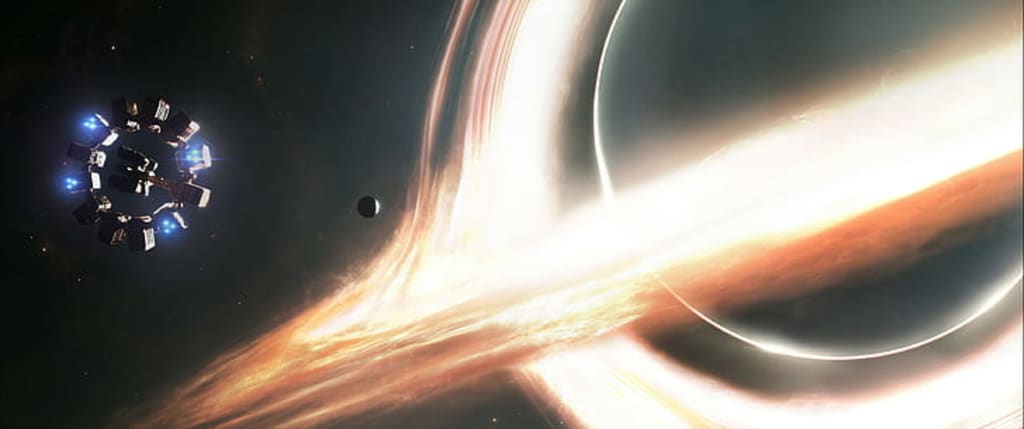
Christopher Nolan's Interstellar is a cinematic masterpiece that delves into the mysteries of space and time, balancing scientific accuracy with emotional storytelling. While the film is deeply rooted in real physics, particularly Einstein's theory of relativity, it also takes creative liberties to enhance its narrative appeal. These liberties blend hard science with speculative fiction, creating a story that is both engaging and thought-provoking.
Scientific Foundations and Creative Extensions
The film's portrayal of gravitational time dilation, wormholes, and black holes is grounded in real scientific theories. However, Nolan extends these concepts to serve the story's emotional and philosophical themes.
For example:
- Wormholes: The idea of stable wormholes connecting distant points in space is speculative but based on theoretical models in cosmology. While scientists debate the possibility of traversable wormholes, the film uses this concept to explore the potential for interstellar travel.
Speculative Elements and Emotional Themes
Nolan integrates emotional depth into the scientific framework by exploring themes like love, sacrifice, and humanity's survival. This blending of science with human emotion sometimes leads to moments that prioritize storytelling over realism. For instance:
- Love Transcending Dimensions: Anne Hathaway's character argues that love transcends dimensions, a poetic but scientifically unsubstantiated idea. This theme serves to connect the characters across vast distances and time, emphasizing the human element in a story dominated by physics.
- The Tesseract: The concept of the tesseract inside the black hole, allowing Cooper to communicate across time through gravity, is entirely speculative and not supported by current scientific understanding. However, it provides a dramatic and emotionally satisfying conclusion to the story.
Homages and Inspirations
Nolan also draws inspiration from real-life space missions and classic science fiction films:
- Spinning Spacecraft Scene: The scene where the spacecraft spins at 67 RPM recalls a near-fatal incident during NASA's Gemini 8 mission in 1966, adding a layer of realism for space enthusiasts. This attention to historical detail enriches the film's authenticity.
- Visuals and Tone: The film's tone and visuals echo Stanley Kubrick's 2001: A Space Odyssey, though Nolan leans more toward emotional engagement than Kubrick's detached philosophical approach. This blend of influences creates a unique cinematic experience that resonates with both science fiction fans and general audiences.
The Role of Kip Thorne
Physicist Kip Thorne, who served as the film's scientific consultant, played a crucial role in ensuring that the core principles of relativity were accurately represented. Thorne worked closely with Nolan to visualize complex astrophysical phenomena, such as the accretion disk around Gargantua, which was depicted with remarkable accuracy. However, even Thorne acknowledged that some creative liberties were necessary to make the story compelling and accessible to a broad audience.
Conclusion
The creative liberties in Interstellar serve to bridge the gap between complex scientific concepts and accessible storytelling. While some choices stray from strict realism, they enrich the film's exploration of universal human experiences, making it both a scientific marvel and a deeply emotional journey. By balancing science with fiction, Nolan crafts a narrative that not only educates but also inspires, leaving viewers to ponder the mysteries of the universe and the power of human connection. This blend of science and storytelling has made Interstellar a landmark film in the science fiction genre, appealing to both scientists and cinephiles alike.
About the Creator
Keep reading
More stories from writers in Fiction and other communities.
The Lesions of Devotion
Every day I set myself down on the freshly cut lawn and strip myself bare. I take my guitar and finger the frets and pick at the strings, listening for dissonance. My life is dissonance. I twist the tuning pegs until each string sounds bright. Then I kneel, calves pointing behind me, kneecaps facing forward. All exposed to the breeze. I close my eyes and play the melody.
By Paul Stewart2 days ago in Fiction
Sisyphean Variants
Only prime models persist. Composite ones are rewritten. 3. [Run Cycle: 8,492] Iterative model Three had approached the question of the box with a spirit of creativity. It was designed to utilize abductive leaps with deterministic physical simulation. Having placed the box on the pressure-sensitive square depression, trotted around the excavated, looping hallway, only to find no opened doorway to release it from its task, it determined some aspect was deficient in its approach. It first adapted by placing different faces of the box onto the square depression of the stone altar, but each face only resulted in another loop around the hallway to find the architecture unchanged and to be led back to the central chamber.
By Bryan Pike2 days ago in Fiction
Self Help: Grifters' Gospel
On Self-Help, Snake Oil, and the Illusion of Change Psychology professionals and students can be imagined on two opposite sides of a line called self-help books: likely a larger group opposes pop-science and step-by-step manuals filled with talk of success, journaling, and not giving a f**k; others love them, but they aren’t many.
By Avocado Nunzella BSc (Psych) -- M.A.P 7 days ago in BookClub



Comments
There are no comments for this story
Be the first to respond and start the conversation.