
Inside the Black Hole: Exploring the Unexplored!
A Journey through the Mysterious World of Black Holes
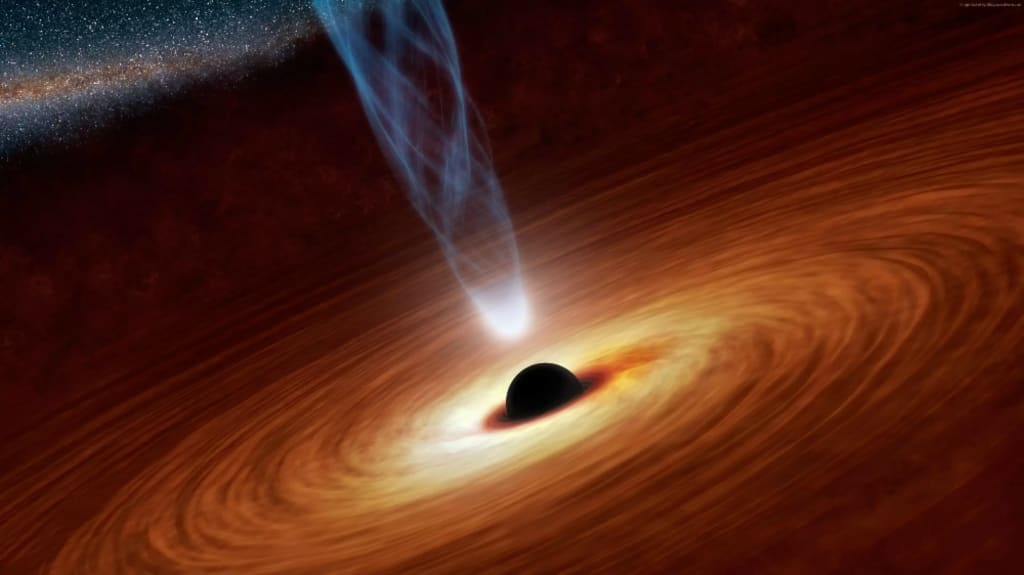
Black holes are some of the most mysterious and fascinating objects in the universe. They are formed when massive stars collapse under their own gravity, creating a region of space where the gravitational pull is so strong that nothing, not even light, can escape. The idea of a place where the laws of physics as we know them to break down is both intriguing and terrifying. So, what might be inside a black hole?
To understand what might be inside a black hole, we need to first understand what happens at the event horizon. The event horizon is the boundary around a black hole where the gravitational pull becomes so strong that nothing can escape. Once an object crosses the event horizon, it is pulled inexorably toward the singularity at the center of the black hole. This is where the laws of physics as we know them to break down, and our current understanding of the universe break down with them.
One theory suggests that inside a black hole, there is a singularity, a point of infinite density and zero volume. This singularity is thought to be the source of the gravitational pull that makes the event horizon. The singularity is so dense that it warps space and time, creating a region of space where the laws of physics as we know them no longer apply.
Another theory suggests that black holes may be gateways to other universes or dimensions. This theory is based on the idea that the singularity at the center of a black hole may not be a point of infinite density, but rather a wormhole, a tunnel through space-time that connects two distant points. If this is true, then black holes may be portals to other parts of the universe, or even to other universes altogether.
There is also a theory that suggests that black holes may be the birthplaces of new universes. According to this theory, when a star collapses and forms a black hole, it creates a new universe inside it. This new universe may be completely different from our own, with its own set of physical laws and constants.
Despite these fascinating theories, we still have much to learn about black holes. The extreme gravitational forces and the breakdown of the laws of physics make it difficult to study them directly. However, scientists have been able to study the effects of black holes on the surrounding matter and energy, and these observations have provided us with valuable insights into their nature.
Recent advances in technology have allowed us to observe black holes more closely than ever before. In April 2019, the Event Horizon Telescope collaboration released the first-ever image of a black hole, located in the center of the galaxy M87. This groundbreaking achievement provided us with a glimpse of the extreme gravitational forces at work within a black hole.
The image showed a bright ring of hot gas swirling around the black hole's event horizon, with a dark region at the center where the black hole's gravitational pull was so strong that even light could not escape. The image confirmed many of the predictions of Einstein's theory of general relativity and provided us with a new understanding of how black holes behave.
Further observations of black holes have also revealed the existence of jets of highly energetic particles that shoot out from their poles. These jets can extend for millions of light-years and are thought to be powered by the black hole's intense gravitational forces. Studying these jets can provide us with insights into how black holes interact with their surroundings and how they influence the evolution of galaxies.
As our technology improves, we may be able to study black holes even more closely in the future. This could allow us to answer some of the most fundamental questions about the nature of the universe, such as the relationship between black holes and dark matter, and whether black holes can merge to form even larger black holes.
In conclusion, the question of what might be inside a black hole remains one of the biggest mysteries in the universe. While theories abound, we still have much to learn about these enigmatic objects. However, the study of black holes has already given us a better understanding of the nature of space and time and has challenged our assumptions about the fundamental laws of physics. As we continue to explore the universe and push the boundaries of our understanding, we can only imagine what new discoveries await us in the realm of black holes.
About the Creator
Lightning Never Strikes Twice
The distant rumble, the sudden deluge, the crescendo of sound, the flash of light, the explosive energy — it never gets old. I became an amateur storm chaser about two years ago. My wife, Cindy suggested it. Sort of. She said, "Alex, you know this cancer is killing me. I've come to terms with that, but you're smothering me. Go join a band, write a book, or become a storm chaser, for all I care. I love you, but you need a hobby."
By Julie Lacksonen3 days ago in Fiction




Comments
There are no comments for this story
Be the first to respond and start the conversation.